


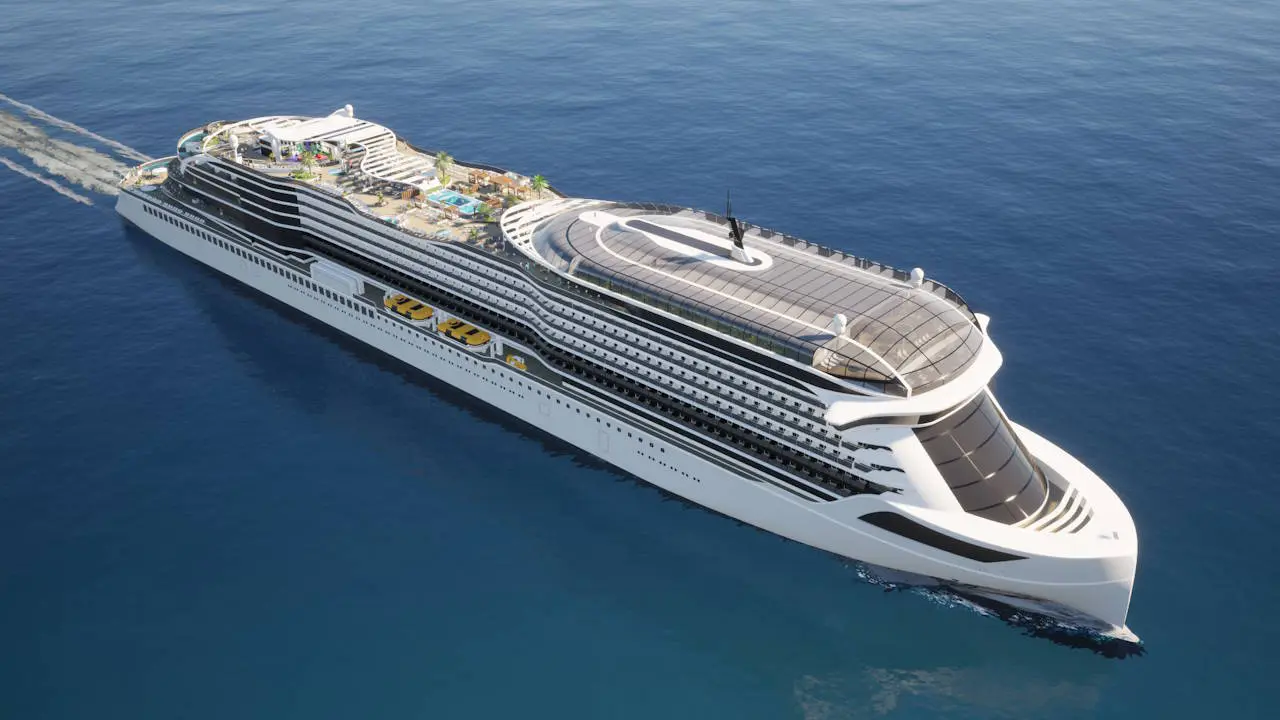
PAPENBURG-GERMANY : Germany’s leading shipbuilder Meyer Werft has unveiled an ambitious concept for what could become the world’s first fully electric, battery-powered cruise ship, marking a significant step toward a cleaner and more sustainable future for the global cruise industry.
The proposed concept, known as “Project Vision,” envisions a nearly 1,000-foot-long cruise vessel capable of carrying approximately 1,800 passengers across the seas without traditional engines, smoke emissions, or local environmental pollution.
Powered entirely by advanced battery technology, the vessel is designed to operate as a large-scale floating electric vehicle, relying on shore-based charging systems to recharge while docked at ports.
“Batteries are now in a state with the energy density, safety, lifecycle performance, and other characteristics where we believe this is the most energy-efficient way to conduct cruises,” said Johannes Bade, Project Engineer at Meyer Werft.
The innovative battery system, developed by Corvus Energy, is based on technology already used in hundreds of electric ferries operating globally. Unlike conventional cruise ships that require extensive engine rooms, Project Vision would incorporate a dedicated battery room to power the vessel throughout its voyage.
According to Meyer Werft, the concept is particularly well suited for cruise routes featuring shorter distances between ports, including the Mediterranean, Northern Europe, Norwegian fjords, Baltic Sea, and Florida–Bahamas itineraries.
The company estimates that the fully electric design could reduce greenhouse gas emissions by up to 95 percent, supporting broader maritime decarbonization efforts and global climate targets.
“We do not convert energy into liquid fuel and burn it again to generate electricity,” Bade explained. “Instead, we directly use generated electricity, store it in batteries during port stays, and continue sailing on recharged batteries without any local emissions.”
Industry leaders believe technological breakthroughs such as Project Vision will play a crucial role in helping the cruise sector achieve its long-term sustainability ambitions.
“It is going to take a mosaic or bundle of solutions to achieve net-zero emissions by 2050,” said Charles ‘Bud’ Darr, representing the Cruise Lines International Association (CLIA). “Every new innovation adds to the toolkit of solutions we will need.”
Despite the promise of battery-powered cruising, infrastructure challenges remain substantial. According to industry estimates, cruise ships currently call at approximately 1,500 ports worldwide, yet only a limited number are presently equipped to provide sufficient electrical shore power.
“As of today, our data shows that only 41 ports can supply electrical power to a single cruise ship,” Darr noted, emphasizing the importance of developing supporting shore-side infrastructure.
However, Meyer Werft remains optimistic, projecting that nearly 100 European ports could be equipped to support battery-powered cruise vessels by 2030.
Although Project Vision remains at the conceptual stage, the company says the required technology is already available and that the vessel could be delivered by 2031, provided a construction contract is secured within the current year.
If realized, Project Vision could redefine the future of cruising by demonstrating the feasibility of large-scale, fully electric passenger shipping and accelerating the maritime industry’s transition toward zero-emission operations.