


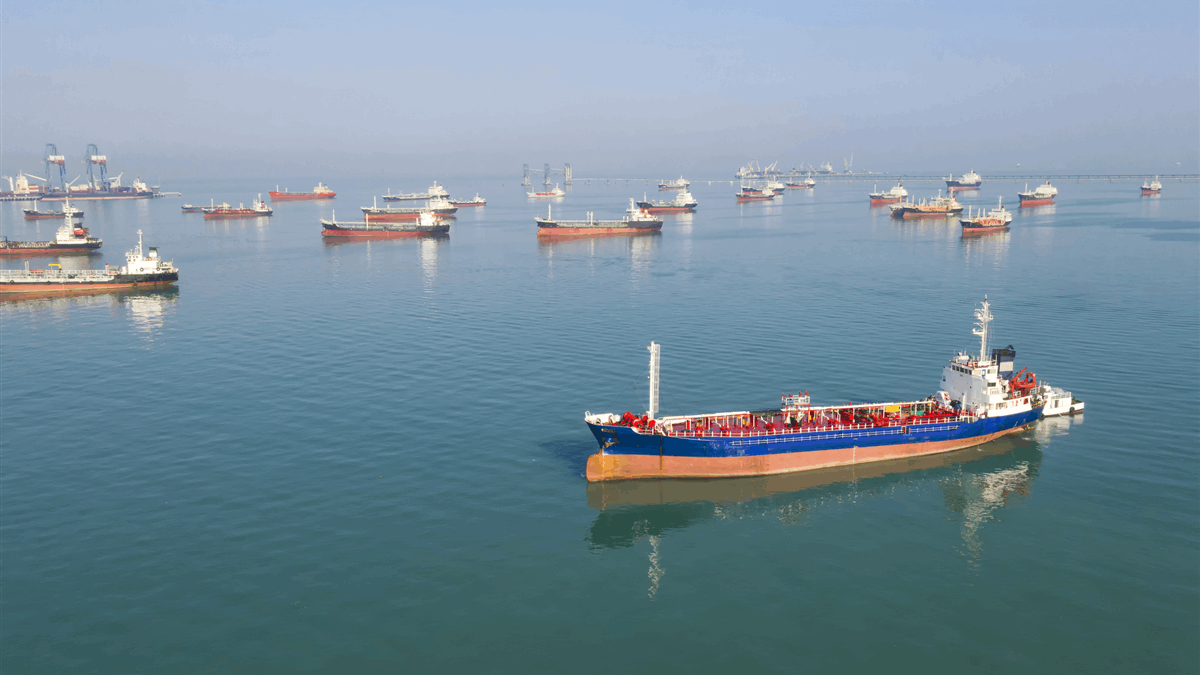
TEHRAN: More than 1,200 cargo vessels carrying goods worth an estimated $125 billion have been stranded by the prolonged closure of the Strait of Hormuz, exposing the vulnerability of global commerce to disruptions at a handful of critical maritime chokepoints.
New data published by insurance giant Allianz on Wednesday offers the first detailed estimate of the economic cost of the shutdown, which followed military strikes on Iran in February and effectively paralysed one of the world’s busiest shipping corridors for more than 100 days.
The insurer described the closure as “unprecedented” and warned that the crisis has fundamentally altered perceptions of risk across the maritime industry.
“We were always talking about realistic disaster scenarios, and now we have a real disaster scenario like this one,” Justus Heinrich, head of marine underwriting at Allianz, told the Financial Times. “So I think it changes a bit the perception of actual operational risks from ‘it can theoretically happen’ to what we know now out of this situation.”
Lifeline of global energy trade disrupted
The Strait of Hormuz is among the world’s most strategically important waterways. Before the conflict, around 135 vessels transited the narrow passage every day, carrying roughly one-fifth of global oil and gas supplies.
Its closure sent shockwaves through energy markets, pushing crude oil prices above $100 a barrel and fuelling concerns over supply shortages in major importing economies across Asia and Europe.
The conflict has also taken a heavy toll on shipping. According to data from the International Maritime Organization (IMO), more than 40 vessels have been struck by missiles during the hostilities, while at least 14 seafarers have been killed. Tankers transporting crude oil and petroleum products have borne the brunt of the attacks.
Shipping traffic shows signs of recovery
The tentative peace agreement between the United States and Iran has improved confidence among shipping companies, prompting a gradual return of vessels to the strait.
According to Lloyd’s List Intelligence, the number of ships leaving the Gulf rose to 69 in the week ending June 21, up sharply from 24 in the previous week. The figure marks the highest level of weekly crossings since the conflict began.
Despite the improvement, industry executives say the disruption is likely to leave a lasting impact on global supply chains and shipping strategies.
Several logistics and shipping companies are increasingly looking at alternative routes into the Gulf through ports on the Gulf of Oman and the Red Sea, while others are exploring expanded land-based transportation networks.
Executives say Iran’s demonstrated ability to disrupt traffic through Hormuz has reinforced the need to diversify supply chains and reduce dependence on a single maritime corridor.
Thousands of containers remain trapped
Michael Aldwell, Executive Vice-president for sea logistics at Kuehne+Nagel, the world’s largest freight forwarder by volume, estimated that around 300,000 twenty-foot equivalent units (TEUs) of container cargo remain stuck in the Gulf.
He added that overland transport routes connecting Gulf states are facing mounting pressure as companies seek alternatives to sea freight.
“Land routes in and out of the region are under a lot of strain,” Aldwell said.
Most of the stranded cargo has either remained aboard ships or been unloaded at regional ports. Because the Middle East exports relatively few perishable consumer goods, much of the cargo has avoided immediate spoilage despite the prolonged disruption.
However, Allianz warned that losses could still mount.
Rahul Khanna, head of marine risk consulting at Allianz, said the insurer has already received claims related to vessels damaged by missiles and drones. Additional claims may emerge from spoiled pharmaceutical products, frozen food shipments and other temperature-sensitive cargoes affected by delays.
Human cost of the crisis
Beyond the economic impact, the closure has created a growing humanitarian challenge for seafarers trapped aboard ships in the Gulf.
Allianz estimates that around 20,000 seafarers remain on vessels in the region, while the IMO said this week that approximately 11,000 crew members are seeking to leave.
To facilitate their evacuation, the UN maritime agency has established a dedicated corridor in coordination with Oman, enabling ships to exit the Gulf more safely.
The insurer’s report also highlighted broader labour shortages facing the maritime industry. Cases of seafarer abandonment — where shipowners fail to pay wages or provide adequate support — rose for a sixth consecutive year in 2025, reaching a record of more than 6,000 incidents worldwide.
“The shipping industry will struggle to retain and recruit seafarers at a time of growing demand for skilled workers, driven by automation and green transitions, ultimately threatening the sector’s resilience and global supply chain stability,” the report said.
Wake-up call for global trade
The Hormuz crisis has become one of the clearest demonstrations in recent years of how geopolitical tensions can disrupt global commerce.
Even as traffic gradually returns to the strait, the disruption has prompted governments, insurers and logistics firms to reassess the risks associated with major maritime chokepoints such as Hormuz, the Suez Canal and the Panama Canal.
For the shipping industry, the more than 1,200 stranded vessels and $125 billion worth of trapped cargo represent not only a costly disruption but also a stark reminder of how quickly global trade can be thrown into turmoil when a critical artery of commerce is cut off.
Source: First Post