



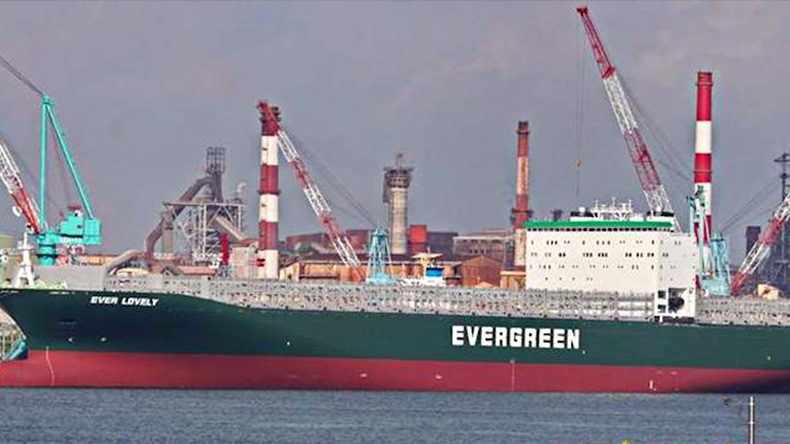
LONDON: The UN’s International Maritime Organization announced that it would be pausing its plan to evacuate the Strait of Hormuz on Thursday, following a cargo ship reporting being attacked as it attempted to pass through the strait close to the coast of Oman.
US officials told The Wall Street Journal that the attack had been conducted by the Islamic Revolutionary Guard Corps.
The IMO is currently assisting ships escape the Gulf, hundreds of which have been stranded there since the Iran war began at the end of February.
The transit plan launched earlier this week was suspended after the Singapore-flagged Evergreen container ship ‘Ever Lovely‘ was struck by an unknown projectile while 7.5 nm Southeast of Dahit, Oman, according to maritime security firm Vanguard Tech.
The United Kingdom Maritime Trade Operations (UKMTO) reported that the vessel had been hit on the starboard side causing damage to the bridge. The Master reported no damage or environmental impact to the vessel it said.
According to the IMO Secretary-General Arsenio Dominguez the container ship was not transiting the strait under its evacuation plan, however, the UN organisation had decided to pause the scheme to reconfirm safety guarantees to ships crossing the waterway.
“Following the launch of the IMO’s evacuation plan, through which several vessels have already been successfully evacuated, I have decided to temporarily pause its implementation in order to reconfirm that the necessary safety guarantees continue to be in place for the ships on our evacuation list and all those in the region,” Dominguez said.
“I have been informed of an attack today in the Gulf of Oman on a vessel which passed through the Strait of Hormuz. This vessel did not transit under IMO’s evacuation framework. I have always reiterated that the safety of the seafarers remains paramount. Therefore, to ensure a coordinated approach and navigational safety, the evacuation plan will be paused until further clarity is obtained.”
The attack on the container ship came after Iran’s Islamic Revolutionary Guard Corps (IRGC) warned that vessels without Iranian permission are using the waterway illegally.
Following the signing of the 60-day accord between the US and Iran two routes had opened up in the Strait of Hormuz – a northern corridor controlled by Iran and a southern corridor in Omani waters close to its coastline – while the usual traffic separation scheme (TSS) remains closed due to potential Iranian mines.
This week Oman had released guidance for ships using the southern route as part of the IMO evacuation plan, however this was followed by the IRGC’s warning reported on Iranian media, as well as reports of broadcasts to vessels that ships without permission should not transit the waterway.
The attack, if confirmed to be by the IRGC, would represent a flagrant disregard for the UN Convention on the Law of the Sea (UNCLOS) which designates the Strait as a waterway of unhindered ‘transit passage’.
As of the time of writing the Ever Lovely, the vessel reported to be involved in the attack, was transiting the Gulf of Oman having continued on its voyage based on AIS data from Pole Star Global.
Transits of the Strait of Hormuz had been increasing sharply in recent days and according to AXS Marine there were 62 verified transits of the waterway on 24 June some 53% of the number recorded on the same date in 2025.
Despite the recent attack and the pause of the IMO evacuation plan at least two vessels could be seen on AIS lining up or starting transits of the Strait of Hormuz via the southern corridor at the time of writing. A third vessel the Togo-registered tanker Blue Star 1 had reversed course mid-transit outbound on 25 June.
The renewed threat to shipping the strait came on the IMO’s Day of the Seafarer on 25 June and Secretary-General Dominguez said: “Today marks the Day of the Seafarer, underlining the importance of ensuring that the continued evacuation of the thousands of seafarers stranded in the Persian Gulf can proceed without the risk of them becoming collateral victims in this geopolitical conflict.”