



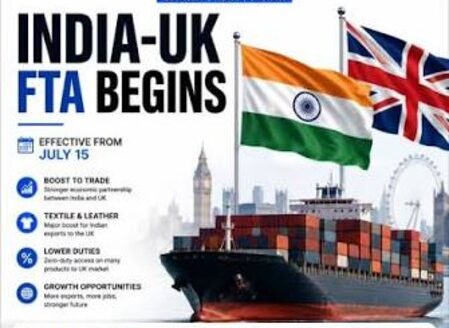
NEW DELHI : India exported goods worth $140 million to the United Kingdom at zero duty on the first day of the India-UK Comprehensive Economic and Trade Agreement (CETA), which came into effect on Wednesday, marking the formal rollout of one of New Delhi’s most ambitious trade deals.
Commerce Secretary Rajesh Agrawal said the agreement between the two complementary economies would deepen bilateral economic ties and open new opportunities for Indian exporters.
Calling CETA one of India’s most aspirational trade agreements, Agrawal said more than 800 technical sessions spread over 14 rounds of negotiations were held before the pact was finalised.
On the first day of implementation, over 50 export consignments valued at more than $140 million were dispatched from over 20 ports, airports, Inland Container Depots (ICDs), Special Economic Zones (SEZs) and manufacturing facilities across the country. The shipments included electronics, pharmaceuticals, gems and jewellery, and other products exported through key hubs such as Mundra, Nhava Sheva, Chennai, Mumbai, Kolkata and Hyderabad.
Under the agreement, nearly 99 per cent of Indian exports receive duty-free access to the UK market, benefiting sectors including leather, footwear, textiles, engineering goods, plastics, base metals, marine products and gems and jewellery, which previously faced tariffs ranging from 2 to 16 per cent. The agreement says, Indian exporters will receive duty-free access for 99.5% of the value of India’s exports to the UK, covering 98.8% of tariff lines, effectively eliminating duties across a wide range of labour-intensive and manufacturing sectors. India, in turn, has offered preferential market access covering 89.4% of the value of UK exports, with tariff reductions being phased in for sensitive products.
PM Shri Narendra Modi hailed the operationalisation of the trade pact as a significant moment in the India-UK partnership. “With the coming into force of the Comprehensive Economic and Trade Agreement and the Agreement on Social Security, our economic linkages are going to get even deeper. Together, these agreements translate our shared ambition into tangible opportunities for our people,” Modi wrote on X.
Fresh momentum
PM added that the CETA will give fresh momentum to India’s farmers, entrepreneurs and MSMEs. Several vibrant sectors will gain stronger access to the UK market. The trade agreement will also deepen cooperation in technology, professional services and innovation, while supporting greater mobility for skilled Indian talent.
“The social security agreement will provide invaluable support to Indian professionals working temporarily in the UK and strengthen the competitiveness of Indian enterprises,” he added.
Meanwhile, Commerce Secretary Rajesh Agarwal said that rules of origin certificates are being issued and customs facilitation is being provided to ensure the smooth operationalisation of the trade pact.
Speaking on the occasion, Lindy Cameron, British High Commissioner to India, said the agreement is expected to increase bilateral trade by over 25 billion pounds annually over the long term and contribute nearly 5 billion pounds annually to the GDP of both the UK and India.
Highlighting the strength of bilateral ties, Cameron noted that India was the UK’s eleventh-largest trading partner in 2025, with bilateral trade approaching £48 billion annually. She also observed that the investment relationship between the two countries supports more than 700,000 jobs.
She said that the agreement provides a framework that will enable businesses in both countries to trade more, invest more, innovate more and grow together. She described it as a decisive step towards a broader, more ambitious and future-focused partnership.
Referring to its long-term economic impact, Cameron said the agreement is expected to boost bilateral trade by over £25 billion annually in the long term and add nearly £5 billion a year to the GDPs of both the UK and India.
S.C. Ralhan, President, Federation of Indian Export Organisations (FIEO), said that the coming into force of the India–UK free trade agreement marks a historic milestone in India’s export journey.
“The India–UK FTA is expected to enhance the global competitiveness of Indian products by enabling exporters to access the UK market on more favourable terms. It will strengthen the position of India’s labour-intensive sectors, many of which are dominated by MSMEs, thereby supporting employment, rural livelihoods, and inclusive economic development,” Ralhan added.
More than a pact
Chandrajit Banerjee, Director General, Confederation of Indian Industry (CII), said that the operationalization of the India-UK CETA is more than the commencement of a trade agreement. It is a strategic step towards strengthening India’s global competitiveness, expanding economic opportunities and supporting the country’s vision of Viksit Bharat 2047. For Indian industry, the CETA opens a new era of opportunities. Zero-duty access for 99% of India’s exports to the UK will significantly enhance the competitiveness of labour-intensive sectors such as textiles and apparel, leather and footwear, gems and jewellery, marine products and processed foods, while also creating new opportunities for engineering goods, auto components, chemicals and other value-added manufacturing sectors,” he added.
“What truly distinguishes this landmark agreement is its depth and ambition as it transcends the traditional boundaries of tariff liberalization and establishes a modern, future-ready framework for cooperation across trade in goods and services, intellectual property, digital trade, financial services, telecommunications, and government procurement – the latter being a groundbreaking achievement,” Said Anil Talreja, partner and leader – trade corridor, Deloitte South Asia.
Maj Gen (Retd) Rajesh Chopra, director general of Indian Malt Whisky Association, welcomed implementation of the India-UK trade pact.
“The phased reduction of duties on Scotch whisky, from 150% to 75% now and further to 40% over ten years, is a calibrated and sensible approach. It gives Indian consumers access to world-class spirits at fairer prices while providing domestic producers a clear and predictable runway. Indian single malts today stand shoulder to shoulder with the finest in the world, and we are confident this agreement will only deepen the appreciation for quality whisky in India, expanding the premium category for all players,” he said.