


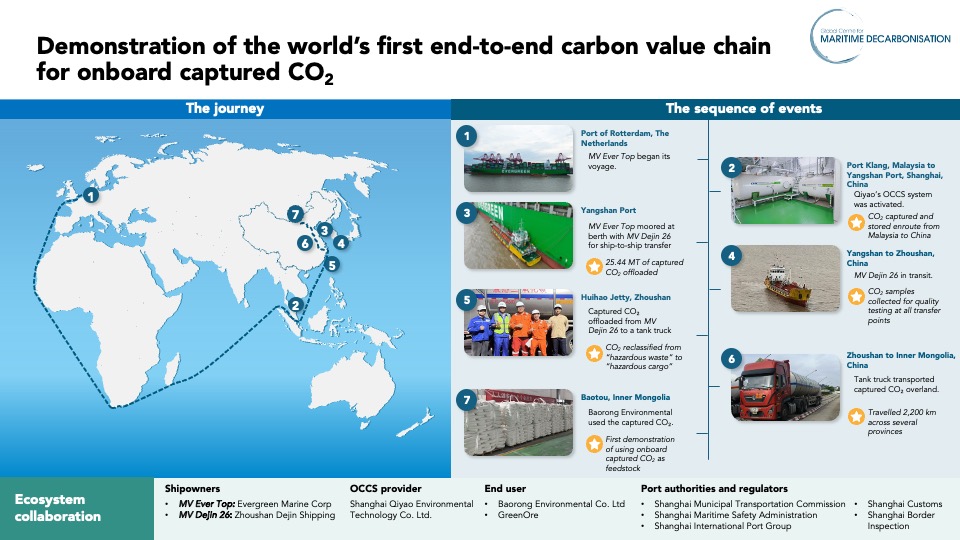
SINGAPORE: Project CAPTURED has achieved two regulatory milestones that strengthen the commercial case for onboard carbon capture and storage (OCCS), following its world’s first demonstration of an end-to-end value chain for onboard captured and liquefied CO2 (LCO2).
Completed in June 2025, the pilot showed that CO2 captured onboard a vessel can be offloaded ship-to-ship, transported overland and permanently bound through carbon mineralisation—a process that converts captured CO₂ into stable materials for industrial use.
EU ETS recognition for onboard captured CO2
The CO2 captured onboard during Project CAPTURED has been formally recognised for compliance under the European Union Emissions Trading System (EU ETS). This means the verified tonnage of captured CO2 can be deducted from emissions requiring the surrender of EU Allowances (EUAs).
To qualify for this recognition, the CO2 must be chemically bound permanently in eligible products. Project CAPTURED demonstrated that CO2 captured onboard vessels can meet this requirement through carbon mineralisation.
IMO’s in-principle support for carbon mineralisation
The data and learnings from the same demonstration formed the basis of a proposal submitted to MEPC 84. This proposal received in-principle support from the International Maritime Organization (IMO) for recognising carbon mineralisation as a form of permanent CO₂ storage.
Complementing geological sequestration, which is already accepted by the IMO, this recognition broadens the downstream options for CO2 captured onboard vessels, and supports the development of maritime carbon value chains. Beyond providing a permanent storage pathway, carbon mineralisation also creates the potential for captured CO2 to serve not only as a waste stream requiring permanent storage, but also as a feedstock for industrial applications through carbon mineralisation, extending emissions reductions beyond the shipping value chain.
About Project CAPTURED
Project CAPTURED demonstrated that captured CO2 can be safely transported and converted into industrial products while maintaining CO2 purity above 99.95 vol% at all custody-transfer points. GCMD’s life cycle assessment further showed that this first-of-a-kind pilot achieved a 7.9% net GHG reduction based on a at 10.7% gross capture rate onboard. An optimised value chain based on the same gross capture rate could deliver GHG savings of 17.8%.
GCMD orchestrated this landmark pilot by bringing together 11 partners across the maritime and industrial ecosystems, including SMDERI-QET, Evergreen Marine Corp, Zhoushan Dejin Shipping, and Greenore/ Baorong.
Professor Lynn Loo, CEO, GCMD, said, “Project CAPTURED has moved OCCS beyond technical demonstration. The acceptance of the EU ETS deduction gives captured CO₂ a compliance value. At the same time, IMO’s in-principle support for carbon mineralisation will help clarify how captured CO2 can be treated after it leaves the vessel. Together, these milestones turn a pilot into a verified reference case for maritime carbon logistics, one that links regulatory recognition, commercial value and emissions impact.”
Dr Su Yi, General Manager of SMDERI-QET, said, “Project CAPTURED has demonstrated that captured CO₂ can be transferred from ship to ship and converted into construction materials. We have now taken a further step by achieving carbon deductions under the EU ETS, which means we have further explored the possibilities of the maritime carbon value chain. The IMO’s support in principle for carbon mineralisation means that our pathway is repeatable, offering a feasible blueprint for future emissions reductions in the shipping industry.”