



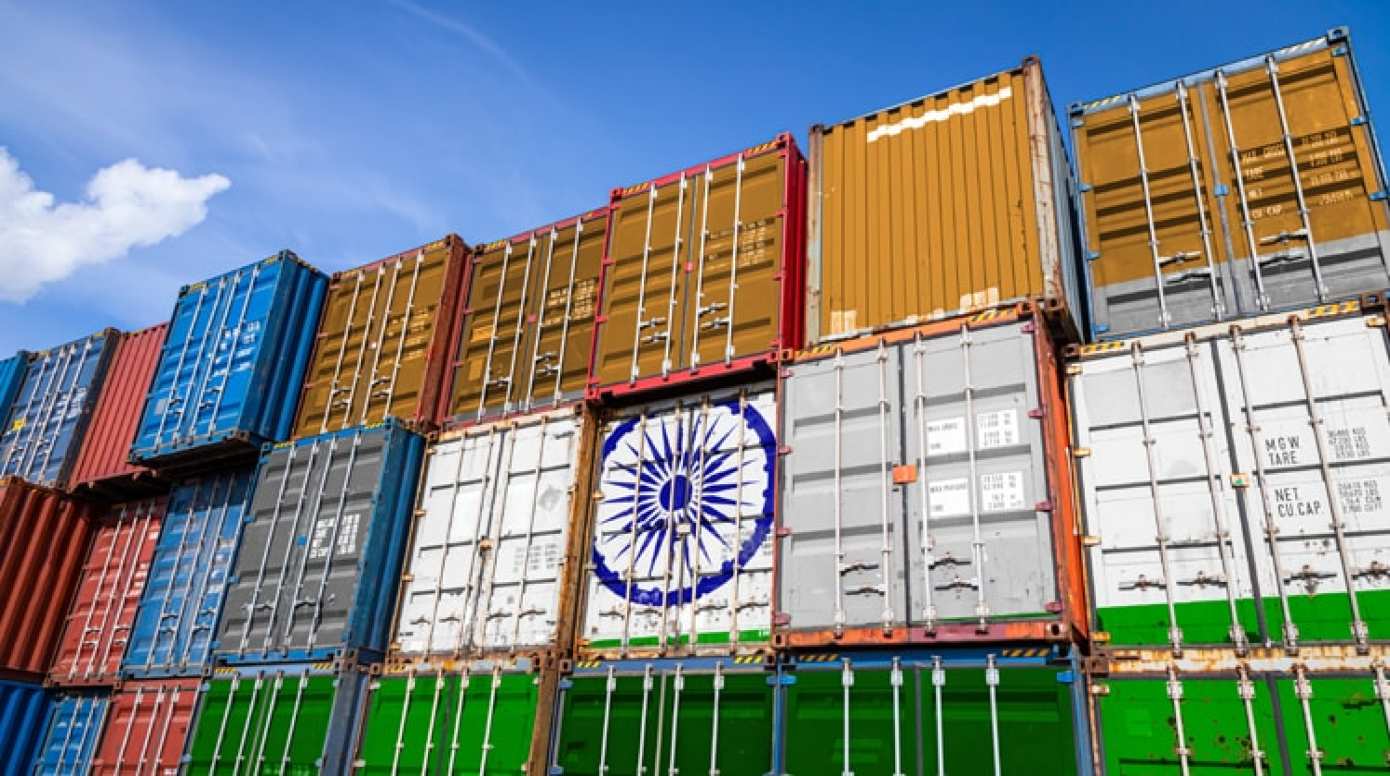
NEW DELHI : India’s Merchandise Exports delivered a strong performance in July 2026, rising nearly 20% year-on-year to US$44.24 billion, even as global trade faced continued geopolitical disruptions, elevated freight costs and supply-chain pressures.
The sharp increase was supported by robust shipments of electronics, engineering goods and other manufactured products, underlining the growing competitiveness and diversification of India’s export basket.
The strong export performance, however, was accompanied by a significant rise in imports. Merchandise imports climbed 17.51% to US$76.22 billion, resulting in a goods trade deficit of approximately US$32 billion—the highest in six months.
Economists attributed the increase in the import bill partly to elevated global commodity prices and higher input costs arising from the continuing West Asia crisis.
According to Aditi Nayar, Chief Economist, ICRA, merchandise imports reached their highest level in nine months, with coal, fertilisers, electronic goods and chemical materials registering more than 20% growth. The July trade deficit was higher than both the year-ago level of US$27.9 billion and the average monthly deficit of US$29 billion recorded during the first quarter of FY27.
Export Momentum Broadens Across Markets
India’s export growth is increasingly being supported by a wider geographical spread. Commerce Secretary Rajesh Agrawal noted that exports to the West Asia region have stabilised, while faster growth is being witnessed in several non-traditional markets, including ASEAN, Africa, South Asia and North-East Asia.
The United States remained one of India’s largest export destinations. Indian exports to the US increased 12.85% year-on-year to US$9.02 billion in July. During April-July 2026, exports to the US rose 3% to US$34.5 billion, while imports from the country increased 22.42% to US$22.12 billion.
Trade with China also recorded a notable acceleration. Indian exports to China surged 64.57% in July to US$2.2 billion. During April-July, exports rose 35.97% to US$7.78 billion, while imports increased 29.68% to US$52.71 billion.
Singapore emerged as another standout market, with Indian exports jumping 83.7% year-on-year to US$1.6 billion in July.
Positive export growth was also recorded across markets including the UAE, Netherlands, Germany, South Africa, Tanzania, Australia, Malaysia, Sri Lanka, Italy and Vietnam.
At the same time, exports to the UK, Bangladesh, Saudi Arabia and Nepal witnessed declines, highlighting the uneven nature of the global demand environment.
Rising Imports Remain a Watchpoint
While stronger imports of capital goods, energy and industrial intermediates can indicate expanding domestic economic activity, the widening trade deficit is emerging as an area requiring close monitoring.
Imports from several major trading partners—including Russia, South Korea, Singapore, Germany, Oman, Malaysia, Taiwan and Brazil—registered substantial increases.
The data reinforces the dual challenge facing India: sustaining export momentum while reducing excessive dependence on imported critical inputs.
Mr.S.C. Ralhan, President of the Federation of Indian Export Organisations, described the July export performance as a reflection of the resilience and adaptability of Indian exporters amid global logistics disruptions and higher transportation costs.
He also stressed the need to strengthen domestic manufacturing capabilities in critical inputs, electronics, machinery and other import-intensive sectors, arguing that export expansion and strategic import substitution should progress together.
A Stronger, More Diversified Export Story
The July figures present a mixed but fundamentally encouraging picture of India’s external trade. A nearly 20% rise in merchandise exports demonstrates that Indian businesses are continuing to find opportunities despite an uncertain global environment.
The expanding contribution of electronics and engineering products, coupled with stronger penetration into emerging markets, points towards a gradual transformation in the composition and destination of India’s exports.
The immediate challenge will be to maintain this export momentum while containing the impact of higher commodity prices, imported inputs and logistics costs.
India’s July trade numbers therefore tell a broader story—not merely of higher exports, but of an increasingly diversified and resilient Indian trade sector navigating a rapidly changing global economy.