



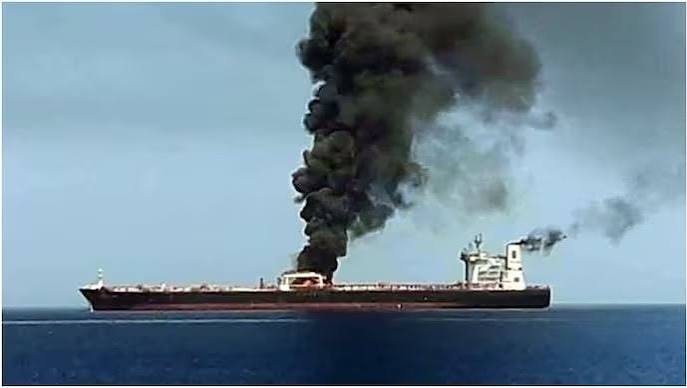
WASHINGTON/TEHRAN : The maritime confrontation between the United States and Iran escalated sharply on September 8, with U.S. Central Command (CENTCOM) announcing the destruction of five additional Iranian crude oil carriers in a second wave of strikes, days after three Iranian tankers were targeted in earlier U.S. operations.
According to CENTCOM, its forces destroyed five Iranian crude oil carriers after the Islamic Revolutionary Guard Corps (IRGC) targeted a U.S. Navy warship with ballistic missiles on two occasions over the preceding two days. CENTCOM said the American warship successfully evaded both attacks and continued its patrol, with no U.S. personnel injured.
The five vessels identified by CENTCOM were M/T Kaviz, M/T Charminar, M/T Horizon 1 and M/T Riesco, struck in the Gulf of Oman, and M/T Derya, located near Iran’s strategically important Kharg Island. CENTCOM said crews aboard the vessels were instructed to abandon ship before the strikes and that the vessels were subsequently rendered inoperable.
The latest action follows the September 5 U.S. strikes on three Iranian crude oil carriers — Downy, Stark I and Kylo/Noxen — after what CENTCOM described as failed IRGC attacks against U.S. naval vessels. Taken together, the two operations represent a significant expansion of the maritime dimension of the U.S.-Iran conflict, with commercial oil shipping increasingly becoming part of the military confrontation.
Kharg Island and Iran’s Oil Lifeline
The location of the latest strikes carries particular economic significance. Kharg Island is Iran’s principal oil-export hub, making any military activity around its anchorage and surrounding waters potentially consequential for the country’s ability to move crude to international markets.
CENTCOM has described the targeted vessels as part of an Iranian maritime “shadow network” that allegedly supports the IRGC and its regional proxies. The U.S. strategy therefore appears to combine military retaliation with economic pressure by targeting vessels associated with Iran’s oil-export infrastructure.
Iranian state media separately reported attacks on Iranian tankers near Kharg Island and Jask, with crews evacuated. Iranian reports described several vessels being hit but did not independently establish the full five-vessel figure cited by CENTCOM. The locations reported by Iranian media broadly correspond with the areas identified in the U.S. military account.
Strait of Hormuz Under Mounting Pressure
The confrontation is unfolding against an increasingly fragile maritime environment in the Strait of Hormuz, one of the world’s most important energy chokepoints.
Shipping activity through the strait has already fallen dramatically. Kpler data cited by Reuters showed that an average of only about 10 commodity vessels per day transited the waterway over the preceding 10 days, the lowest level since May. At one point, only two vessels crossed the strait in a single day, highlighting the growing caution among shipowners, operators and crews.
Qatar has warned that continued disruption could result in an “industrial catastrophe”, underscoring the potential consequences for regional energy supplies and industries dependent on uninterrupted Gulf shipping.
The stakes extend far beyond Iran and the United States. The Strait of Hormuz is a critical route for global oil and energy shipments, meaning prolonged disruption could affect crude prices, marine insurance, vessel deployment, freight costs and refinery supply chains across Asia and other major consuming regions.
Iran Warns Tankers in Gulf Ports
Following the latest U.S. strikes, the IRGC Navy warned tanker crews operating near Kuwaiti and Bahraini ports to evacuate their vessels, threatening possible retaliation. Iran has accused those countries of hosting U.S. forces and supporting American military operations in the region.
The warning raises the possibility that the conflict could spread beyond Iranian-flagged or Iran-linked vessels to a much broader range of commercial shipping. Such a development would substantially increase risks for tanker operators, charterers, insurers and ports throughout the Gulf.
Iran has also threatened the establishment of an exclusion zone around the Strait of Hormuz, while the United States has maintained that it will continue to support maritime movement through the waterway. The competing positions further complicate efforts to restore predictable commercial navigation.
Oil Markets React to Escalation
The latest escalation is already being reflected in energy markets. Brent crude briefly approached $100 per barrel, with prices rising sharply as traders assessed the possibility of further disruptions to Gulf energy flows. The combination of tanker strikes, reduced Hormuz traffic and attacks involving regional energy infrastructure has intensified concerns about supply security.
The impact could extend into freight and logistics markets. Prolonged restrictions on tanker movements could increase voyage distances, waiting times, war-risk premiums and insurance costs, while disruptions to crude and refined-product flows could place additional pressure on Asian refineries and other major energy consumers.
A New Phase in Maritime Economic Warfare
The September 8 strikes underline a significant shift in the character of the conflict. What began primarily as a military confrontation involving naval vessels and missile attacks is increasingly affecting commercial tankers, oil exports and maritime trade routes.
The United States has demonstrated that attacks on its naval forces could be followed by direct action against Iranian oil assets, while Iran has shown its willingness to threaten commercial vessels and challenge the movement of shipping through Hormuz.
For the global maritime industry, the central concern is now whether the cycle of retaliation remains confined to Iranian-linked vessels or expands to neutral and third-country shipping.
The immediate facts remain subject to competing accounts from the parties to the conflict. CENTCOM’s specific claim that five Iranian crude carriers were destroyed, and its account of two missile attacks against a U.S. warship, should be treated as the U.S. military’s version of events. Iranian state media independently reported tanker strikes near Kharg Island and Jask and the evacuation of crews, providing corroboration for the occurrence of fresh tanker attacks without independently establishing every detail of the U.S. account.
With Hormuz traffic already at its lowest level in months, the next moves by Washington and Tehran could determine whether the current disruption remains a limited maritime confrontation or develops into a much wider threat to global energy and commercial shipping.
For the maritime sector, the message is increasingly clear: the Strait of Hormuz is no longer merely a geopolitical flashpoint — it has become the central arena where military pressure, energy security and commercial shipping are colliding.