


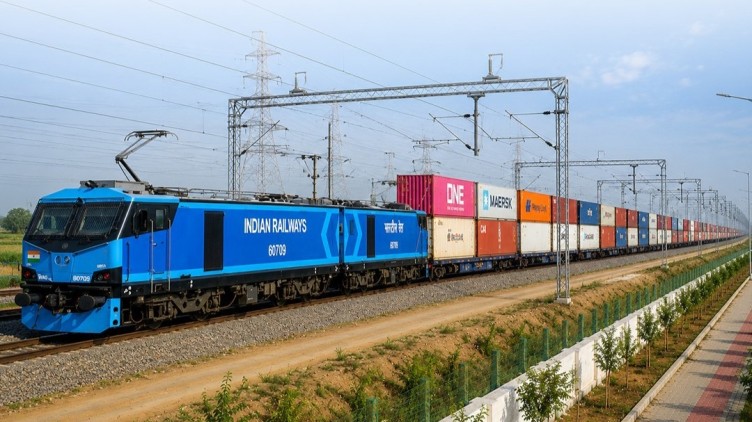
NEW DELHI: The completion of India’s original Dedicated Freight Corridor network marks far more than the commissioning of another railway infrastructure project. It represents the emergence of a new logistics backbone capable of changing how freight moves across the country—and potentially how India competes in global manufacturing and trade.
On 8 September 2026, Prime Minister Shri Narendra Modi dedicated three crucial sections of the Western Dedicated Freight Corridor to the nation: New Sanand (North)–New Makarpura, New Umbergaon–New Saphale and New Saphale–New JNPT. Together, these sections cover 326 route kilometres and have been developed at a cost exceeding ₹20,700 crore. With their commissioning, the entire 2,843-km Eastern and Western Dedicated Freight Corridor network has become operational.
From Railway Capacity to National Logistics Capacity
The Eastern Dedicated Freight Corridor connects Ludhiana with Sonnagar over 1,337 km, while the Western Dedicated Freight Corridor connects Dadri with Jawaharlal Nehru Port Terminal over 1,506 km. The two corridors were conceived to separate high-volume freight traffic from conventional passenger and mixed-traffic routes, allowing heavier and longer freight trains to operate with greater efficiency.
The significance of the final WDFC sections is particularly important because direct connectivity with JNPA provides a faster rail link between India’s northern and western industrial hinterland and one of the country’s most important maritime gateways.
This is not simply about faster trains.
It is about faster supply chains.
Industrial production centres, logistics parks, ports, container terminals and consumption markets can now be connected through a substantially more capable freight railway network. The expected benefits include shorter transit times, better asset utilisation, lower logistics costs and reduced congestion on conventional railway routes.
DFCs Are Creating Capacity Beyond the Corridors
One of the most important but less visible benefits of the DFC programme is the capacity it releases on the existing railway network.
When freight traffic moves onto dedicated corridors, conventional routes gain additional paths for passenger services as well as other freight operations. The Ministry of Railways has reported that the fully commissioned DFC network is handling more than 443 trains a day, with freight volumes showing steady growth alongside improvements in average speed, turnaround time and reliability.
The impact therefore extends far beyond the physical alignment of the DFC.
It is effectively creating additional capacity across the wider Indian railway system.
From 1,670 MT to the Next Freight Revolution
Indian Railways carried a record 1,670 million tonnes of freight in FY 2025–26, representing 3.25% growth over the previous year. The Railways has described this as making it the world’s second-largest freight-carrying railway system.
But the next challenge is much larger.
The objective cannot simply be to move more tonnes. India must move freight faster, more reliably, more predictably and at lower total logistics cost.
That requires an integrated freight ecosystem around the DFCs.
Modern Gati Shakti Cargo Terminals, upgraded railway goods sheds, private freight terminals, inland container depots, multimodal logistics parks, specialised wagons, containerisation and efficient first- and-last-mile connectivity will determine whether the enormous investment in DFC infrastructure translates into a corresponding transformation in India’s logistics performance.
Indian Railways is already pursuing this broader strategy through the Gati Shakti Multi-Modal Cargo Terminal policy, wagon investment schemes and customised parcel and cargo services.
The Port Connection Could Be a Game Changer
The connection to JNPA deserves particular attention.
For India’s exporters and importers, the competitiveness of a supply chain is determined not merely by the cost of manufacturing but by the time and cost required to move products from factory to port and from port to market.
A dedicated, high-capacity railway connection to JNPA can therefore strengthen India’s EXIM ecosystem by providing manufacturers in the northern and western hinterland with a more efficient rail pathway to maritime trade.
This is where the DFC programme intersects directly with Make in India, Atmanirbhar Bharat and Viksit Bharat 2047.
If Indian manufacturing is expected to become globally competitive, logistics must become globally competitive as well.
The Next Frontier: Dankuni to Surat
The completion of the existing DFC network should not be viewed as the end of the programme.
Union Budget 2026 announced a new Dedicated Freight Corridor connecting Dankuni in the east with Surat in the west, and the preparation/updating of its Detailed Project Report has commenced.
This proposed east-west connectivity could eventually add another strategic dimension to India’s freight network by linking eastern industrial and mineral regions with western manufacturing centres and ports.
The larger vision should be to create a genuinely integrated national freight grid connecting production clusters, consumption centres, ports, logistics parks, industrial corridors and international trade gateways.
The Industry Must Now Think Beyond Tracks
The completion of the DFC network creates a major opportunity for India’s railway industry.
The next phase should not be defined only by kilometres of track constructed. It should be defined by the ecosystem created around those kilometres.
There is enormous potential for Indian companies in signalling, train control, locomotives, wagons, braking systems, electrification, telecom, terminal automation, freight IT platforms, condition monitoring, predictive maintenance, logistics technology and multimodal integration.
The DFC should become a living laboratory for Railway 4.0—where artificial intelligence, IoT, digital twins, predictive maintenance, automated inspection and real-time freight visibility increasingly become part of everyday railway operations.
A New Measure of Success
According to Dr. Vinod Shah, Director General, Chamber of Railway Industries (Rail Chamber):“The completion of India’s Dedicated Freight Corridor network is a landmark achievement, but the real measure of success will be what we build around it. The next revolution must connect DFCs with ports, terminals, industries, logistics parks, technology platforms and global supply chains. India must move from building freight infrastructure to creating a globally competitive logistics ecosystem.”
That is the real opportunity before India.
The DFCs have provided the railway backbone. The next task is to build the logistics nervous system around it.
India now has the infrastructure to move freight differently. The question is whether industry, government, logistics operators and technology providers can work together to transform that infrastructure into a decisive competitive advantage for Indian manufacturing and trade.
From Dedicated Corridors to a Dedicated Logistics Vision
The completion of the 2,843-km EDFC–WDFC network is a defining milestone in India’s railway transformation.
But infrastructure is only the foundation.
The next chapter must focus on seamless multimodal connectivity, competitive logistics pricing, efficient terminals, digital freight visibility, private-sector participation, modern wagons, first- and-last-mile connectivity and globally benchmarked service quality.
India has built the dedicated freight highway. Now it must build the world’s most efficient freight ecosystem around it.
The conversation should therefore move from “How many kilometres of DFC have been completed?” to “How much value, speed and competitiveness can India’s DFC network create for the economy?”
We invite railway professionals, manufacturers, logistics companies, policymakers, technology providers and industry leaders to share their perspectives on India’s next freight revolution.
Join the Chamber of Railway Industries (Rail Chamber) to participate in knowledge exchange, policy dialogue and industry collaboration shaping the future of India’s railway and freight ecosystem.