


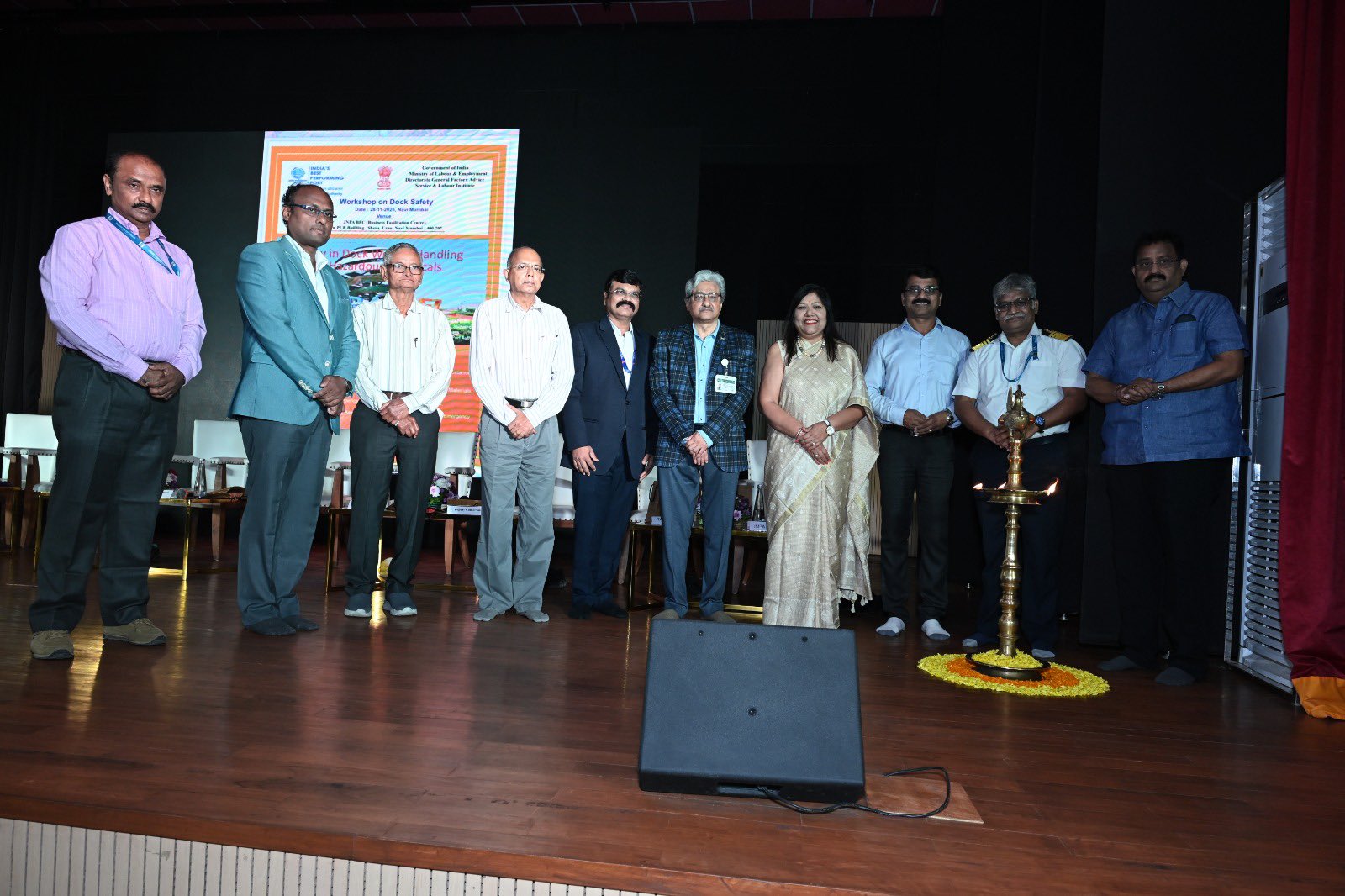
MUMBAI : Jawaharlal Nehru Port Authority (JNPA), India’s largest container port, hosted a One-Day Workshop on Dock Safety & Handling of Hazardous Chemicals on Friday, November 28, in collaboration with the Ministry of Labour & Employment (MoLE) and Directorate General, Factory Advice Service & Labour Institutes (DGFASLI). The workshop, held at the JNPA Business Facilitation Centre (BFC), brought together port officials, terminal operators, safety professionals, emergency responders, and industry experts to strengthen awareness and operational readiness in managing hazardous cargo at ports.
This program is a component of JNPA’s persistent efforts to create a robust, safe, and compliant operational environment by making sure that international best practices are included in regular port operations.
The workshop featured a series of expert-led technical sessions covering critical safety themes:


- Overview of National and International Regulations on Handling of Dangerous Substances in Dock Operations
Participants were briefed on key regulatory frameworks, international conventions, and statutory obligations governing hazardous materials movement in port ecosystems. - Competence and Supervision in Handling Hazardous Cargoes
Experts emphasised the importance of skilled manpower, competency-building, and supervisory excellence to prevent incidents and ensure safe cargo operations. - Radiation Protection and Emergency Preparedness in Port Environments
The session addressed protocols for radiation safety, monitoring mechanisms, and readiness planning for radiation-related contingencies.
- Port Safety Against Hazardous Chemical Incidents
Specialists from DGFASLI highlighted risk identification, preventive safety measures, and incident control strategies specific to chemical hazards in port zones. - Mitigation of Medical Emergencies Due to Hazardous Chemical Incidents
Medical and safety professionals guided attendees on first response, emergency medical care, coordination with health agencies, and post-incident management.
Held at JNPA, the workshop forms part of an ongoing nationwide capacity-building initiative aimed at strengthening hazardous chemical management across major Indian ports.
The event was graced by several eminent dignitaries, including Capt. Balasaheb Pawar, Deputy Conservator, JNPA, along with JNPA HoDs, Chief Guest Shri Dinesh Kumar Shukla, Chairman, Atomic Energy Regulatory Board (AERB); Dr. D. N. Sharma, Former Member, National Disaster Management Authority (NDMA) and Former Director, HSE Group, BARC; Shri Sumit Roy, Deputy Director General, DGFASLI; and Dr. Sandip Roy, Professor of Chemical Engineering, IIT Bombay. Senior technical experts from AERB, BARC, IIT Bombay and DGFASLI also participated, offering valuable scientific, regulatory and operational insights.
About JNPA: The Jawaharlal Nehru Port Authority (JNPA) is one of the premier container-handling ports in India. Since its inception on May 26, 1989, JNPA has transformed from a bulk cargo terminal into the premier container port in the country.
Currently, JNPA operates five container terminals – NSFT, NSICT, NSIGT, BMCT and APMT. The Port also has a Shallow Water Berth for general cargo. A Liquid Cargo Terminal present at the JNPA Port is managed by the BPCL-IOCL consortium and the additional liquid cargo terminal developed by JNPA will be operated by M/s JSW – JNPT Liquid Terminal Pvt. Ltd. Additionally, the newly constructed coastal berth links other Indian ports and facilitates enhancing the traffic of coastal containers.
Nestled across 277 hectares of land, JNPA also operates a meticulously designed multi-product SEZ, with state-of-the-art infrastructure, to boost export-oriented industries in India.
JNPA is also developing an all-weather, deep-draft, greenfield port at Vadhvan, the 13th Major Port of India in Maharashtra. It is poised to be among the top 10 ports globally and will be a 100% green port since its inception.