



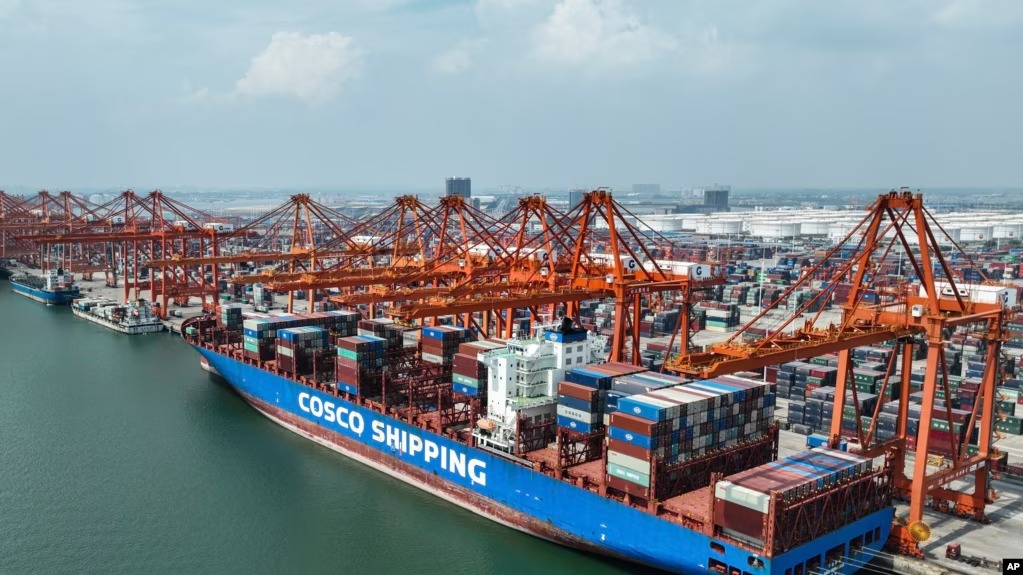
BEIJING : As the Arctic ice thins and geopolitics harden, Beijing is quietly stress‑testing a shortcut between Asia and Europe. China quietly turns a marginal Arctic route into a strategic test bed
In 2025, Chinese operators completed 14 container ship voyages between Asia and Europe via the Northern Sea Route (NSR), compared with 11 in 2024 and just 7 in 2023. The curve is steep. The experimental phase has faded into the background. China now treats this icy corridor as a live laboratory, not a one‑off stunt.
The push comes almost entirely from Chinese shipping companies sailing under Russian icebreaker escort. Western carriers, who flirted with the NSR a few years ago, now stay away, citing climate concerns, legal uncertainty and reputational risk. That absence leaves the field to a tight Sino‑Russian alignment in one of the world’s most sensitive regions.
On paper, the economics look tempting. Shorter routes mean fewer days at sea, lower fuel bills and reduced exposure to congestion around Suez or the Red Sea. In practice, ice, darkness and thin infrastructure still dictate the calendar.
What 14 voyages really mean on the Northern Sea Route
A shorter season, a more intense schedule
The 2025 Arctic season opened on 16 July, when the NewNew Polar Bear left Shanghai for Arkhangelsk in northern Russia. It closed on 30 October with the Xin Xin Tian 2 sailing from Shanghai to Kaliningrad in the Baltic. That window was about three weeks shorter than in 2024, as sea ice formed earlier in the eastern Arctic.
Despite fewer navigable days, traffic increased. Operators packed more voyages into a compressed calendar, showing a willingness to push assets and planning systems to the limit of what summer and early autumn ice conditions allow.
Two Chinese carriers at the sharp end
NewNew Shipping Line and Sea Legend sit at the centre of this build‑up. Both companies have stated they want more NSR transits in 2026, with one key objective: make schedules predictable on a route where wind, fog and drifting ice still write the rule book.
Reliability, not just speed, will decide whether the NSR attracts repeat customers. For now, the window runs mainly from mid‑summer to early autumn, when ice retreats, visibility improves and icebreaker support can be planned with some confidence. Chinese carriers keep investing anyway, betting that experience gained now will deliver an advantage if traffic later scales up.
400,000 tonnes of containers: a record, but still tiny
According to Rosatomflot, Russia’s state nuclear icebreaker operator, container cargo along the NSR reached around 400,000 tonnes in 2025, roughly 2.6 times more than in 2024. For a corridor historically dominated by crude oil, liquefied natural gas and bulk commodities, that marks a real adjustment in the traffic mix.
Why Western shipping stepped back while China leaned in
From Maersk’s trial to a Chinese near‑monopoly
The idea of container traffic in the Arctic is not new. In 2018, Danish giant Maersk sent the Venta Maersk through the NSR on an experimental trip. Technically, the voyage succeeded. Commercially, it stopped there. No regular service followed.
Big Western carriers then turned away from the Arctic. Concerns piled up: risks of spills in fragile ecosystems, reputational damage amid rising climate activism, high insurance costs, patchy port infrastructure, and an unpredictable regulatory environment shaped by Russian authorities and changing ice regimes.
As a result, the NSR’s container segment now rests almost entirely on Russian and Chinese shoulders. Where European and US firms see litigation, emissions and brand risk, Beijing sees strategic leverage and a chance to learn by doing.
Russia’s nuclear icebreakers underpin the experiment
None of this traffic would happen without Russia’s nuclear icebreaker fleet. These ships escort convoys through the thickest ice and keep channels open late into the season. Rosatom, the state nuclear corporation, not only runs the icebreakers; it also shapes much of the NSR’s infrastructure plan, from ports to navigation aids.
For Moscow, the NSR offers a dual prize: an export corridor for hydrocarbons and raw materials, and a geopolitical lever that binds China more tightly to Russian Arctic assets. For Beijing, alignment with Rosatom brings guaranteed icebreaker support and influence in setting operational norms on a route Western players barely use.
Climate, risk and the politics behind a shorter route
An Arctic shortcut shaped by warming seas
The NSR’s viability closely tracks shifts in sea ice. Satellite data over recent decades show a long‑term decline in summer ice extent. September – the seasonal low point – now brings record or near‑record minima some years, especially in the Siberian sector that the NSR crosses.
Thinner, more mobile ice opens the door to longer seasons, but it also increases unpredictability. Pressure ridges, drifting floes and rapidly changing conditions can still trap ships, as several cargo vessels have learned the hard way in recent winters. For insurers, that volatility complicates pricing. For climate scientists, growing traffic raises alarm bells about black carbon emissions and spill risk in a region that recovers slowly from accidents.
Strategic leverage, not just shipping margins
For Beijing, the NSR carries several advantages that go beyond saving a few days of sailing time:
Diversification of sea lanes away from Suez and the Malacca Strait.
Closer coordination with Russia on Arctic technology and governance.
Practical knowledge on operating in extreme cold, useful for both commercial and military assets.
Signalling power: China presents itself as a near‑Arctic stakeholder with real skin in the game.
This strategic dimension partly offsets the modest cargo volumes. Even if the NSR never rivals Suez in raw tonnage, it offers a pressure valve in moments of crisis, and a testing ground for winterised hull designs, ice navigation software and remote monitoring tools.
What could come next for shippers and policymakers
Several scenarios now preoccupy analysts. A gradual lengthening of the NSR season, combined with more powerful ice‑class container ships, could lift annual voyage numbers into the dozens or low hundreds over the next decade. That would still represent a niche route globally, yet it could become significant for specific trades, like Russia–China energy flows bundled with east–west container traffic.
At the same time, new rules may tighten the environmental screws. Restrictions on heavy fuel oil in the Arctic, limits on black carbon, or regional speed caps would change the cost calculus. Companies using the route would have to balance shorter distances against cleaner, often pricier fuels and stricter operational standards.
For ports, logistics hubs and governments far from the Arctic, the NSR serves as a kind of early warning system. It shows how quickly new routes can rise from near zero when climate, technology and geopolitics align. Watching China’s 14 voyages in 2025 gives clues about how future shocks to Suez or Panama might accelerate interest in alternatives that look marginal today.
For students of shipping or risk management, the NSR also offers a concrete case study. A simple simulation comparing a Shanghai–Rotterdam service via Suez and via the Arctic can highlight trade‑offs: fuel burned, days saved, CO₂ emitted per container, icebreaker fees, seasonal constraints and insurance premiums. Numbers from such exercises rarely favour the NSR in a normal year, but they shift during crises, when time reliability on traditional routes collapses.