


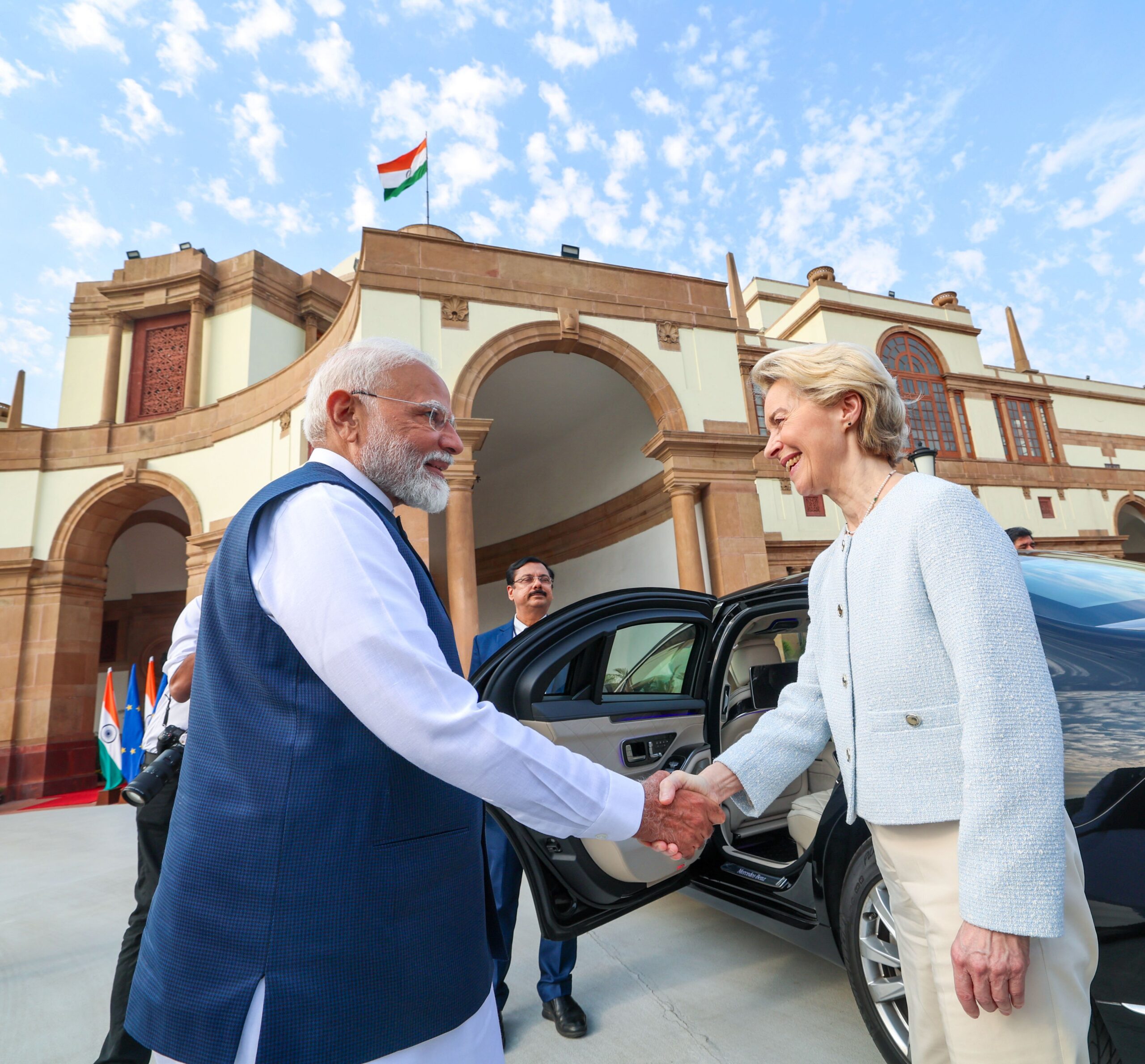
NEW DELHI : India and the European Union are set to announce the conclusion of a free trade agreement, firming up of a defence partnership pact and a framework for mobility of Indian professionals at the summit talks next week, diplomatic sources said on Monday.
European Council President Antonio Costa and European Commission President Ursula von der Leyen will be the Chief Guests at the Republic Day celebrations on January 26, and the India-EU Summit will be held the next day.
A military contingent from the EU, featuring the military staff flag and flags of Operations Atalanta and Aspides, the naval operations of the grouping, will feature at the Republic Day parade.
The two sides are expected to conclude about 10 agreements, including one disaster risk management, the people said. The business forum, which will be addressed by Prime Minister Shri Narendra Modi and Von der Leyen, will focus on leveraging the implementation of the FTA, building resilient supply chains in critical sectors and advanced manufacturing using clean technologies.
This is only the second time that India has invited leaders of a grouping – after the Asean in 2018 – to be chief guests at the celebrations, an honour reserved for the country’s closest strategic and economic partners. Disruptions and geo-economic churn created by the trade policies of the US added urgency to efforts to finalise the trade deal with the EU, negotiations for which were relaunched in 2022 after a hiatus of almost a decade.
The 90-member delegation accompanying the top EU leaders will include foreign and security policy chief Kaja Kallas, trade commissioner Maroš Šefčovič and senior officials dealing with trade, energy and industrial policy.
With the two sides still engaged in last-mile negotiations for the free trade agreement (FTA) on contentious issues such as (CBAM), the EU’s tariff on imports of carbon-intensive goods, the summit is expected to lead to an announcement on the successful conclusion of negotiations for the trade deal, the people said.
With the conclusion of negotiations, the two sides will focus on legal scrubbing and other processes so that the FTA can be signed and come into force as soon as possible. The EU side will expedite the process of getting consent for the deal from the European Parliament and European Council, the people said.
While there was progress on the FTA’s agriculture chapter because both sides marked and mapped each other’s red lines on sensitive sectors, such as India’s concerns on dairy and farm products, CBAM continues to be an issue for which the two sides are working on a “compromise solution”, one of the people said. The Indian side has referred to CBAM as a non-tariff barrier while the EU has ruled out any dilution of the measure as it also applies to European companies.
“The idea is to have a level playing field and ensure competition while offering support for India’s decarbonisation process,” the person said.
The people said the two sides had reached an agreement on wines and spirits and that there will be tariff-rate quotas for automobiles, allowing a higher rate to be applied for quantities exceeding the quota to be imported at a lower tariff rate. The two sides are also working on a compromise for inclusion of climate-related standards under the Paris Agreement, an ask of the EU side, while retaining policy space for India, they said.
In addition to the SDP, being described as a political enabler for bringing all existing security-related initiatives under one umbrella and for branching out into new areas such as the protection of undersea cables and critical infrastructure, the two sides are expected to unveil a joint comprehensive strategic agenda for 2026-2030, the people said.
India and the EU are also set to launch negotiations for a security of information agreement, which combined with the SDP, will allow India to become a trusted partner for joint development and joint production of defence hardware such as drones and air defence systems, the people said. This will also facilitate the participation of Indian firms in EU’s Security Action for Europe (SAFE) programme, a €150-billion initiative to provide low-cost, long-term loans for defence procurement, the people said.
EU member states have scaled up their rearmament drive and begun strengthening their defence industries in view of the perceived unreliability of the US as a defence partner, and the SAFE programme will begin disbursing funds in 2026.
The proposed memorandum of understanding on facilitating the mobility of Indian workers will be a platform to help EU member states to pursue their mobility agendas through measures such as exchange of information, the people said. Seven EU member states, including France, Germany and Italy, have migration and mobility partnerships with India.
The people said regional and global issues such as the Russia-Ukraine conflict, the situation in Greenland, Venezuela and Iran, and tensions in West Asia are expected to figure in the summit.