



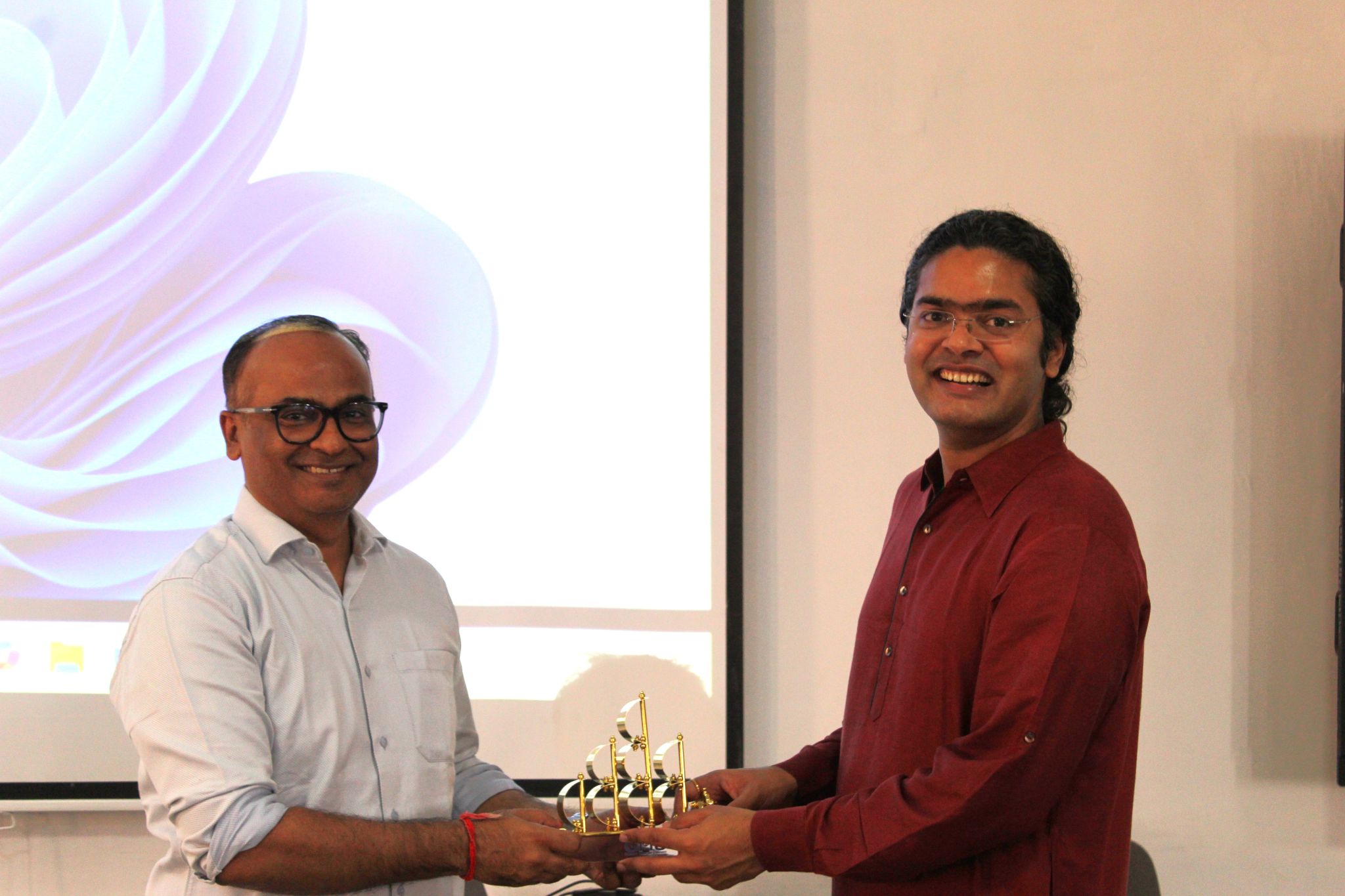
GANDHINAGAR : Gujarat Maritime University (GMU) organised an insightful Expert Session on “Maritime Zones of India Act, 1976 – Recent Developments,” featuring Mr. Apurv Kumar Mishra, Consultant at the Economic Advisory Council to the Prime Minister (EAC-PM), Government of India. The session offered students and faculty an in-depth understanding of India’s maritime legal architecture and its evolving policy landscape.
The programme commenced with a formal welcome address, followed by a reflective note emphasising the importance of applying academic knowledge to real-world governance challenges. Students were encouraged to look beyond statutory provisions and examine how maritime laws operate within administrative, strategic, and economic frameworks.
Drawing upon his professional experience at the EAC-PM, Mr. Mishra elaborated on the significance of the Maritime Zones of India Act, 1976, which defines India’s territorial waters, contiguous zone, exclusive economic zone (EEZ), and continental shelf. He highlighted recent developments, including regulatory updates, policy alignment with international maritime conventions, and the growing importance of maritime security, resource management, and blue economy initiatives.
The session also covered:
India’s jurisdictional rights and sovereign powers in different maritime zones
Governance mechanisms involved in maritime administration
Inter-ministerial coordination in maritime policy formulation
Strategic implications of maritime law in trade, energy security, and coastal development
Emerging challenges in ocean governance and sustainable utilisation of marine resources
Mr. Mishra underscored how maritime legislation plays a crucial role in safeguarding national interests, regulating offshore resources, and strengthening India’s position as a leading maritime nation. He also shared insights into evidence-based policymaking and the role of advisory institutions in shaping high-level national decisions.
An interactive Q&A session followed, where students engaged in discussions on maritime boundary disputes, deep-sea resource exploration, and the future trajectory of India’s blue economy. The deliberations enabled participants to connect theoretical concepts with contemporary policy issues.
The event successfully provided a meaningful platform for academic-industry-policy interaction, reinforcing GMU’s commitment to fostering practical learning and preparing students for leadership roles in maritime governance and law.
The session concluded with a vote of thanks, acknowledging the speaker’s valuable contribution and reaffirming the University’s dedication to promoting dialogue on critical maritime and legal developments.