



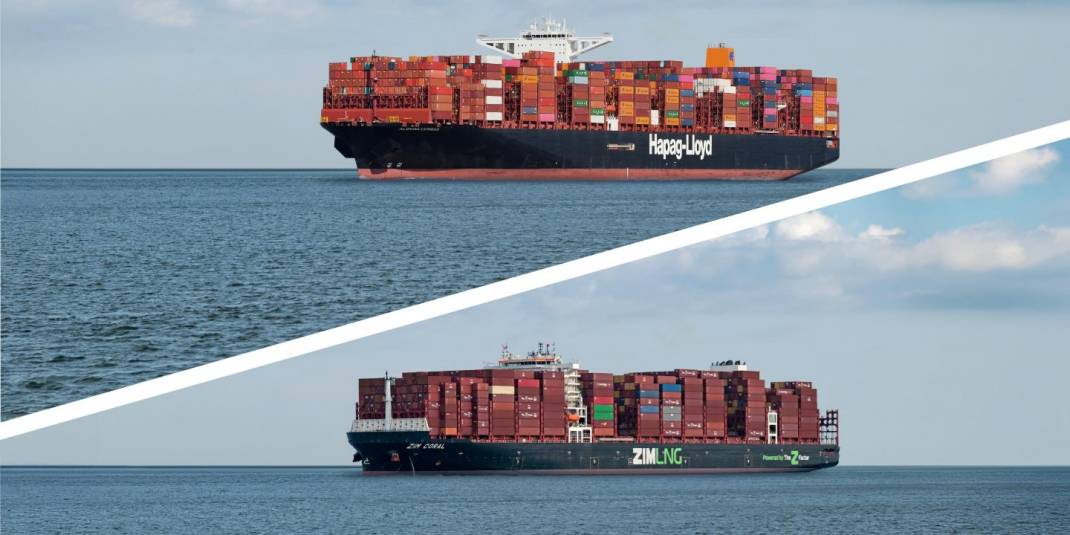
LONDON: Hapag-Lloyd’s planned $4.2 billion takeover of Zim will help it stay relevant in an increasingly consolidated container shipping market. What are the implications of the Top 5’s share rising to 67% and other smaller carriers being left behind?
On Monday, Germany’s Hapag-Lloyd, the world’s fifth largest carrier by operating capacity, announced an agreement to acquire Israeli carrier Zim (ranked tenth) for $4.2 billion. The deal is subject to Zim shareholder approval (simple majority), clearance from the Israeli government, and antitrust approvals globally. Hapag-Lloyd expects completion in late 2026.
If approved, the combined group would reinforce Hapag-Lloyd’s fifth-place capacity ranking, lifting its active fleet to around 3.2 million teu and its orderbook to roughly 700 kteu (see Figure 1). This would narrow the gap to fourth-placed Cosco (3.6 mteu active fleet / 1.4 mteu orderbook).
Zim’s fleet of 117 containerships is predominantly chartered-in, although it has 218 kteu on order. Hapag-Lloyd said the additional chartered tonnage would provide greater flexibility to adjust capacity in line with demand, and expects annual synergy savings of $300m–$500m, mainly from network optimisation.
The takeover of Zim would be Hapag-Lloyd’s fifth in the last 20 years and is part of a relentless consolidation of the carrier industry. A more detailed analysis of carrier M&A this century is available in Drewry’s OnDemand tool.
When news first emerged late last year that talks were under way, we assigned a very low probability to Hapag-Lloyd succeeding. We assumed its ownership structure would be unacceptable to the Israeli government, given that it includes Middle East-based sovereign funds from Saudi Arabia and Qatar, a legacy of its 2017 merger with United Arab Shipping Company (UASC).
To address Israeli strategic concerns, FIMI Opportunity Funds, Israel’s largest private equity fund, will become the owner of “New Zim”, an independent carrier that will assume the obligations of the State of Israel’s “Golden Share” structure, which grants veto rights over certain corporate actions.
New Zim will acquire 16 ships (12 owned, four chartered) from the combined group to maintain Israel’s connectivity with key Mediterranean and US East Coast markets. Hapag-Lloyd will also act as a slot-charter partner to New Zim.
So, given the deal’s complexity and political sensitivities, what is the business logic for Hapag-Lloyd?
In our view, it comes down to scale and relevance.
Scale is becoming existential
Previous M&A this century, combined with aggressive organic growth from the largest operators, has shifted the balance of power sharply towards a handful of dominant carriers.
In 2005, the Top 5 carriers collectively controlled 37% of global capacity. Twenty years later, that share has risen to around 65% It would climb to roughly 67% if Hapag-Lloyd completes the Zim acquisition.
Notably, the Top 5’s growth has largely come at the expense of carriers ranked outside the Top 10. The aggregate share of carriers ranked six to nine has remained relatively stable over the past two decades at 18%–20%, but that stability still implies a loss of relevance versus the much faster-growing Top 5.
By contrast, carriers ranked 11–15 have seen their collective share shrink from 13.5% to 4.7%, while those ranked 16–20 have fallen from 10.6% to just 2.1%.
The Top 20 is no longer an exclusive club signalling power or influence. In 2005, entry into the Top 20 required minimum capacity of around 150k teu and a market share of 1.7%. Today, the threshold has fallen closer to 100k TEU and 0.4%.
Ultimately, being viewed as a major global carrier that can genuinely “move the needle” increasingly requires membership of the Top 5.
Hapag-Lloyd’s position was under threat
The problem for Hapag-Lloyd is that its position within the Top 5 is being squeezed from both directions.
Below it, without Zim’s capacity, Ocean Network Express (ONE) and Evergreen both threaten to overtake Hapag-Lloyd, supported by larger orderbooks. Above it, the four carriers ahead will stretch further away for the same reason.
Hapag-Lloyd first entered the Top 5 in late 2005 when its $2.3 billion takeover of CP Ships propelled its ranking from sixteenth to fifth place. It has since been bounced out on some occasions by Evergreen and NOL/APL, but it has locked down fifth place ever since the 2017 merger with UASC. Since that deal was concluded the same five carriers have occupied the Top 5, although there have been some positional changes involving the other four carriers.
To stay in the Top 5, it was imperative for Hapag-Lloyd to beat Maersk to Zim, which also helps explain the elevated price premium: the agreed $35 per share represents a 58% uplift to Zim’s closing price on Friday 13 January.
Had Maersk succeeded instead, Hapag-Lloyd would have risked drifting into the role of a mid-tier operator, and increasingly the junior partner in the Gemini Cooperation (the Maersk/Hapag-Lloyd alliance). In strategic terms, it is the difference between being predator and prey.
Implications for market structure
One could conclude that, in the container shipping sector, the top 5 carriers alone will shape the future of the sector and drive structural changes across the industry.
However, much will depend on the response from mid-tier players and occasional new entrants. Will ONE, Evergreen, HMM and Yang Ming continue trying to keep pace through newbuild ordering – often to the detriment of supply/demand balance?
Or, might they consider deeper cooperation to bridge the widening gap? Echoes here of Canadian prime minister Mark Carney’s recent Davos speech regarding middling powers’ response to overbearing superpowers.
Alternatively, could more of them follow Zim’s route and ultimately be absorbed into the Top 5?
Our view
The preeminent top 5 global carriers (4 from Europe and 1 from China) will increasingly control network decisions, operational discipline, pricing, cost leadership, terminals, shipbuilders and other contractors, and could even influence how the top carriers respond to shippers’ tenders.
Source: Drewry