



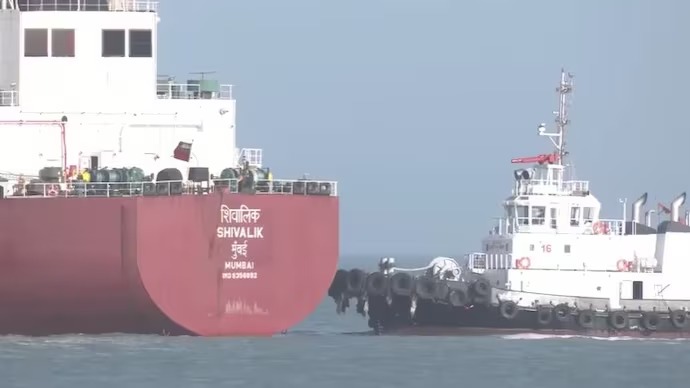
MUMBAI : For the captain and the 26-member crew of the Shivalik, it was an uncharted route. Sailing close to the Iranian coast, the LPG carrier made its way out of the Strait of Hormuz making it the first Indian vessel to return home from the Persian Gulf on March 16.
Captain B K Tyagi, chairman and managing director of Shipping Corporation of India (SCI) recounted on Sunday that the transit was made possible due to excellent coordination between Indian Navy, Directorate General of Shipping and the Ministries of External Affairs and Shipping.
“I clearly remember the night of March 13 when we were planning the passage of our LPG carriers Shivalik and Nanda Devi. The Strait of Hormuz was closed and we were not sure what would be the next course for the vessel. We were given instructions after about 5-6 hours of waiting and were told about the route to follow,” Tyagi said at the National Maritime Day event in Mumbai.
“Normally the master (captain) of a merchant vessel decides the route himself and then executes the passage. But this was an extraordinary situation where the master was given the route coordinates. This was not a normal route that any master would take in the region. Our agencies coordinated so well that the master and we as ship owners had no doubt at all,” Tyagi said.
Shivalik was asked to navigate close to Iran’s coast and channel width in some of the areas was just one mile. “Once we were given the clearance no one bothered us. The operation went on the entire night of March 13 first with the passage of Shivalik and then Nanda Devi,” he said.
After these six other Indian-flagged LPG vessels have transited the Strait of Hormuz. The latest to exit the region on Sunday was a tanker named Green Asha which is estimated to carry 20,000 tonnes of LPG. Still 17 Indian flagged vessels with around 460 seafarers remain in the Persian Gulf.
“The situation in the Persian Gulf region is critical. There is a lot of uncertainty. All the shipowners and ship managers are doing a good job but it will not be complete until all seafarers come out and the Strait of Hormuz is open for normal navigation,” Tyagi said.