


MUMBAI: When US President Donald Trump declared the truce on April 8, 2026 subject to the complete and immediate reopening of the Strait of Hormuz, the world exhaled. Equity futures surged. Oil slid 8% within the hour. The news cycle declared the crisis over.
It isn’t. Not yet. Not for shipping.
For the global maritime industry, the current disruption is no longer about whether vessels can transit. It is about whether operators are willing to move at scale under conditions that remain uncertain, conditional, and fragile.
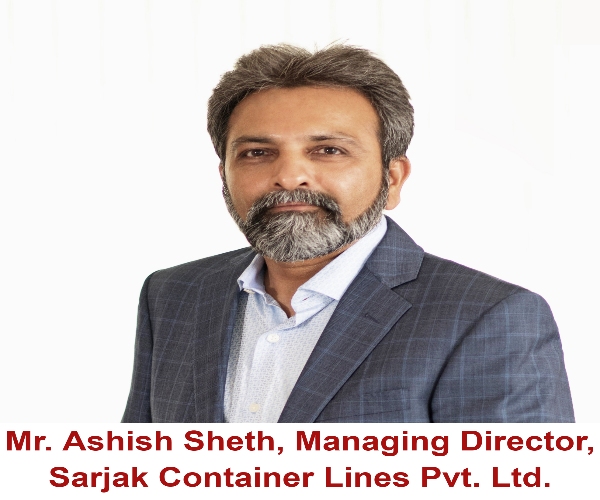
“The Strait may be open, but until confidence returns, the system isn’t. And in shipping, confidence is what moves cargo.”— Mr. Ashish Sheth, Chairman & MD, Sarjak Container Lines
A Managed Corridor, Not an Open One
The two-week ceasefire mediated by Pakistan’s Prime Minister Shehbaz Sharif and Field Marshal Asim Munir has produced a conditional reopening of Hormuz. Iran’s Foreign Minister has confirmed coordination through its armed forces for vessel transit. In theory, the waterway is accessible.
In practice, it is functioning very differently from the corridor the world relied on before February 28.
“The corridor is technically accessible, but operationally constrained. The ceasefire is conditional across all sides — the US, Iran, and Israel are not fully aligned. From a shipping perspective, the Strait may be temporarily open, but it is functioning as a managed corridor, not a neutral one.”— Ashish Sheth, Chairman & MD, SCL
Transit volumes reflect this reality starkly. Daily vessel movements through Hormuz, which stood at 130–140 before the war began on February 28, fell to single digits at the peak of the disruption. Even with the ceasefire announcement, traffic remains well below 10% of typical capacity, at around 9 vessels a day, compared to the pre-war norm.
The ceasefire is for two weeks. The Islamabad talks, beginning Friday April 10, will determine whether it holds or collapses. Every shipowner watching their screens knows that.
Shipowners Move on Assurance, Not Announcements
The announcement of a ceasefire and the physical reality of a normalised corridor are two very different things. The maritime industry has watched Trump extend this same deadline four times before following through. Iran’s Supreme National Security Council, in accepting the ceasefire, explicitly stated: “Our hands remain upon the trigger.”
Israel has not fully stood down. Missile alerts continued in Israel and the UAE even after the ceasefire announcement. The IRGC has warned it will deprive the region of oil “for years” if civilian infrastructure is struck. This is the environment in which operators are being asked to commit vessels and cargo.
“Shipowners don’t move on announcements, they move on assurance. Right now, the market is still in a wait-and-watch mode because risk perception hasn’t eased at the same pace as political signalling.”— Ashish Sheth, Chairman & MD, SCL
The result is a confidence deficit that is now the central bottleneck in global shipping, not physical access.
The Backlog: A Recovery Measured in Weeks, Not Days
The sharp drop in Hormuz transit flows during the peak disruption created a significant backlog of vessels across Gulf anchorage points — Fujairah, Khor Fakkan, and wider Gulf waiting zones. This overhang will not clear quickly.
“When a corridor drops from over 100 daily transits to single digits, normalisation doesn’t happen overnight. Clearing the backlog requires sustained stability — not just a ceasefire announcement.”— Ashish Sheth, Chairman & MD, SCL
At current movement levels, backlog clearance will naturally extend over several weeks. Ports and anchorages in the UAE and Oman, along with India’s west coast gateways, are likely to experience localised congestion and operational strain as vessel flows resume in clusters rather than smoothly.
Indian port traffic data remains stable so far, reinforcing that the upstream disruption has not yet fully reached Indian shores. But that lag is closing.
Insurance: The Real Gatekeeper
Beyond the geopolitics and the vessel backlog, one factor above all others is determining how quickly large-scale movement resumes through Hormuz: insurance.
“Insurance is the real gatekeeper here. As long as the region is priced as a war-risk zone, large-scale movement will remain constrained, regardless of whether the Strait is technically open.”— Ashish Sheth, Chairman & MD, SCL
War-risk premiums for Hormuz-area transits surged from 0.125% of hull value to 0.2–0.4% per voyage at the start of the conflict, an increase of a quarter of a million dollars per transit for very large crude carriers. The Joint War Committee of the London insurance market has extended its high-risk area listings to include waters around Oman.
A temporary ceasefire does not automatically reset these underwriting positions. Until the Islamabad talks produce a durable framework and until the IRGC and Israel both demonstrate sustained restraint on the ground, war-risk premia will remain elevated, and underwriter appetite will remain restricted.
What is emerging is not a return to open passage. It is a shift to managed passage — whether through coordinated routing, IRGC clearance protocols, or informal controls. The bigger signal is that transit through Hormuz is becoming more conditional in structure, not less.
India’s Dual Exposure: Supply and Execution at Risk
The Hormuz disruption is typically framed as an energy security story for India. That framing is incomplete.
India is not just importing energy through this corridor. It is exporting execution.
“India today is both a destination for energy and a source of execution for global projects. Any disruption at Hormuz therefore hits us on both sides of the value chain — impacting supply on one end and delivery commitments on the other.”— Ashish Sheth, Chairman & MD, SCL
With petroleum cargo accounting for nearly a third of total Indian port traffic, any sustained disruption in Hormuz will reflect first in POL volumes in the coming weeks. India remains heavily dependent on the Gulf for crude oil and LNG imports. Any disruption directly impacts inbound energy flows, freight costs, and supply predictability.
But the less-discussed dimension is India’s role as a global execution hub. Indian manufacturers and EPC contractors are deeply embedded in project supply chains across the Middle East, Africa, and Southeast Asia. These movements are highly time-sensitive, synchronised with tight construction and commissioning schedules:
- Refinery and petrochemical equipment
- EPC-linked cargo and infrastructure modules
- Project components moving between India, the Gulf, and global markets
Unlike commodity cargo, project logistics operates on sequencing. A single delayed shipment — a reactor component, a structural module, critical rotating equipment — can cascade across entire project timelines.
“In project logistics, it’s not just about whether cargo moves — it’s about whether it moves on time. When movement becomes uncertain, execution itself is at risk.”— Ashish Sheth, Chairman & MD, SCL
The cost envelope is also expanding beyond freight. Companies are absorbing elevated war-risk insurance premiums, delay penalties tied to EPC contracts, and idle equipment and workforce costs at project sites. The disruption is multi-layered, and in project cargo, those layers compound.
The 15-Day Trap: The Voyage Math Nobody Is Talking About
There is a critical operational reality that is being overlooked in the relief surrounding the ceasefire announcement. The Strait of Hormuz is open — but only for fifteen days. And fifteen days is not enough time to complete a voyage and safely exit the war zone.
Voyage Leg Typical Duration Risk Window
Transit into Gulf (Hormuz entry) 1–2 days Days 1–2
Passage to discharge port (e.g. Dammam, Jubail, Khalifa) 2–3 days Days 3–5
Port operations — berthing, discharge, documentation 3–7 days Days 6–12
Return transit to Hormuz exit 2–3 days Days 13–15 ⚠️
Total voyage cycle 8–15 days minimum Zero buffer
The arithmetic is unforgiving. A vessel departing today, transiting Hormuz, proceeding to a Gulf discharge port, completing port operations, and returning to Hormuz exit will use every single day of the 15-day window — with zero margin for delay. Any port congestion, berthing queue, documentation hold, or operational disruption, and the vessel is still inside the war zone when the ceasefire expires.
And if the ceasefire expires without renewal or a permanent framework from the Islamabad talks — that vessel is trapped.
“The corridor may be open for 15 days, but a round voyage through the Gulf cannot be completed in 15 days with any operational certainty. The shipowner who commits today is not just taking a transit risk — they are taking a post-ceasefire entrapment risk. That changes the commercial calculus entirely.”— Ashish Sheth, Chairman & MD, SCL
What This Means in Practice
The entrapment risk cascades across every stakeholder in the chain:
- Shipowners face potential vessel detention in a declared war zone with no legal or diplomatic recourse if the ceasefire collapses mid-voyage
- War-risk underwriters are unlikely to cover a vessel that knowingly commits to a voyage that cannot be completed within the ceasefire window — read your policy language before sailing
- Charterers and cargo owners face force majeure triggers, ETA failures, and contractual penalties if the vessel cannot exit on time
- P&I clubs will be scrutinising due diligence — did the shipowner make a reasonable commercial decision given the known 15-day window?
- Crew safety obligations under MLC and ISM Code become acute if a vessel is caught inside the war zone post-ceasefire
The practical implication is that only short-haul, high-priority cargo movements — where the full voyage cycle can be completed with a meaningful buffer inside 15 days — should be seriously considered right now. Longer voyages, complex multi-port calls, and vessels with uncertain port turnaround times should hold.
The 15-day clock also creates a perverse incentive: operators who do commit will rush, creating congestion at ports that are already operating under strain from the backlog of the past five weeks. Speed of port operations cannot be assumed.
The Islamabad Talks Are the Real Signal to Watch
The Friday April 10 talks in Islamabad between US and Iranian negotiators will determine everything. If they produce a framework for a permanent ceasefire, the 15-day trap dissolves and normal commercial planning can resume. If they stall or collapse, any vessel inside the Gulf at that point faces the worst-case scenario.
Until Islamabad delivers a clear outcome, the prudent commercial position is: assess every voyage against the 15-day clock, not just against current transit access.
Outlook: Confidence Restoration Remains the Critical Variable
In response to the uncertainty, operators are beginning to adapt. There are early signs of a shift from containerised movement to breakbulk and multi-modal solutions, greater reliance on flexible routing, and increased planning buffers to absorb uncertainty.
But adaptation is not normalisation. The cargo is there. The vessels are there. What is not yet there is the sustained, predictable stability that large-scale shipping movement requires.
“The Hormuz uncertainty is a confidence disruption for shipping lines. The cargo is there, the vessels are there, but the willingness to move at scale depends entirely on how stable and predictable the corridor proves to be — which is currently being reshaped by every negotiation between the US, Israel, and Iran.”— Ashish Sheth, Chairman & MD, SCL
ABOUT SARJAK CONTAINER LINES
Sarjak Container Lines (SCL) is an asset-owning breakbulk and project cargo shipping operator, operating MV SCL Mercury across 84+ countries. With deep expertise in India-linked flows across oil & gas, infrastructure, and EPC projects, SCL delivers end-to-end logistics solutions for complex and high-value cargo segments. Built on decades of experience in containerised shipping and cargo movement, SCL has evolved into a trusted partner for handling the most demanding project logistics challenges.