


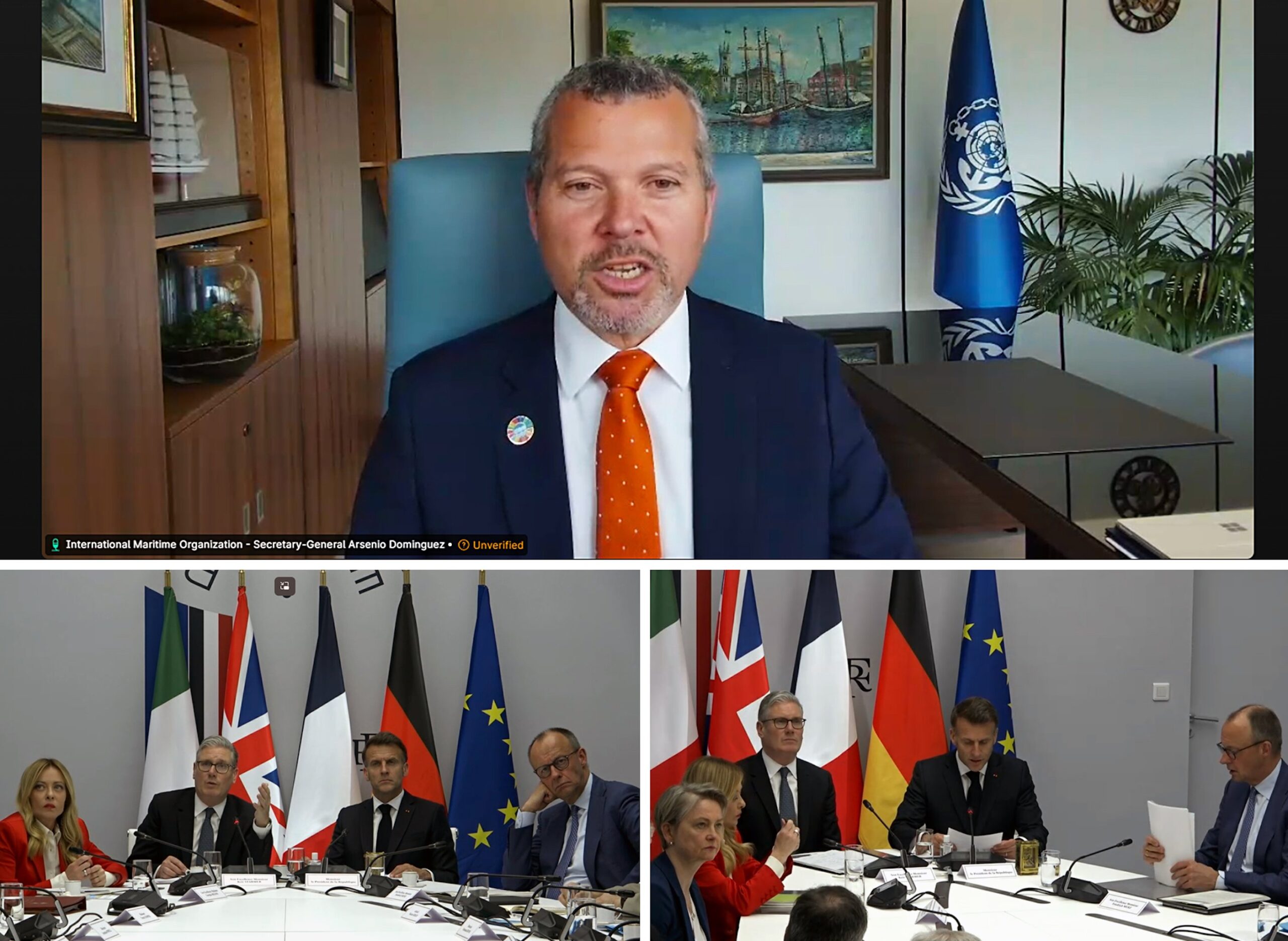
PARIS/LONDON: The Secretary-General of the International Maritime Organization, Arsenio Dominguez, has issued a strong appeal for immediate international cooperation to safeguard freedom of navigation and protect seafarers affected by the escalating geopolitical tensions in the Strait of Hormuz.
Delivering keynote remarks (virtually) France–UK Summit on Freedom of Navigation held on Friday (17th April) in Paris, the IMO Secretary-General highlighted the severe impact of the ongoing conflict on global shipping and maritime personnel.
Approximately 20,000 seafarers and nearly 2,000 vessels remain stranded in the Persian Gulf region, underscoring the urgent humanitarian and operational challenges confronting the maritime sector. The disruption, he noted, poses a direct threat to global energy supplies, food security, and economic stability.
Reaffirming the fundamental principles of international maritime law, the Secretary-General emphasized that freedom of navigation must be upheld without compromise. Referring to the United Nations Convention on the Law of the Sea, he reiterated that straits used for international navigation cannot be closed by bordering states, nor can tolls, fees, or discriminatory transit measures be imposed.
Any departure from these established norms, he warned, would set a dangerous precedent and undermine the stability and integrity of global shipping operations.
The Secretary-General further highlighted the longstanding traffic separation scheme in the Strait of Hormuz, established by the IMO in 1968 and jointly operated by Iran and Oman. This maritime corridor, governed under the SOLAS Convention, has ensured safe navigation for decades and remains central to current operational planning.
IMO Evacuation Framework Underway
In response to the crisis, the IMO has initiated the development of a dedicated evacuation framework aimed at facilitating the safe removal of stranded vessels and seafarers from the affected region. The framework is being developed in close coordination with regional stakeholders, including Iran, and with the support of relevant international partners.
The Organization has indicated its readiness to implement the evacuation plan without delay, subject to prevailing safety conditions.
Call for International Support
The IMO Secretary-General called upon governments and international partners to intensify diplomatic engagement with the IMO and the United Nations, with a focus on:
- Upholding the principle of freedom of navigation
- Rejecting unlawful tolls, fees, or restrictions on transit
- Supporting the IMO-led evacuation of affected seafarers
- Assisting in the clearance of navigational hazards, including mines
- Providing technical and operational support to implement evacuation measures
- Ensuring access to affordable insurance to enable the resumption of shipping operations
He also acknowledged the efforts of countries in the region that continue to supply essential provisions to seafarers and facilitate crew changes where possible.
Humanitarian Priority
Concluding his remarks, the Secretary-General stressed that seafarers and commercial shipping must not be used as leverage in geopolitical conflicts, underscoring the need to prioritize safety, welfare, and the uninterrupted flow of global trade.