


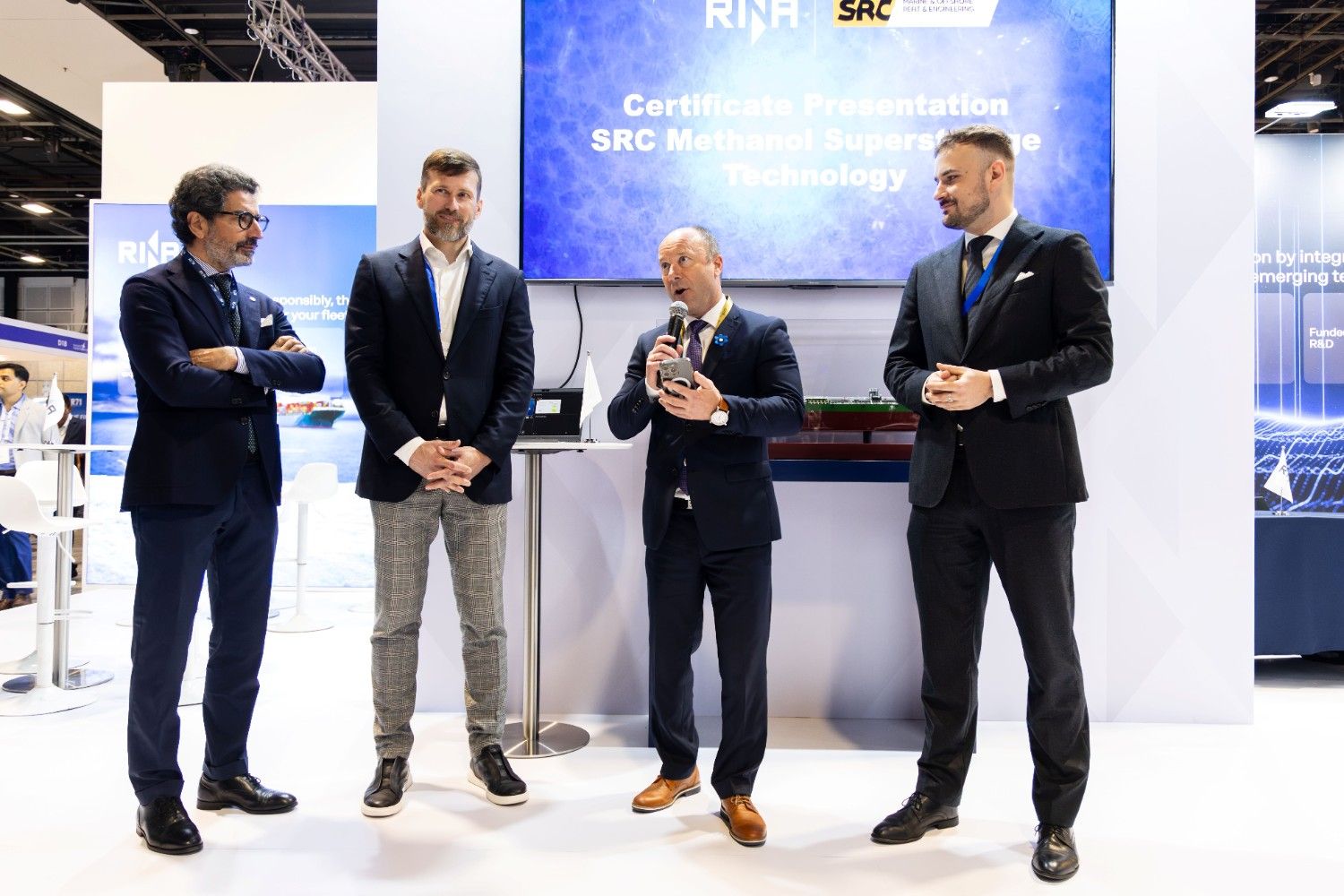
GENOA: SRC Group’s Methanol Superstorage system has received Type Approval from RINA, in a formal recognition of a solution which allows shipowners and operators to use methanol and ethanol as green marine fuels without sacrificing storage space.
The formal recognition means owners can adopt Methanol Superstorage with confidence that it meets the exacting standards for safety, performance, reliability and compliance required for Type Approval by one of shipping’s leading class societies. RINA awarded Approval in Principle (AiP) status to Methanol Superstorage in March 2025.
Methanol has emerged as a strong contender as an alternative fuel for marine and offshore applications, given its ability to reduce greenhouse gas (GHG) emissions by up to 95% compared with heavy fuel oil (HFO). Ethanol also produces significantly lower greenhouse gas, SOx and particulate emissions than HFO, while being easy to handle and commercially available.
However, both methanol and ethanol also require approximately two times more storage volume than HFO.
To protect the tank from external fire and mechanical impact, and to provide leakage mitigation, conventional shipboard fuel storage tanks feature cofferdams which separate their inner and outer shells. While effective and necessary, the cofferdam is typically a minimum of 600mm-wide and occupies valuable onboard space.
Methanol Superstorage overcomes the space challenge by creating a tank with a sandwich-structure using SPS Technology’s Sandwich Plate System (SPS). The SPS comprises a 25mm solid elastomer core, fully enclosed between two steel plates rated to A60 equivalence. The elastomer acts as a load-transferring, energy-absorbing and sealing layer that creates an oxygen-free atmosphere between the plates, preventing hidden corrosion without the need for the through-life manual inspections required of conventional cofferdams.
The SPS’ fully bonded interface ensures shear transfer and structural continuity while forming a third containment barrier to prevent leaks and emissions. The solid elastomer helps to prevent local buckling and distributes impact and pressure loads effectively while maintaining safety levels equivalent to the prescriptive arrangements for conventional cofferdams, as outlined in IMO MSC.1/Circ. 1621.
The design eliminates key hazards such as asphyxiation, toxic exposure, falls, entrapment and vapour accumulation during inspections. It also reduces structural risks by lowering stress concentrations and fatigue cracking, removing large internal surfaces prone to corrosion/coating breakdown and maximising resistance to high impacts and punctures.
Type Approval demonstrates a class society’s high level of trust in the system’s capabilities. Pino Spadafora, Marine Market Development Vice President at RINA, commented: “SRC Group’s Methanol Superstorage is a practical, space-efficient solution with the potential to accelerate the adoption of green methanol as a marine fuel, delivering increased storage capacity of conventional tank designs while maintaining equivalent safety.”
A range of case studies confirm that vessels incorporating Methanol Superstorage would store nearly twice the volume of methanol or ethanol as would be possible using conventional tanks. Simpler by design and with fewer parts, the solution also removes the need for regular inspections and gas-freeing procedures, thereby extending its service life.
As a scalable solution, Methanol Superstorage is suited to all vessel types, from small workboats and tugs to offshore support vessels, yachts, ferries, cruise ships, tankers and cargo vessels.
Type Approval will make it easier for flag states to issue project-specific approvals for the system, at a time when forecasts suggest a surge in demand for methanol-powered vessels: by 2030, methanol ships are expected to account for nearly 20% of the global order book.
Methanol Superstorage has also obtained AiP from IACS members Lloyd’s Register and ClassNK, as well as from the Panama Maritime Authority. The solution also earned SRC Group the Royal Institution of Naval Architects’ Maritime Innovation Award in 2025.
Alex Vainokivi, Innovation Manager, SRC Group, said: “Obtaining Type Approval from RINA is great news, and an important step forward in building industry-wide confidence in Methanol Superstorage. It provides ship owners with clear validation as they evaluate methanol as a long-term clean fuel that can support their decarbonisation targets, covering a wide range of vessel types.”