



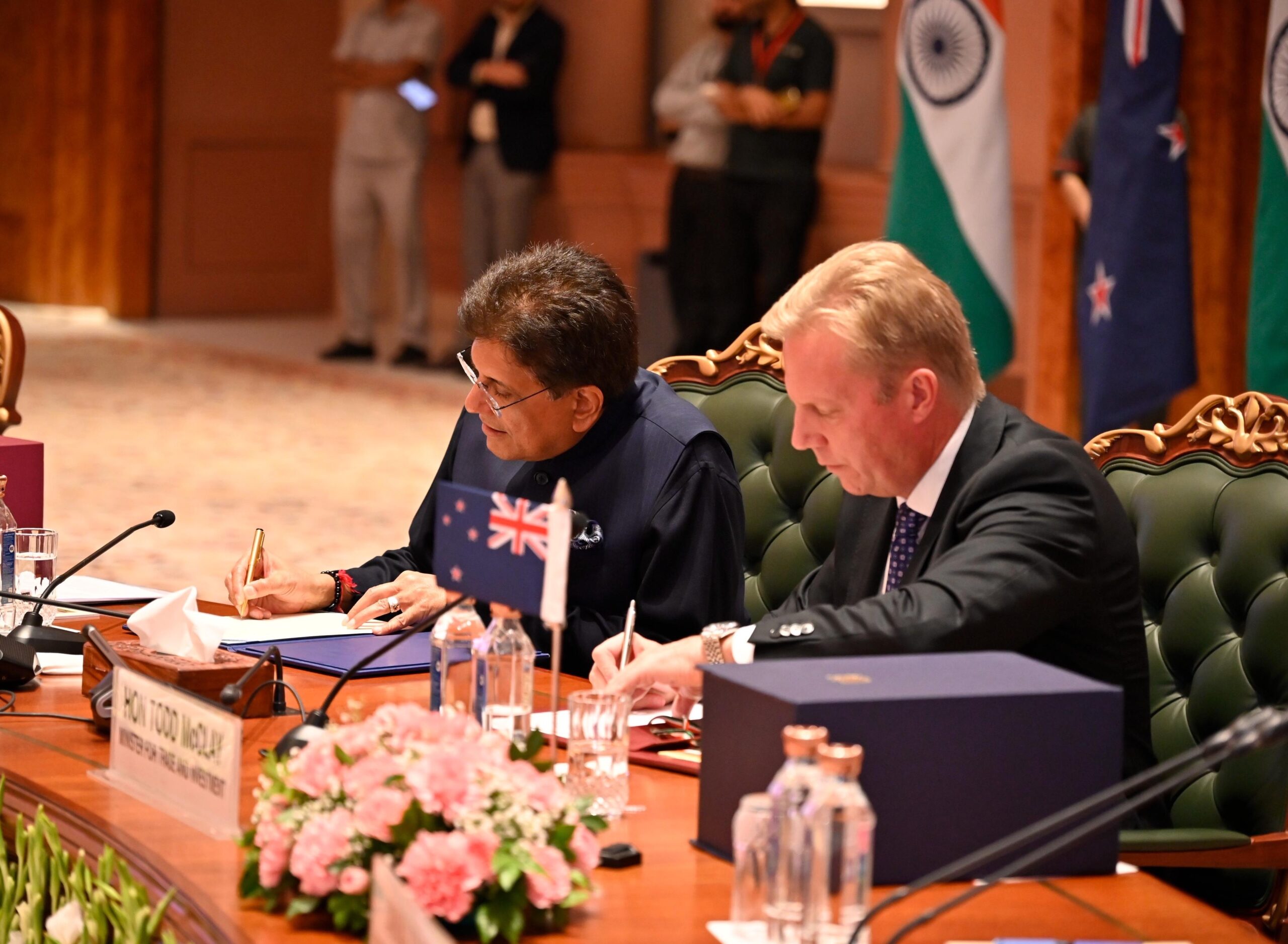
NEW DELHI : India and New Zealand on April 27 signed a free trade agreement (FTA), concluding 13 months of negotiations.
Food preparations ($119.2 million), industrial machinery ($98.8 million), excavators and earth-moving equipment ($95.6 million), and vehicle parts ($88.5 million) also feature prominently
New Zealand could absorb at least 12 percent of India’s exports currently exposed to the Strait of Hormuz if disruptions in the key shipping route persist, according to a Moneycontrol analysis of trade data. The estimate assumes a prolonged blockade of the Hormuz corridor and a slower recovery in demand from affected Gulf markets.
The pact is expected to significantly boost bilateral trade, with Wellington offering zero-duty access to 100 percent of Indian exports. New Delhi, in turn, has agreed to eliminate tariffs on 70 percent of tariff lines, covering about 95 percent of New Zealand’s exports by value, while keeping sensitive sectors such as dairy outside the agreement.
“This FTA reflects the shared trust between the two nations, the confidence of policy stability, business environment stability and all of this leading to a resilient supply chain,” Union Commerce and Industry Minister Shri Piyush Goyal said at the signing.
New Zealand could help India redirect nearly $7.3 billion worth of exports that currently move through the Strait of Hormuz, a critical artery for India’s trade with Gulf economies, particularly if regional demand takes time to recover.
Among the most exposed product categories routed through Hormuz are medicaments, worth $417.2 million, and cosmetics and toilet preparations, worth $267.3 million. Food preparations ($119.2 million), industrial machinery ($98.8 million), excavators and earth-moving equipment ($95.6 million), and vehicle parts ($88.5 million) also feature prominently.
Trade diversification benefits limited
Diversification options remain limited in the near term, with the New Zealand market currently capable of offsetting less than 2 percent of India’s total exports. However, India’s expanding export basket could improve that over time.
New Zealand shows the strongest potential demand in selected manufactured and consumer goods categories. It could absorb exports worth $603.1 million in turbo-jets, $390.8 million in communication apparatus and $384 million in food preparations.
Medical and surgical instruments could see additional demand of $305.6 million, while aluminium oxide exports worth $257.8 million may also find a market in New Zealand.
Other categories with relatively high replacement potential—where India’s trade remains over 50 percent dependent on Gulf markets, the US, UK, European Union, South Korea and Japan—include cosmetics ($194.6 million), plastic articles ($175.8 million), toys and scooters ($160.9 million), electrical static converters ($142.5 million) and iron or steel structures ($135.7 million).
Source : Moneycontrol