


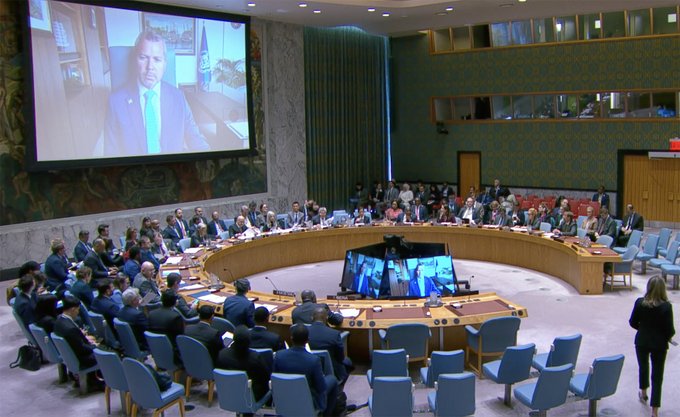
LONDON : The Safety and Protection of Waterways in the Maritime Domain”. Agenda item “Maintenance of international peace and security”. Keynote Remarks by IMO Secretary-General Arsenio Dominguez on Monday, 27 April 2026.
“Mr. President, Excellencies and distinguished members of the United Nations Security Council. Since the 1980’s, IMO has been addressing maritime security in the shipping and port sector and has in place the relevant mandatory standards to enhance global maritime security. Our regulatory process is constantly evolving to adapt to any new threats and make use of our experience and expertise.
The geopolitical conflict around the Strait of Hormuz is having a very negative effect on seafarers and shipping, and on the global population and economy.
Approximately, 20,000 innocent seafarers and nearly 2,000 vessels remained trapped in the Persian Gulf. Any disruption to shipping represents a global interference to energy and food security.
The principle of freedom of navigation is not negotiable. Ships must be allowed to trade worldwide unhindered and in accordance with international law.
In accordance with the United Nations Convention on the Law of the Sea and customary international law: Straits used for international navigation cannot be closed by bordering States.
Equally, there is no legal basis for any country to introduce payments or impose tolls, fees, or any discriminatory conditions on international straits.
Any deviation from these well-established and recognized principles would set a negative precedent and severely undermine the integrity and stability of shipping operations worldwide.
Since 1968, the International Maritime Organization has established a traffic separation scheme or maritime corridor, in the Strait of Hormuz.
This maritime corridor, jointly operated between Oman and Iran, has ensured safe navigation for decades. This is a mandatory mechanism in accordance with the IMO’s International Convention on the Safety of Life at Sea. Both countries are signatories to this Convention, which has governed the safety of ships at sea since 1974.
Our main concern remains the safety and the well-being of the innocent seafarers trapped in the Gulf due to the conflict.
Following the IMO Council decision, I have begun the development of an evacuation framework, using the existing traffic separation scheme, to securely evacuate ships and seafarers from the conflict zone provided it is safe to do so.
The technical and operational developments are being carried out with the involvement of the regional countries, including Iran, and with the support from relevant countries assisting in the negotiations.
As an Organization, we are ready to implement this framework without delay, but only once it is safe to do so. In this respect, I call upon States to uphold the principle of freedom of navigation; and reject an imposition of tolls, fees or discriminatory transit measures for the passage through a strait used for international navigation.
I would like to take this opportunity to further request States to: Support the IMO’s plan to facilitate the evacuation of affected seafarers; At the appropriate time, assist with the clearance of any hazards to the commercial ships navigating in the Strait of Hormuz, including mines; Provide any technical and operational civilian assistance to operationalize the evacuation framework; and Ensure practical assurances to the shipping sector, including access to insurance at reasonable costs, to enable the resumption of normal operations as soon as practicably possible.
I would like to reiterate my appreciation for the support provided by the countries in the region in delivering essential supplies to seafarers in the Persian Gulf, safeguarding their well-being, and request them to facilitate crew changes when safe and possible. Shipping and seafarers should never be used as leverage in geopolitical conflicts.
I would like to join and reiterate the call for de-escalation to ensure safety of seafarers, freedom of navigation and stability of supply chains worldwide. Thank you for this opportunity“.