



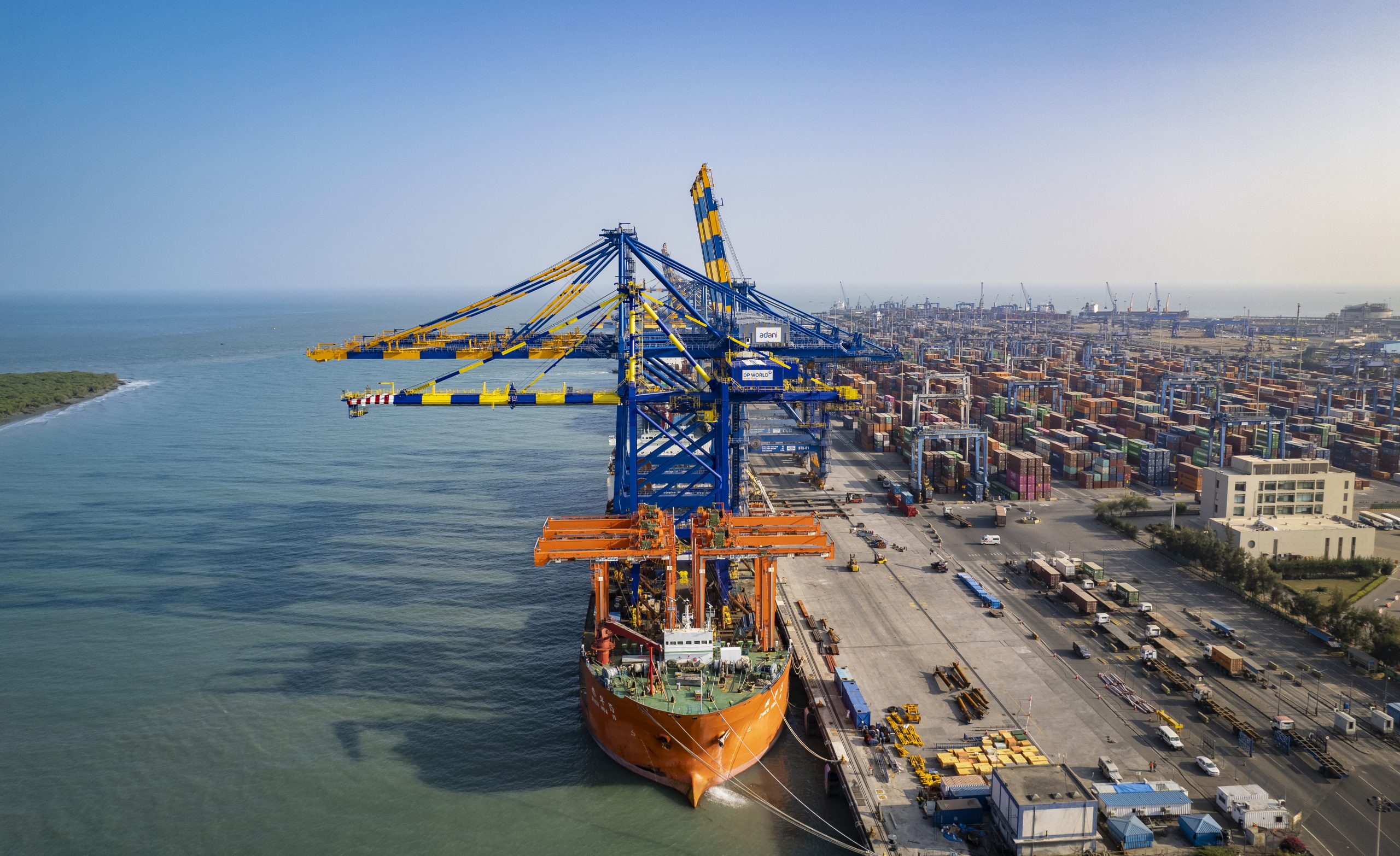
AHMEDABAD : With key ports such as Mundra and Vizhinjam running near full capacity, Adani Ports and Special Economic Zone Ltd (APSEZ) has prepared a ₹90,000 crore–₹1 lakh crore infrastructure blitz over FY27–FY31, accelerating expansion across container terminals, liquid cargo facilities and logistics networks to capture the next wave of India’s trade growth.
The aggressive scale-up will be centred around ports including Mundra, Vizhinjam, Dhamra, Hazira, Krishnapatnam, Ennore and Kattupalli, with over 60 per cent of the planned capex earmarked for domestic ports expansion. During the next five years, the company plans to spend ₹60,000–63,000 crore on domestic ports, with a large part of the investments directed towards expanding container handling infrastructure, liquid terminals and cargo evacuation systems.
A significant portion of the expansion will come from container terminals, with Mundra set to add 94 MTPA of capacity, while expansions are also planned at Vizhinjam, Ennore and Kattupalli. Dhamra will see an additional 49 MTPA capacity expansion driven by rising rail-sea-rail cargo movement, while Hazira’s liquid cargo handling capacity will be expanded by 11 MTPA. APSEZ is also scaling up dry cargo infrastructure at Krishnapatnam.
“We have accelerated the capex in Mundra because we are fully utilised now. CT5 is coming up and we have accelerated future expansion,” said Ashwani Gupta, CEO and whole-time director of APSEZ. Gupta added that the company has also fast-tracked investments in Vizhinjam after the port hit full utilisation levels amid disruptions caused by the West Asia crisis. “Vizhinjam is already at 100% capacity. During the West Asia crisis, we had many vessels waiting outside, so we are not waiting for Phase II and have already kicked it off,” he recently told investors while adding that the next phase is being developed as an automated terminal.
The company said more than 60% of incremental domestic port capacity will focus on container cargo, currently APSEZ’s fastest-growing cargo category with a 16% CAGR in container volumes between FY21 and FY26.
Beyond ports, APSEZ has earmarked around ₹9,000 crore for logistics infrastructure, including rail rakes, multimodal logistics parks, warehouses, agri silos and trucks. Another ₹13,000 crore will go towards marine fleet expansion, while ₹8,000 crore has been allocated for technology upgrades, automation and decarbonisation initiatives.
APSEZ also plans to invest ₹6,000–7,000 crore in international ports, largely centred around Colombo West International Terminal (CWIT) Phase-II. “Our commitment is to deliver twice the growth in five years with a 20% return on capital at the consolidated level,” Gupta said. “If India grows at 7%, we can grow at 10–11%,” he added.
APSEZ currently has a domestic port capacity of 653 MTPA and is targeting a capacity of more than 1 billion tonnes annually by 2031. The company said it also expects to unlock nearly 91 MMT of additional capacity through efficiency improvements at existing infrastructure.
On international operations, Gupta said overseas ports are witnessing strong momentum, particularly in Tanzania and Colombo. Of APSEZ’s international cargo volumes of around 22 million tonnes, North Queensland Export Terminal contributes roughly 11 million tonnes, with the balance coming from Tanzania, Haifa and Colombo.
The company spent around ₹15,000 crore in FY26 and has guided for ₹12,000–14,000 crore capex in FY27.