


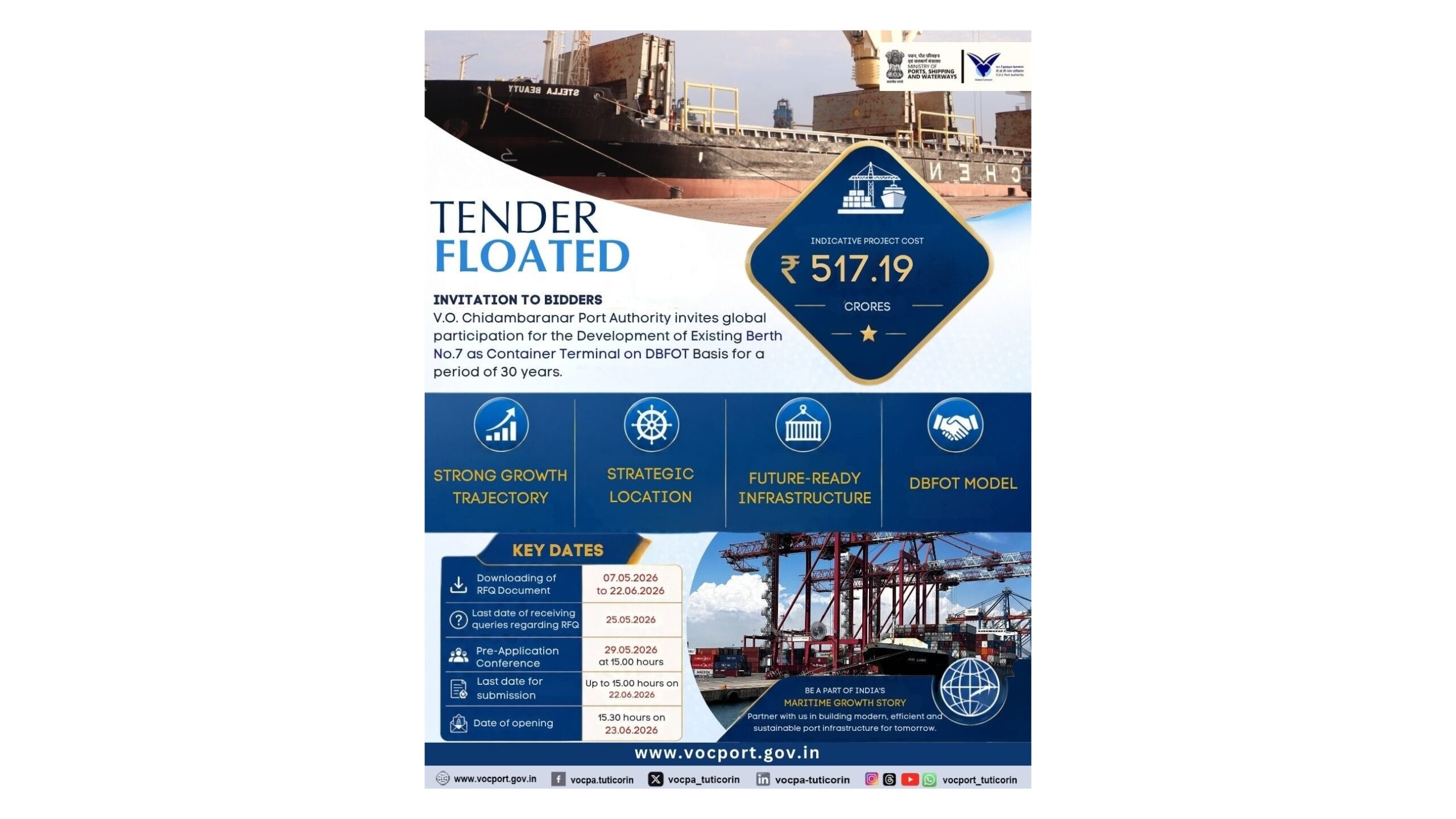
TUTICORIN: The V.O. Chidambaranar Port Authority has floated a global tender to upgrade Berth No. 7 at the VOC Port in Thoothukudi into a modern container terminal capable of handling large container vessels of up to 12,100 Twenty foot equivalent unit (TEU) capacity, with a draft of 14.20 m.
The ₹517-crore project, proposed on a Design, Build, Finance, Operate and Transfer (DBFOT) basis for a concession period of 30 years, is expected to create an annual handling capacity of 4.2 lakh TEUs. The port authority has invited global participation for the project, which is aimed at strengthening the port’s container handling capability and boosting India’s maritime infrastructure.
According to the tender document, the proposed upgradation includes strengthening the existing berth with new piles, dredging the berth pocket to a depth of minus 16.5 metres, and installing new fenders, bollards and utility infrastructure. The project also envisages deployment of modern container handling equipment such as quay cranes, rubber tyred gantry cranes (RTGCs), electric tractor trailers and reach stackers.
Berth No. 7, located within the inner harbour of the VOC Port on India’s southeastern coast, was originally constructed in 1998 with blockwork construction. The berth has a length of 370 metres, crane rail spacing of 23.47 metres and an existing dredged depth of 11.85 metres.
Container operations at the berth were handled by BOT operators between December 1999 and February 2025. In 2008, the PSA International had entered into a joint venture with Sical Logistics to operate the berth for 30 years. However, PSA later exited the project following a legal dispute with the port authority over royalty payments.
Following the exit of container operations, the berth is currently being used for handling other cargoes.
The VOC Port presently has 20 berths in its inner harbour, including dedicated container berths, coal and oil jetties and captive berths serving nearby industries. Existing container traffic is being handled at Berths 8 and 9, while coal and oil jetties primarily cater to thermal power and petroleum cargo.
The tender document said the proposed project would leverage the port’s strategic location along international shipping routes and support the growing container traffic demand in the region.