



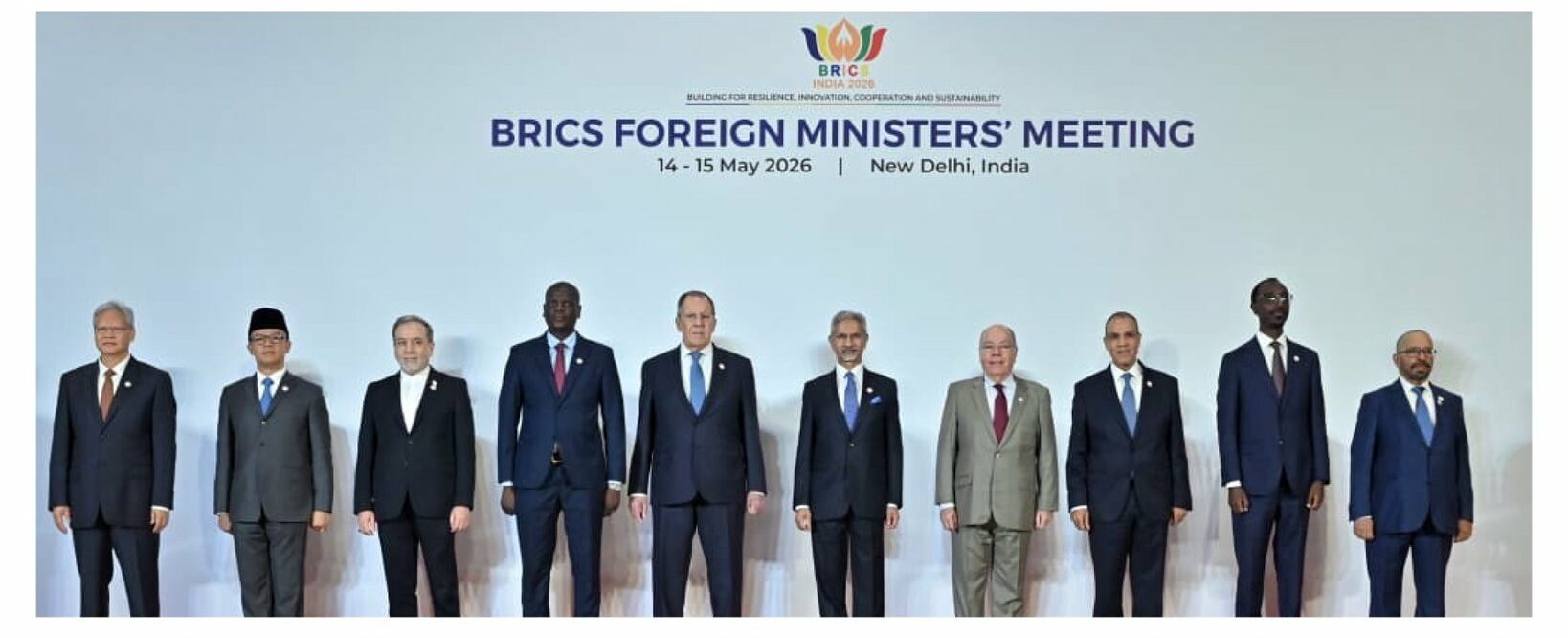
NEW DELHI : The BRICS Foreign Ministers’ Meeting hosted by India failed to reach a consensus because of Iran’s dissent on two paragraphs on Palestine and the Red Sea, it is learnt.A source revealed that Iran had an issue with paragraphs 26 and 29.
However, Iranian Foreign Minister Seyed Abbas Araghchi Friday, without naming the United Arab Emirates (UAE), blamed a country in the “region with a special partnership with Israel” for the lack of consensus during the meeting.
“The ministers recalled that the Gaza Strip is an inseparable part of the Occupied Palestinian Territory. They underlined, in this regard, the importance of unifying the West Bank and the Gaza Strip under the Palestinian Authority, and reaffirmed the right of the Palestinian people to self-determination, including the right to their independent State of Palestine. They called on the international community to support the Palestinian Authority in undergoing reforms to fulfil the Palestinians’ legitimate aspirations for independence and statehood,” paragraph 26 of the outcome document and chair statement published by India said.
It was noted in the document that a “member had reservation on some aspects of this paragraph.” Similarly, paragraph 29 on the situation in Yemen and ensuring free navigation through the Red Sea and Bab Al-Mandab Strait had a member dissenting on the final language being negotiated by the BRICS grouping.
The source confirmed that in both cases the dissent was solely by Iran. Indian diplomacy had focused on bridging the differences between Iran and the United Arab Emirates (UAE), both members of the grouping and on opposite sides of the ongoing conflict in West Asia to ensure a joint outcome document during the foreign ministers meeting.
The other paragraph that saw dissent was paragraph 21 of the outcome document, which spoke on the situation in West Asia. The UAE has faced the brunt of Iran’s retaliation since the US and Israel launched strikes on Tehran on 28 February.
The BRICS has been unable to issue a joint statement on the conflict due to both Tehran and Abu Dhabi sparring over which side’s aggression should be condemned.
Araghchi, while speaking to the Indian media Friday in the national capital, said that “it is a matter of fact that the final statement was blocked by a member-state due to its special relationship with Israel”.While the Iranian foreign minister did not directly name the UAE, he highlighted that it is a country within West Asia and houses American assets including military bases.
Israel also recently deployed an Iron Dome air defence system for the UAE during the active phase of the conflict, highlighting the growing security convergence between Tel Aviv and Abu Dhabi.
Paragraph 21 made it clear that there “were differing views among some members as regard to the situation in the West Asia/Middle East region”.
This is the second time that a BRICS meeting in the last two months under India’s chairship has failed to issue a joint statement.The foreign ministers meeting was held on 14 and 15 May in the national capital. A number of foreign ministers including Araghchi attended the meeting under the stewardship of External Affairs Ministers S. Jaishankar.
Last month during a meeting of the deputy foreign ministers and special envoys on the Middle East and North Africa (MENA), differences between Iran and the UAE, as well as India looking to dilute language on Palestine led to the lack of consensus for a joint outcome document.
This time round within the foreign ministers meeting, India has changed its position regarding the language surrounding Palestine.
‘Two-state solution with East Jerusalem as capital’
India changed its position on the recognition of a two-state solution with East Jerusalem as the capital of an independent Palestine between the meeting in April and the foreign ministers meeting on 14 and 15 May.
During the meeting in April of deputy foreign ministers and special envoys, India had diluted the language on Palestine to roughly two paragraphs, as reported by ThePrint. The earlier position of the BRICS grouping as elucidated by the joint statement under Brazil’s chairship last year had 16 paragraphs on the situation in Palestine alone.
The drastic change in the language had surprised a number of member states, as it was perceived that India was looking to make the language similar to an earlier statement announced during the India-Arab League foreign ministers meeting held in January.
However, the current chair statement published Friday following the foreign ministers meeting had four paragraphs on Palestine including one reverting to recognising a two-state solution with East Jerusalem as the capital of an independent Palestine.
The formulation in the current document published by the Ministry of External Affairs is similar to the 2025 language found in joint statements from the BRICS leadership.
“They reaffirmed their support for the State of Palestine’s full membership in the UN in the context of the unwavering commitment to the two-state solution, in accordance with international law, including relevant UN Security Council and General Assembly resolutions, and the Arab Peace Initiative, that includes the establishment of a sovereign, independent and viable State of Palestine within the internationally recognised 1967 borders, which included the Gaza Strip and the West Bank, with East Jerusalem as its capital, in order to achieve the vision of two States living side by side, in peace and security,” said the agreed language in the chair statement Friday.
Source : The Print