



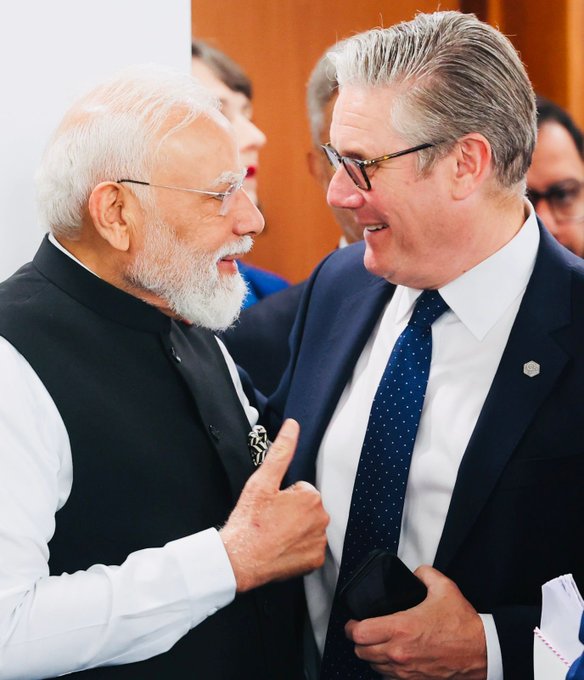
EVIAN : Prime Minister Shri Narendra Modi has welcomed the coming into force of the India-UK Comprehensive Economic and Trade Agreement (CETA) on 15 July 2026, describing it as a historic milestone in bilateral relations between the two countries.
The Prime Minister stated that the landmark agreement will significantly strengthen trade and investment ties between India and the United Kingdom while creating new opportunities across key sectors of the economy.
According to Shri Modi, the agreement is expected to deliver substantial benefits to Indian farmers, workers, micro, small and medium enterprises (MSMEs), startups, and innovators, while contributing meaningfully towards the vision of Viksit Bharat 2047.
Highlighting the importance of the agreement, the Prime Minister noted that both he and UK Prime Minister Keir Starmer, who are currently in Evian for the G7 Summit, are pleased with the strong momentum being generated in India-UK economic relations.
In a post on X, Prime Minister Modi said:
“A historic milestone for India-UK relations.
Delighted to note that the India-UK Comprehensive Economic and Trade Agreement will enter into force on 15th July 2026.
This agreement will significantly boost our bilateral trade and investment.
It will also unlock numerous opportunities for Indian farmers, workers, MSMEs, startups and innovators and contribute meaningfully to the realisation of Viksit Bharat 2047.
Both PM Starmer and I, who are in Evian for the G7 Summit, are naturally very happy with the significant momentum being added to our economic ties.”
The implementation of the agreement is expected to deepen economic cooperation, facilitate market access, enhance supply chain integration, and further strengthen the strategic partnership between India and the United Kingdom.
The India-UK CETA represents a significant step forward in expanding bilateral engagement and underscores the shared commitment of both nations to fostering inclusive growth, innovation, and long-term economic prosperity.
A Next-Generation Trade Framework
Comprising 30 chapters, CETA establishes a new paradigm for next-generation trade pacts, directly supporting India’s “Viksit Bharat 2047” vision. Beyond traditional tariff-cutting, the agreement modernizes bilateral engagement by integrating traditional goods and services with advanced disciplines like digital trade, telecommunications, financial services, intellectual property, and—for the first time bilaterally—government procurement. It also embeds forward-looking chapters on innovation, SMEs, sustainability, and transparency to ensure inclusive growth. Ultimately, this framework is engineered to secure critical supply chains, accelerate technological collaboration, and establish a transparent, rules-based benchmark for India’s future economic diplomacy.
Key Economic Gains
The operationalization of the Comprehensive Economic Trade Agreement (CETA) and the simultaneous Double Contribution Convention (DCC) will mark a structural transformation in India’s global trade architecture. This comprehensive framework leverages India’s manufacturing prowess, service capabilities, and grassroots production directly into one of the world’s premier consumer arenas.
- Transformational Market Access for Indian Exports
With the entry into force, Indian exporters will benefit from the complete elimination of UK tariffs across several key sectors. Tariffs of up to 70% on processed food products, up to 21.5% on marine products, up to 18% on engineering goods and auto components, up to 16% on leather and footwear products, up to 12% on textiles and clothing, and up to 8% on chemicals and pharmaceutical products will be reduced to zero. The immediate duty-free access secured under CETA is expected to significantly enhance the competitiveness of Indian exports in the UK market, generate new opportunities for farmers, fishermen, workers, MSMEs and manufacturers, and strengthen India’s integration into global value chains.
This immediate duty-free window injects immense pricing power into the engine rooms of Indian manufacturing, allowing traditional artisans, large-scale factories, and regional industrial hubs to compete entirely on merit from day one of implementation.
At the same time, India has protected sensitive sectors including dairy products, cereals, millets, edible oils, oilseeds, apples and several vegetable products.
- Landmark Services Package and Mobility Provisions
The UK has provided one of its most comprehensive services commitments ever, covering all major services sectors and 137 sub-sectors of export interest to India.
Indian service providers in IT and IT-enabled services, financial services, professional services, healthcare, education, engineering, telecommunications and consultancy services will benefit from enhanced market access and greater regulatory certainty.
The Agreement also provides predictable mobility pathways for:
• Business Visitors
• Intra-Corporate Transferees
• Contractual Service Suppliers
• Independent Professionals
• Investors
In a first-of-its-kind arrangement, 1,800 Indian chefs, yoga instructors and classical musicians will be able to access dedicated mobility opportunities annually under the Agreement.
- Agreement on Social Security: A Major Breakthrough
The Agreement on Social Security, entering into force alongside the Agreement, exempts Indian workers and employers from making dual social security contributions in the United Kingdom during temporary assignments. The period of exemption has been increased from 3 years to 5 years.
More than 75,000 Indian professionals and over 900 companies are expected to benefit. The Agreement will support mobility and continued social security coverage of the employees on temporary overseas assignments. This will enhance India-UK partnerships in the service sector, leveraging the high skills and innovative service sectors of both countries.
- Interests of Steel Exporters Protected
Demonstrating the collaborative strength of the India-UK Comprehensive Economic Partnership Agreement (CETA), India and the United Kingdom have successfully reached a landmark consensus to safeguard and promote bilateral steel trade. Following constructive deliberations regarding the UK’s upcoming steel measures effective July 1, 2026, both sides mutually agreed to protect commercial interests, minimize market disruptions, and ensure an overall balanced and stable trading environment for exporters.
85% of India’s exports are out of the Steel measures. On the lines under the Steel measures India’s interest has been protected through a mix of CSQ, residual quota and access under Authorised Use Scheme (AUS).
A People-Centric Trade Agreement
The India–UK CETA has been designed as a people-centric agreement that delivers benefits across society.
Farmers gain access to premium export markets. Fisherfolk benefit from enhanced seafood exports. Workers gain new employment opportunities in labour-intensive sectors. Women entrepreneurs, youth, startups and MSMEs receive improved access to global value chains. Professionals benefit from enhanced mobility and recognition opportunities
The implementation of the India–UK CETA and DCC from 15th July 2026 marks a major step in India’s journey towards becoming a globally integrated, resilient and competitive economy and reflects the shared commitment of India and the United Kingdom to deepen their strategic partnership and deliver prosperity for their people.
This historic economic architecture effectively prepares both nations to navigate the complexities of modern international commerce while permanently accelerating India’s trajectory toward an inclusive, prosperous, and self-reliant “Viksit Bharat 2047.