



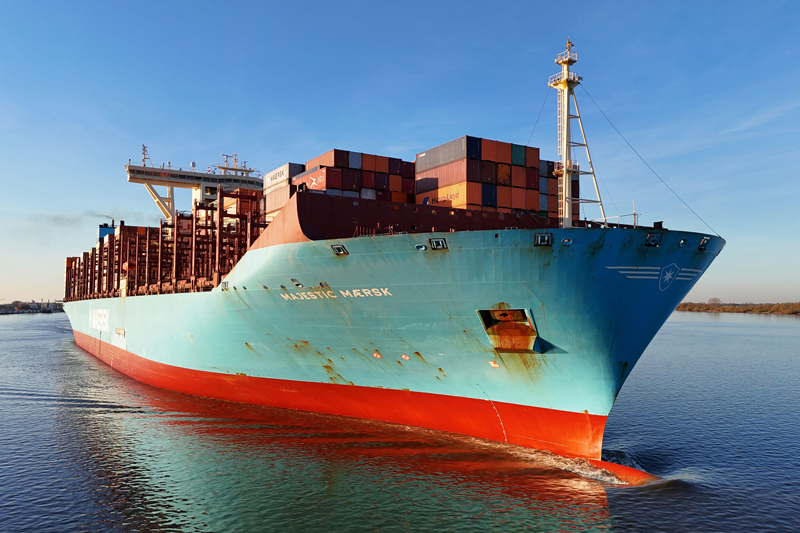
COPENHAGEN : Maersk completed the first headhaul Red Sea transit under its Gemini Cooperation with Hapag-Lloyd this week, marking a milestone 30 months in the making — and then watched it be overshadowed within days by the worst Strait of Hormuz escalation since the Iran-US war began. As of Sunday, no cargo vessel above 10,000 deadweight tonnes has crossed the Hormuz Southern Highway with its Automatic Identification System switched on since July 7. The question for importers, freight buyers, and supply chain planners is not whether Maersk’s Suez return happened, but whether a maritime corridor that cannot be tracked can ever be commercially viable enough to matter.
Maersk Made the Transit. Two Corridors Still Do Not Work.
The approximately 19,000-TEU Majestic Maersk — a Danish-flagged vessel operating under Maersk’s Gemini Cooperation network with Hapag-Lloyd — completed a successful transit through the Bab al-Mandeb strait and the Suez Canal in the days following Maersk and Hapag-Lloyd’s July 6 announcement that their AE15 service would shift back from Cape of Good Hope routing to the trans-Suez corridor.
The AE15 service connects Asia, the Mediterranean, and Turkey. The new port rotation runs: Qingdao – Kwangyang – Ningbo – Tanjung Pelepas – Port Said – Damietta – Colombo – Singapore. The Majestic Maersk’s successful passage was confirmed as a positive indicator when Maersk announced a second expansion three days later — restoring its MECL service, linking the Middle East and India with the US East Coast, to the trans-Suez route as well. That move will cut westbound transit times by about seven days and eastbound sailings by up to fourteen days compared with Cape of Good Hope routing.
“This joint decision with Hapag-Lloyd comes following thorough assessments of the security situation in the Red Sea area, and marks a step towards a gradual return to the trans-Suez corridor,” Maersk said in its July 6 advisory. The company added that it has no specific timeline for wider Gemini network changes and is “not at a point where we are considering a wider East-West network change back to the trans-Suez corridor.”
The Suez Canal Authority has noted that Maersk alone completed 1,158 transits through the waterway in 2023, carrying 127 million tonnes of cargo — a figure that collapsed under the weight of rerouting decisions when Houthi attacks on Red Sea shipping began in November 2023. While CMA CGM had been the primary large carrier to maintain Suez routes during 2026, Maersk’s structural commitment was widely expected to pull other major operators back to the corridor.
Senior consultant Antonella Teodoro of MDS Transmodal told Seatrade Maritime News that the announcement “marks an important step towards the gradual normalization of global liner networks,” but cautioned that a complete return to pre-crisis operating patterns is unlikely in the near term. Jyske Bank analyst Haider Anjum offered a more optimistic read, writing in a note to clients that the move represents the first step toward a full Red Sea return by year-end, and that a complete corridor restoration — combined with an expected surge in vessel deliveries in 2027 and 2028 — could put substantial downward pressure on freight rates.
AIS Dark: What the Shipping Data Is Not Telling You
Understanding the Hormuz situation requires understanding what Automatic Identification System data can and cannot capture — a gap that matters both commercially and militarily.
AIS is the VHF radio transponder system that all vessels above 300 gross tonnes are legally required to operate continuously under the International Maritime Organization’s SOLAS Convention. Transponders broadcast a ship’s identity, position, course, and speed at regular intervals, unencrypted and publicly receivable. The system was designed for collision avoidance and port traffic management. It was never designed for a conflict in which one party — Iran’s Islamic Revolutionary Guard Corps — has declared that any vessel transiting via an “unauthorized route” may be attacked, and in which vessel captains must choose between maritime safety law (AIS on) and physical security (AIS off).
Lloyd’s List Intelligence confirmed that no vessels above 10,000 deadweight tonnes transited the so-called Southern Highway — the US-coordinated Hormuz route established by the Joint Maritime Information Center — with their AIS active since July 7. At least two ships are believed to have crossed dark in that period, meaning actual transit activity may slightly exceed what satellite tracking recorded — but the structural point holds: the commercial corridor is functionally shut.
The IMF PortWatch data recorded just 34 vessel transits of the Hormuz corridor on July 5 against a pre-crisis baseline of approximately 88 per day. That is 39 percent of normal throughput — and that reading predates the July 6-12 escalation that followed.
The AIS-dark phenomenon exposes a structural paradox of the Southern Highway routing architecture. The US-coordinated route requires AIS-on transit to be tracked and protected. Iran has declared that using the route without IRGC authorization makes a vessel a legitimate target. Vessels that turn on their AIS to signal compliance with the Southern Highway protocol simultaneously identify themselves as targets under the IRGC’s own enforcement logic. This is not a navigational risk — it is a system design conflict between two incompatible frameworks governing the same geographic chokepoint.
US Maritime Advisory 2026-006, issued by the US Department of Transportation’s Maritime Administration, explicitly advised US-flagged vessels to disable their AIS transponders in the Red Sea and Gulf of Oman when captains believe “continual operation of AIS might compromise the safety or security of their ship.” SOLAS Chapter V and IMO Resolution A.29/Res.1106 both permit this. The result is a maritime corridor where the standard transparency infrastructure is being deliberately turned off by both parties — vessels to avoid targeting, Iran to conduct enforcement — and where the internationally visible transit count is a floor on actual activity, not a ceiling.
Insurance, Not Guns, Is the Real Barrier
The June 17, 2026 Memorandum of Understanding between Washington and Tehran created a ceasefire framework that oil markets recognized immediately — Brent crude fell sharply after the signing, and daily Hormuz transits recovered from fewer than 10 in early March to approximately 35 by late June. But those numbers had already collapsed back toward crisis lows by July 5, before the current escalation, and the July 6-12 attacks have almost certainly repriced the war risk insurance market again.
The mechanism that explains why ceasefire announcements do not automatically reopen commercial shipping is not military — it is actuarial. War risk insurance for maritime operations is underwritten separately from standard hull and P&I coverage. When the Joint War Committee — the Lloyd’s of London body that maintains a “Listed Areas” classification of high-risk maritime zones — reclassifies a corridor as a war-risk area, existing ship insurance policies contain automatic seven-day cancellation provisions. After that window, cover lapses unless shipowners individually negotiate new terms at whatever premium the underwriting market will accept.
All 12 members of the International Group of P&I Clubs — mutual insurers that collectively cover approximately 90 percent of the world’s ocean-going tonnage — issued 72-hour cancellation notices for war cover in the Gulf within days of the February 28 strikes on Iran. Most reinstated cover at revised premiums. At the crisis peak, additional war risk premiums reached 4.5 to 6 percent of hull value, according to S&P Global Market Intelligence — compared with approximately 0.25 percent before February 28. For a $150 million tanker, that difference represents a single-transit insurance bill rising from roughly $375,000 to as much as $9 million.
The June ceasefire brought premiums down to around 3 to 4 percent of hull value, according to Marsh’s global head of marine, Marcus Baker. Insurance was available — the Lloyd’s Market Association issued a statement in March emphasizing that cover remained on offer and that safety concerns, not insurance availability, were the primary reason ships were not moving. But availability at 12 times pre-crisis cost is a very different commercial proposition from availability at standard rates. And every IRGC attack since the MoU signing — including the drone strike on the Kiku tanker June 27, the missile attacks on two ships July 7, and the Cyprus-flagged container ship attack July 11 — has reset the underwriting risk assessment, because insurance capacity withdrawn at the treaty level must be rebuilt through individual underwriting decisions, not political announcements.
The AXSMarine data compiled for the WTO’s Strait of Hormuz Trade Tracker confirmed that LNG shipments through the strait have shown no meaningful AIS-traceable activity since the MoU was signed — a stark illustration of the gap between ceasefire text and commercial reality.
July’s Escalation in Full
The events of July 6-12 represent the most intense exchange since the ceasefire period began.
On July 5, a cargo vessel reported being attacked by an unidentified armed skiff approximately 30 nautical miles southwest of Hodeidah, Yemen. Security guards returned fire; the attackers retreated to a larger vessel operating with AIS switched off. The same day, Kpler data showed Hormuz daily transits at 31 — already near crisis lows. Also on July 5, Houthi forces sank a vessel after attacking a cargo ship in the Red Sea.
On July 6, the Houthis attacked the Liberian-flagged bulk carrier Magic Seas southwest of Hodeidah, surrounding the vessel with skiffs and rocket-propelled grenades, then deploying unmanned surface vessels. The crew abandoned ship and was rescued by a passing vessel. Magic Seas was subsequently sunk using planted explosives — a tactic that represents an escalation in Houthi maritime attack methods, according to Crisis24.
On the same day, Maersk and Hapag-Lloyd announced the AE15 resumption.
On July 7, Iran’s IRGC fired missiles at at least two commercial ships transiting the Strait of Hormuz. A liquefied natural gas tanker caught fire off the Omani coast after being struck by a projectile. A Saudi-flagged crude tanker was also damaged in a separate IRGC missile engagement. From that date, Lloyd’s List Intelligence recorded no large vessels transiting the Southern Highway with AIS active.
On July 8, President Trump declared the ceasefire with Iran “over” following the ship attacks, according to Bloomberg.
On July 9, Maersk announced the MECL service expansion — citing the Majestic Maersk’s recently-completed Red Sea transit as a positive indicator. The Drewry World Container Index stood at $4,639 per 40-foot container, up 2 percent week-on-week and the highest reading since September 2024.
On July 11, the IRGC attacked a Cyprus-flagged container ship transiting the strait. One crew member was reported missing. US Central Command launched its third round of strikes in a single week, hitting more than 140 Iranian military targets including missile and drone sites, naval capabilities, ammunition storage, and coastal surveillance installations, according to the CENTCOM statement. Iran launched retaliatory strikes on US military assets in Bahrain, Kuwait, Qatar, Jordan, and Iraq.
As of Sunday, Iran’s Foreign Minister Abbas Araghchi was in Oman for Hormuz security talks. A source told CNN that Oman had drafted a tentative proposal to manage traffic in the strait. US officials stated that peace talks cannot progress until ships are assured safe passage.
Source : Tech Times