


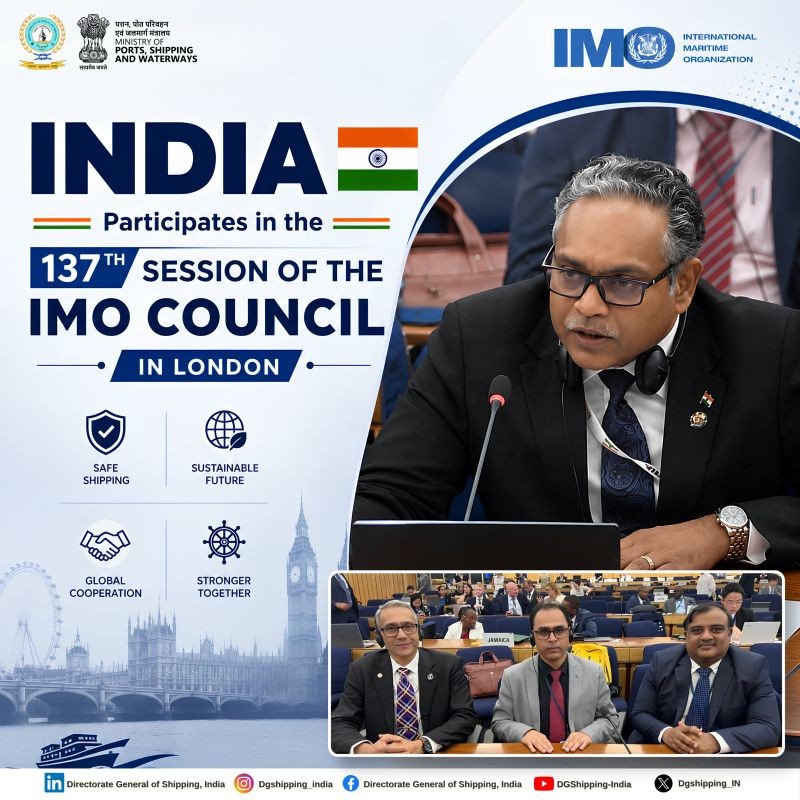
LONDON : India reaffirmed its commitment to global maritime governance, seafarer welfare and sustainable shipping during the 137th Session of the International Maritime Organization (IMO) Council, held in London from 6–10 July 2026. The Indian delegation, led by Shri Shyam Jagannathan, IAS, Director General of Maritime Administration, and Shri Ash Mohomad, Deputy Director General of Maritime Administration, along with representatives from the Indian maritime industry, actively participated in deliberations and held a series of high-level bilateral engagements.
Throughout the four-day session, India made substantive interventions on key policy issues, advocated reforms to strengthen international maritime governance, and highlighted its ongoing efforts to improve seafarer welfare through digital transformation and international cooperation.
India Calls for Consensus-Based IMO Reforms
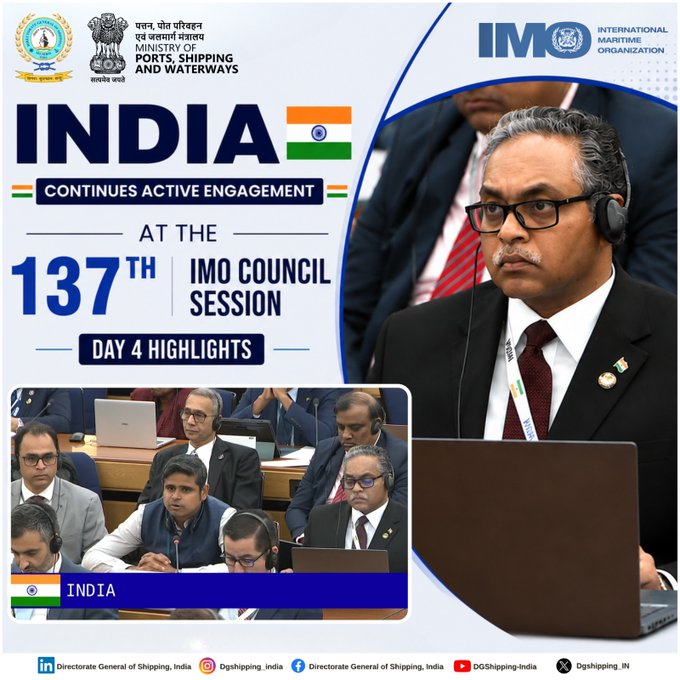
On the opening day, India participated in discussions on proposed amendments to the IMO Rules of Procedure, advocating greater clarity, accessibility and consistency while stressing that any reforms should preserve the consensus-driven and technical nature of the Organization.
India also raised concerns regarding the interpretation of Effective Implementation (EI) percentages and the limited public disclosure of IMO Member State Audit Scheme (IMSAS) outcomes. The delegation emphasized that audit indicators should be accompanied by appropriate contextual information and should not lead to unintended comparisons or rankings among Member States. India reiterated that the Audit Scheme must continue to serve its developmental and cooperative objectives.
Strong Focus on Seafarer Welfare
India reiterated its commitment to safeguarding the rights and welfare of seafarers by calling for enhanced international cooperation, timely repatriation, robust financial security mechanisms and effective implementation of the Maritime Labour Convention (MLC).
The delegation highlighted several institutional initiatives undertaken by the Directorate General of Maritime Administration (DGMA), including the launch of the 24×7 e-Navik Seafarer Assistance Portal and an integrated crisis response mechanism to provide timely support, coordination and grievance redressal for Indian seafarers worldwide.
Meeting with IMO Secretary-General
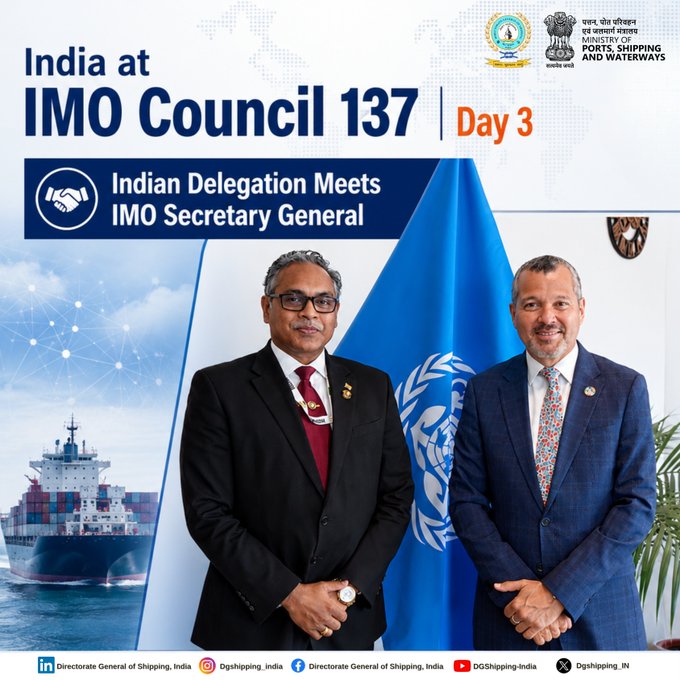
A key highlight of the session was the meeting between the Indian delegation and IMO Secretary-General H.E. Arsenio Dominguez. During the discussions, India raised critical issues affecting Indian seafarers and the country’s maritime interests, including the criminalisation of the Master of MV Smyrtos, the significant reduction in seafarer abandonment cases, sponsorship of the C.P. Srivastava Chair at the World Maritime University (WMU), and India’s continued efforts relating to maritime security in the Strait of Hormuz.
The Secretary-General expressed condolences over the loss of Indian seafarers in recent regional conflicts and assured the IMO’s support wherever feasible. India also extended an invitation to the Secretary-General to participate in INMARCO 2026 in Mumbai, which was graciously acknowledged.
The discussions further covered the proposal for posting a Deputy Director General-rank technical representative from DGMA at the IMO, sponsorship of Senior and Junior Professional Officers, strengthening India’s engagement with the World Maritime University, and collaborative efforts with the India Maritime Centre, London, to address seafarer abandonment and improve global awareness of these issues.
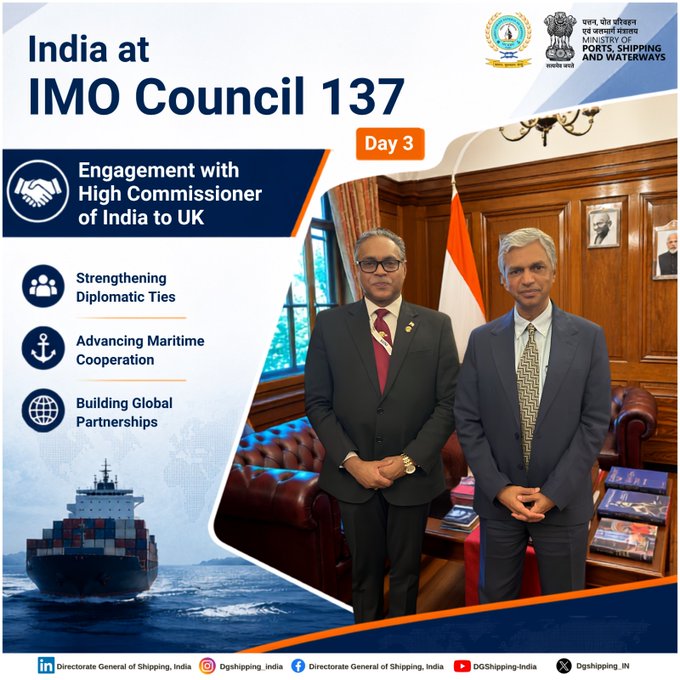
Engagement with the Indian High Commission
The delegation also met the High Commissioner of India to the United Kingdom, discussing matters relating to Indian seafarers overseas, maritime diplomacy and strategies to further enhance India’s global maritime profile.
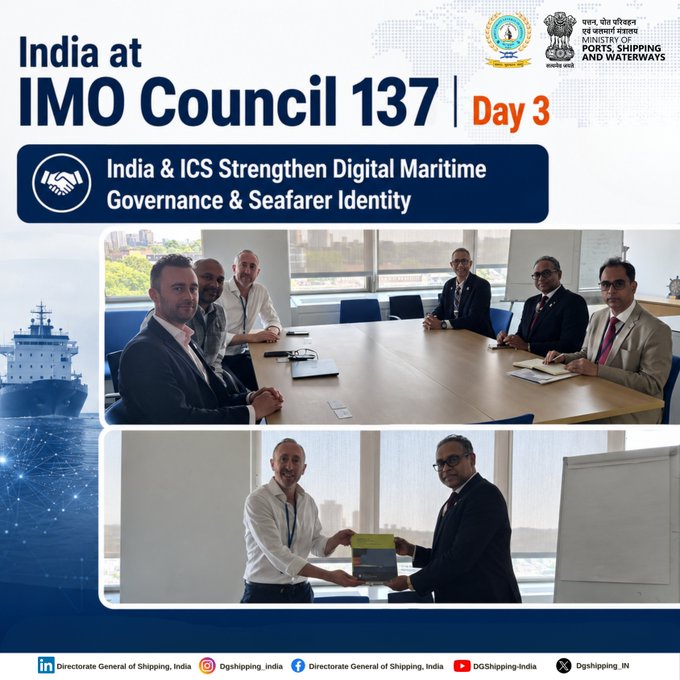
Digital Maritime Governance with ICS
India held productive discussions with the International Chamber of Shipping (ICS) on strengthening digital maritime governance and advancing global standards for seafarer welfare.
The meeting focused on the International Seafarers Validation Platform and finalisation of a Memorandum of Understanding to ensure compliance with digital data protection requirements for Maritime Labour Convention inspections under Port State Control and Flag State regimes.
The delegation showcased India’s comprehensive e-governance initiatives, including upgraded Recruitment and Placement Services Licence (RPSL) and Maritime Training Institute (MTI) modules, strengthened measures against fraudulent crewing practices, and complete digitalisation of Certificates of Competency, reinforcing the credibility and global recognition of Indian seafarers.
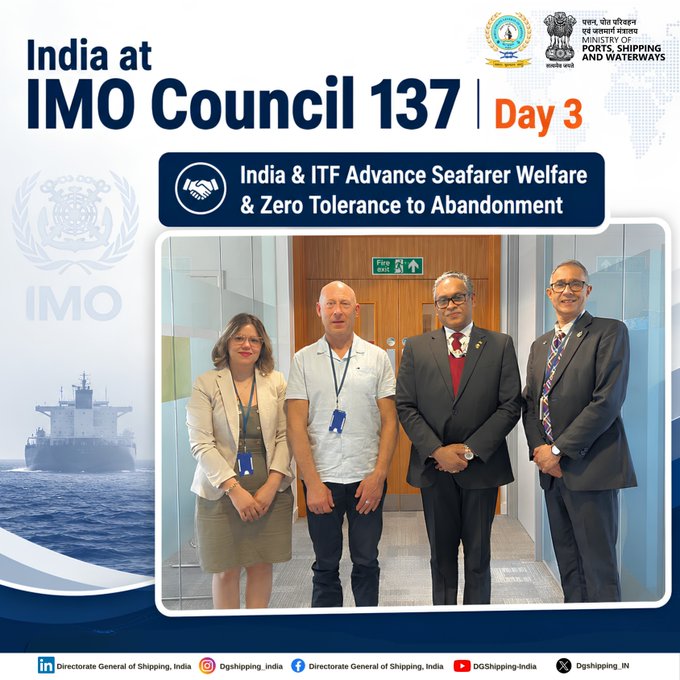
Constructive Dialogue with ITF
India also met representatives of the International Transport Workers’ Federation (ITF) to review progress on seafarer welfare and abandonment cases.
The delegation highlighted the reduction in abandonment cases to 56 vessels involving 449 seafarers, supported by institutional initiatives such as the 24×7 grievance redressal helpline, ITF-MILAAP coordination mechanism, welfare assistance to families of affected seafarers and a zero-tolerance approach towards corrupt crewing practices.
Both sides also discussed concerns relating to diluted Certificate of Competency standards issued by certain flag administrations and the criminalisation of seafarers. India invited the ITF to undertake an independent evaluation of the Indian Flag Administration.
India’s Intervention on the West Asia Situation
During discussions on developments in West Asia, India welcomed the understanding reached among concerned parties aimed at ending the conflict and expressed hope that peace efforts would continue despite recent tensions.
The delegation underscored the severe impact of the conflict on global maritime trade, including disruptions to shipping, economic losses and the tragic loss of seafarers’ lives. India stressed the importance of restoring peace and stability to ensure safe, secure and uninterrupted navigation through the Strait of Hormuz.
Reaffirming its longstanding position, India called for all disputes to be resolved through dialogue and diplomacy while conveying its deepest sympathies to the families of seafarers who lost their lives during the conflict.
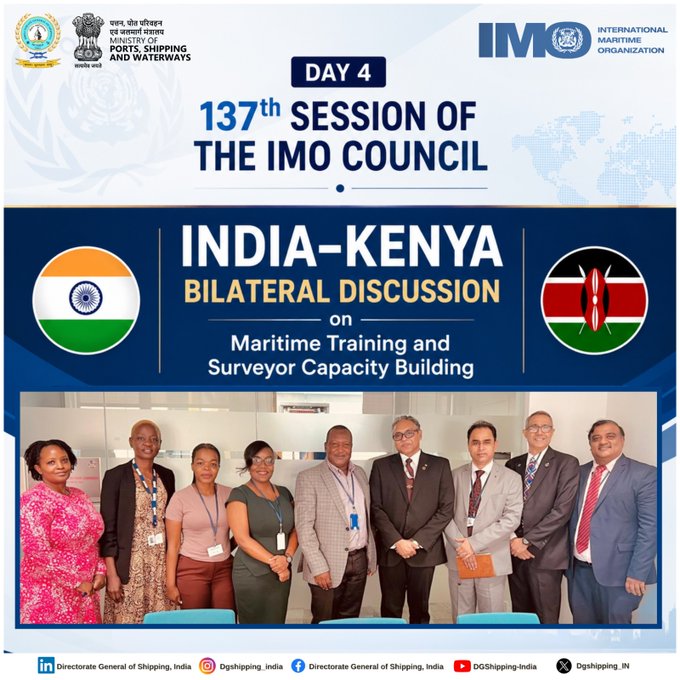
Bilateral Cooperation with Kenya
On the sidelines of the Council session, India held bilateral discussions with the Kenyan delegation to explore enhanced cooperation in maritime education, training and capacity building.
The talks covered training support for Kenyan surveyors, opportunities for Indian maritime professionals in Kenya and broader collaboration aimed at strengthening maritime skills, institutional capacity and technical cooperation between the two countries.
Reinforcing India’s Maritime Vision
India’s active participation at the 137th IMO Council Session reflected its growing role in shaping international maritime policy and promoting collaborative solutions to global maritime challenges. Through constructive interventions, digital governance initiatives and sustained focus on seafarer welfare, India reaffirmed its commitment to advancing safe, secure, sustainable and efficient international shipping while strengthening its leadership within the global maritime community.