Gridlock on the Bonny Channel: Inside the Maersk grounding that disrupted Nigeria’s Maritime Gateway
By Priyatham Sanjeeva Reddy Ramidi
In the early hours of May 20, 2026, a routine maritime operation in southern Nigeria spiraled into one of the region’s most disruptive shipping incidents in recent memory. A collision involving the Singapore-flagged container vessel MV Maersk Valparaiso and the Nigerian-flagged oil tanker MT Lady Martina triggered a chain of events that temporarily crippled vessel movement along the Bonny Channel, one of Nigeria’s most strategically important waterways.
The accident did more than halt ships. It exposed the fragile balance between commercial shipping, oil logistics, and navigational safety in the Gulf of Guinea — a maritime corridor that handles enormous volumes of cargo tied to Nigeria’s energy sector and international trade.
As salvage teams, maritime regulators, and port authorities rushed to respond, the grounding quickly became a story about far more than two vessels colliding at anchor.
A Critical Maritime Artery
The Bonny Channel serves as the gateway to Onne Port and the wider Port Harcourt maritime complex in Rivers State. The waterway is essential to Nigeria’s offshore oil and gas economy, supporting containerized trade, energy supply operations, industrial imports, and petroleum transportation.
Onne Port in particular has become one of West Africa’s most important logistics hubs for the oil and gas industry. Major international shipping companies use the port to service offshore energy installations and move cargo throughout the region.
Because of its importance, even a short interruption in vessel movement can have immediate commercial consequences.
When the channel became obstructed following the collision, incoming ships were forced to wait at anchorage while outbound vessels remained trapped inside the port area. Shipping schedules were disrupted almost instantly.
For logistics operators, time at sea is money. Every hour lost affects fuel consumption, berthing windows, cargo coordination, and contractual obligations. In a region already dealing with infrastructure pressure and fluctuating global shipping conditions, the incident created significant operational anxiety.
What Happened
According to Nigerian maritime authorities and multiple reports from the port community, the incident occurred near the Bonny Inner Anchorage at approximately 11:30 a.m. local time.
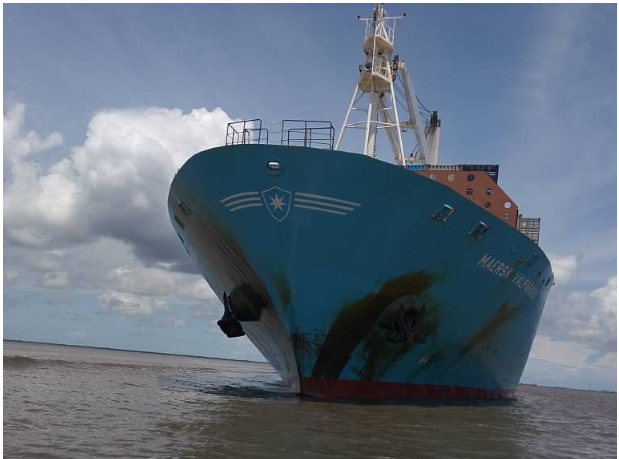
The Maersk Valparaiso, a container vessel carrying an estimated 717 containers, was maneuvering within the channel when it came into contact with the Lady Martina, a smaller Nigerian oil products tanker.
The exact sequence of navigational decisions that led to the impact remains under investigation, but early reports from local maritime sources suggested the vessels may have encountered positioning complications while transiting or maneuvering in restricted waters.
After the collision, conditions rapidly deteriorated.
The Lady Martina reportedly drifted and eventually grounded along the Bonny Channel. The Maersk Valparaiso also became stuck after veering into shallow mud within the channel area. The result was effectively a maritime bottleneck across a critical access route.
The situation immediately drew emergency attention from the Nigerian Maritime Administration and Safety Agency (NIMASA), which activated response teams through its Deep Blue maritime security infrastructure.
Authorities dispatched personnel and interceptor boats to the site to secure the area and assist the affected crews.
Injuries and Environmental Concerns
Five crew members aboard the Lady Martina sustained injuries during the collision and were evacuated for medical treatment.
While no fatalities were reported, the accident also triggered environmental concerns after authorities confirmed an oil spill in the surrounding waters.
Oil contamination in the Niger Delta region is an especially sensitive issue. Communities throughout the region have dealt with decades of environmental degradation linked to petroleum extraction, pipeline leaks, and marine pollution.
Even relatively small spills attract intense scrutiny because of their potential impact on fisheries, mangrove ecosystems, and coastal livelihoods.
In the hours following the incident, containment and monitoring efforts became a major priority. Maritime authorities began assessing the scale of the spill while simultaneously coordinating salvage and channel recovery operations.
The balancing act was delicate.
Officials needed to reopen one of the country’s busiest maritime corridors as quickly as possible, but moving grounded vessels too aggressively could worsen hull damage or increase environmental contamination.
Why the Incident Matters
At first glance, the grounding may appear to be a localized maritime accident. In reality, the implications stretch far beyond a single collision.
Nigeria depends heavily on maritime trade. The majority of the country’s imports and exports move through seaports, while offshore oil production remains deeply tied to marine logistics.
Any disruption inside the Bonny Channel affects:
- Offshore oil servicing operations
- Containerized cargo movement
- Industrial supply chains
- Fuel distribution logistics
- Regional trade schedules
- Port revenue generation
For international shipping companies, delays in Nigeria can also create broader network disruptions.
Modern container shipping operates on tightly managed schedules where delays at one port can ripple across multiple continents. Vessel rotations, cargo transshipment windows, trucking coordination, and inland distribution systems all depend on predictability.
The grounding therefore became more than a local navigation problem. It evolved into a test of Nigeria’s maritime emergency response capability.
Questions About Navigation and Infrastructure
As investigators began examining the incident, maritime observers quickly raised familiar concerns about navigational safety within congested African port approaches.
Channels like Bonny are challenging environments.
Large container vessels must navigate relatively narrow waterways while accounting for tides, traffic density, under-keel clearance, and local weather conditions. Restricted maneuvering space increases the risk of grounding or collision, particularly when multiple commercial vessels are operating simultaneously.
In many emerging maritime markets, port infrastructure expansion has struggled to keep pace with the increasing size of global commercial vessels.
Modern container ships are larger, heavier, and deeper drafted than many of the ships waterways were originally designed to accommodate.
This reality creates mounting pressure on:
- Channel dredging programs
- Vessel traffic management systems
- Pilotage operations
- Tugboat availability
- Maritime communication protocols
Industry experts are likely to examine whether infrastructure constraints, vessel coordination issues, or human error contributed to the Bonny collision.
The investigation may also renew debate about how Nigeria modernizes and safeguards its maritime gateways as trade volumes continue to rise.
Salvage Operations and Recovery Efforts
Following the accident, efforts shifted toward stabilizing the vessels and reopening the channel.
Salvage operations in restricted waterways are notoriously complicated. Teams must account for vessel stability, hull integrity, tides, underwater obstructions, and environmental risk.
The Maersk Valparaiso, built in 2010 and operating under the Singapore flag, represented a particularly difficult challenge because of its size and cargo load.
Authorities worked to evaluate whether the vessel had sustained structural damage while also determining the safest strategy for refloating it.
Meanwhile, congestion at anchorage areas continued to build as ships waited for clearance.
Shipping agents, freight operators, and energy contractors closely monitored updates from the port community, aware that prolonged closure could create substantial financial losses.
Reports emerging a day later suggested that the containership had eventually been refloated and moved toward anchorage for inspection.
That development eased immediate fears of a long-term shutdown, but the broader impact on scheduling and operations continued beyond the initial recovery.
Nigeria’s Maritime Ambitions Under Pressure
The timing of the incident is particularly significant.
Nigeria has spent years attempting to position itself as a stronger maritime and logistics hub for West Africa. Investments in port modernization, security initiatives, and shipping reforms are intended to attract greater commercial confidence and reduce dependency on foreign transshipment hubs.
Programs such as NIMASA’s Deep Blue Project were designed to improve maritime security, emergency response, and operational oversight in Nigerian waters.
In some respects, the rapid deployment following the collision demonstrated improved institutional coordination compared to previous years.
However, the grounding also highlighted the immense pressure facing the country’s maritime system.
As vessel traffic increases and shipping lines deploy larger ships into West African trade lanes, the margin for navigational error becomes smaller.
Accidents involving container ships, oil tankers, and offshore support vessels carry enormous economic and environmental risks.
For Nigeria, maintaining safe and efficient access to ports like Onne is not simply a transportation issue. It is directly tied to national revenue, industrial growth, and international investor confidence.
The Bigger Picture for Global Shipping
The Bonny Channel collision arrives during a period of heightened sensitivity across the global shipping industry.
Recent years have seen a series of high-profile maritime disruptions worldwide — from canal blockages and port congestion to vessel collisions and weather-related supply chain interruptions.
The lesson repeated across each incident is clear: modern global trade is deeply vulnerable to chokepoint disruptions.
A single grounded vessel in the wrong location can trigger delays that spread across international supply networks.
While the Bonny grounding did not reach the scale of incidents like the Suez Canal blockage, it reinforced how regional waterways remain essential pressure points within the global maritime economy.
For shipping companies operating in West Africa, the incident will likely encourage renewed focus on navigational planning, local pilot coordination, and risk management procedures.
It may also intensify conversations about investment in African maritime infrastructure as trade volumes continue growing.
An Investigation Still Unfolding
At the center of the story remains an unanswered question: what exactly caused the collision?
Investigators will likely examine vessel movement data, communication logs, navigational procedures, weather conditions, and pilot coordination records.
Determining liability could involve multiple parties, including ship operators, local navigation authorities, insurers, and maritime service providers.
For now, the Bonny grounding stands as a vivid reminder of how quickly maritime operations can unravel inside crowded commercial waterways.
What began as a navigational incident evolved into a multi-layered crisis involving environmental risk, port disruption, economic pressure, and national maritime credibility.
Although vessel traffic has begun recovering, the aftereffects of the accident are expected to linger through ongoing investigations, insurance assessments, and operational reviews.
In the shipping industry, incidents are often measured not only by immediate damage, but by the lessons they force the industry to confront.
The collision involving the Maersk Valparaiso and Lady Martina may ultimately become one of those moments for Nigeria’s maritime sector — a warning about the growing complexity of modern shipping in increasingly congested waters.
The P&I Insurance Fallout
Beyond the operational and environmental consequences, the Bonny Channel collision is also expected to trigger significant Protection and Indemnity (P&I) insurance activity. P&I clubs, which provide liability coverage for shipowners, will likely become deeply involved in assessing claims related to pollution response, crew injuries, salvage costs, cargo disruption, and potential third-party liabilities arising from the channel blockage.
Given the oil spill and the temporary paralysis of a major commercial waterway, insurers may face a complicated matrix of claims involving vessel operators, charterers, terminal stakeholders, and environmental authorities. Questions surrounding navigational responsibility and fault allocation will play a central role in determining how costs are distributed between the parties involved. Depending on the findings of the investigation, the incident could also influence future underwriting assessments for vessels operating in congested West African waterways, particularly where channel limitations and high traffic density increase operational risk.
In the shipping industry, incidents are often measured not only by immediate damage, but by the lessons they force the industry to confront.
The collision involving the Maersk Valparaiso and Lady Martina may ultimately become one of those moments for Nigeria’s maritime sector — a warning about the growing complexity of modern shipping in increasingly congested waters.
Author:

Mr. Priyatham Sanjeeva Reddy Ramidi
Disclaimer:
Priyatham Sanjeeva Reddy Ramidi is a maritime professional specializing in technical operations and commercial P&I, with recognized experience in the industry. The perspectives and research shared are the result of independent professional analysis and are presented in a personal capacity. They do not reflect or represent the official views of any employer, organization, or affiliated institution.