
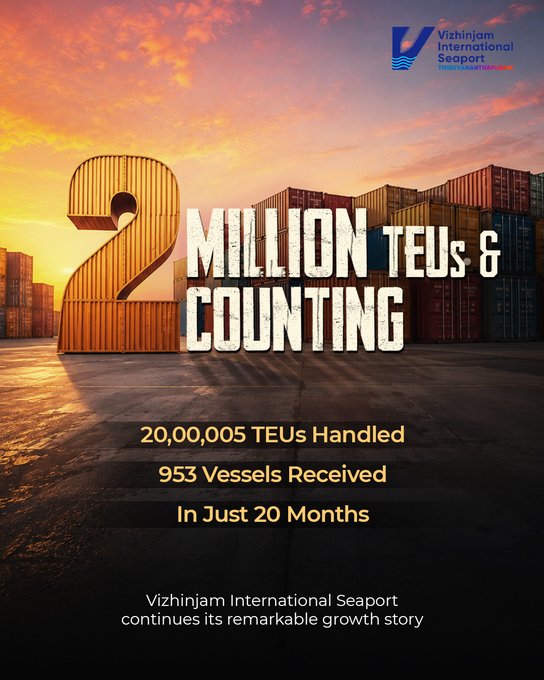
Adani Vizhinjam Port becomes fastest to handle 2 Million TEUs since starting operations
THIRUVANANTHAPURAM : Adani Vizhinjam International Seaport in Kerala has crossed the landmark milestone of handling 2 million twenty-foot equivalent units within just 18 months of commencing operations, becoming the fastest Indian port to achieve the feat.
The port, operated by Adani Ports and Special Economic Zone Ltd for the Government of Kerala, commenced trial operations in July 2024 and was dedicated to the nation by Prime Minister Shri Narendra Modi in May 2025.
Vizhinjam crossed the 1 million TEU mark in August 2025, underlining the rapid operational scale-up achieved within a short span of time.
Since commencing operations, the port has handled over 950 vessels, including 67 Ultra Large Container Vessels, each measuring nearly 400 metres in length.
The port has also berthed some of the world’s most iconic container vessels, including MSC Irina, recognised as the world’s largest container ship, and MSC Verona, among the deepest-draft container vessels to call at an Indian port.
Located just 10 nautical miles from the international east-west shipping route, Vizhinjam offers a significant geographic advantage for global trade movement between Asia, the Middle East, Europe and Africa.
Its natural deep draft of around 20 metres enables large vessels to dock without extensive capital dredging, improving operational efficiency and reducing turnaround time.
The port’s proximity to key global shipping lanes enables shipping lines to save both transit time and fuel costs.
The rapid growth in cargo volumes is expected to play a critical role in reducing India’s reliance on foreign ports across Asia for transhipment cargo.
For decades, a substantial share of India’s transhipment cargo has been routed through overseas hubs.
Phase 2 expansion of the port is currently underway with an investment of approximately Rs 16,000 crore and is expected to be completed by 2028, which will increase capacity from 1 million TEUs to 5.7 million TEUs by 2029.