AP accelerates maritime transformation with 3 new ports, shipbuilding hub and industrial corridors
AMRAVATI : Andhra Pradesh is rapidly emerging as one of India’s most dynamic maritime growth engines, with a series of large-scale port, logistics, and industrial infrastructure projects set to redefine the state’s economic landscape and strengthen its role in global trade.
In a landmark maritime expansion program, the state is developing five greenfield ports with a combined investment of approximately ₹22,833 crore. The initiative represents one of the largest port infrastructure drives currently underway in India and is expected to significantly enhance cargo-handling capabilities along the country’s eastern seaboard.
Among the flagship projects, the ports at Machilipatnam, Ramayapatnam, and Mulapeta are progressing at an accelerated pace and are expected to become operational between December 2026 and March 2027. Upon commissioning, these three ports alone will boost Andhra Pradesh’s cargo-handling capacity by more than 50 percent, increasing it from the present 195 million tonnes per annum (MTPA) to approximately 286 MTPA.
The expansion is expected to improve maritime connectivity, reduce logistics costs for industries, attract export-oriented investments, and create new opportunities across sectors such as manufacturing, mining, agriculture, energy, and containerized trade.
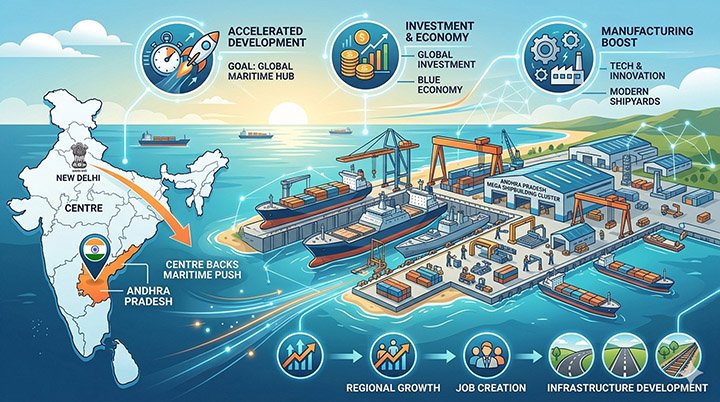
Complementing the port-led growth strategy, Andhra Pradesh is also moving ahead with plans to establish a world-class shipbuilding and maritime manufacturing cluster at Duggarajapatnam through a dedicated Special Purpose Vehicle (SPV). The project, envisaged with an investment potential of nearly ₹29,000 crore and a planned shipbuilding capacity of 1.2 million gross tonnage, is expected to become one of the largest maritime industrial hubs on India’s east coast.
The proposed cluster is designed to support shipbuilding, ship repair, fishing harbours, marine engineering, offshore structures, and ancillary industries, while generating substantial employment opportunities and fostering a robust maritime ecosystem.
A key strength of Andhra Pradesh’s strategy lies in the integration of port infrastructure with broader industrial development initiatives. The ports are being linked with the Visakhapatnam-Chennai Industrial Corridor (VCIC), logistics parks, freight corridors, industrial nodes, manufacturing clusters, and multimodal transportation networks. This integrated approach is expected to ensure seamless cargo movement from production centers to ports, enhancing supply-chain efficiency and global competitiveness.
The maritime infrastructure push is also aligned with major industrial investments planned across the state, including the upcoming ArcelorMittal Nippon Steel India (AM/NS India) integrated steel project and significant investments proposed by JSW Group and other leading industrial players.
With strategic geographic advantages, deep-water port infrastructure, strong industrial linkages, and a forward-looking development agenda, Andhra Pradesh is positioning itself as a premier maritime, logistics, and manufacturing hub that will play a pivotal role in supporting India’s vision of becoming a global trade and industrial powerhouse.
As these projects move closer to completion, the state is set to witness a new era of economic growth driven by modern ports, advanced shipbuilding capabilities, enhanced connectivity, and world-class industrial infrastructure.