
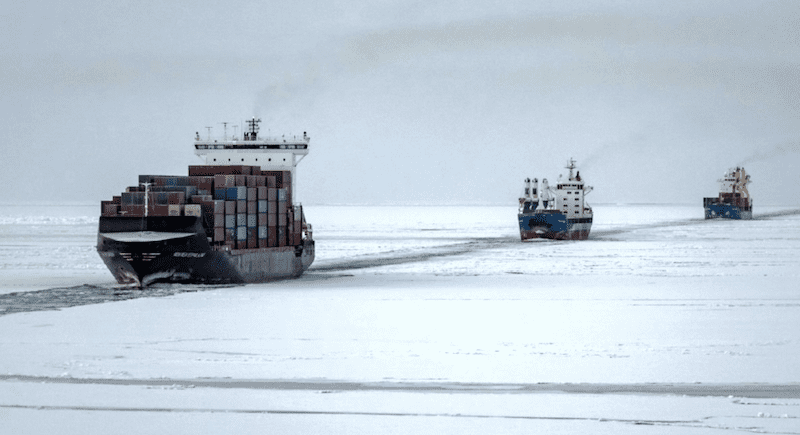
China sets new record on a sea route abandoned by the West : 14 container voyages on the Northern Sea Route in 2025
BEIJING : While Western lines double down on familiar passages through Suez and the Cape of Good Hope, Chinese operators now push deeper into Arctic waters, betting that a shorter, harsher route could one day reshape how goods move between China and Europe.
China’s big Arctic bet moves from trial to strategy
In 2025, Chinese shipping companies completed 14 container voyages between Asia and Europe via the Northern Sea Route (NSR), which runs along Russia’s Arctic coast. They logged 11 such voyages in 2024 and only 7 in 2023. The curve points one way: up.
This is no longer a curiosity driven by a single experimental ship. It looks more like the early stages of a deliberate strategy, with Chinese companies filling a space that Western carriers have largely abandoned for political, environmental and insurance reasons.
Volumes remain tiny compared with the world’s main trade lanes, yet the signal they send about long‑term logistics and geopolitics is hard to ignore.
What makes the Northern Sea Route so attractive?
The NSR cuts across the top of the globe, hugging Russia’s Arctic shoreline. For a Shanghai–Antwerp service, it shaves about 24% off the distance versus the Suez Canal route.
The Arctic route also avoids geopolitical choke points such as the Suez Canal and the Bab el‑Mandeb Strait, both exposed to regional tensions and disruption. That diversification angle increasingly matters to cargo owners bruised by recent Red Sea attacks, canal groundings and climate‑driven low‑water events.
Two Chinese operators at the sharp end
NewNew and Sea Legend push beyond trial runs
The current Arctic push rests mainly on two Chinese carriers: NewNew Shipping Line and Sea Legend. Both have signalled plans to raise their NSR transit count again in 2026. Their priority now: not just adding more voyages, but making schedules reliable enough for big retail and manufacturing clients.
A shorter 2025 season, but more traffic
The 2025 Arctic season started on 16 July with the NewNew Polar Bear sailing from Shanghai to Arkhangelsk in northern Russia. It ended on 30 October, when the Xin Xin Tian 2 completed a Shanghai–Kaliningrad trip.
That window was roughly three weeks shorter than in 2024 because ice formed earlier in the eastern Arctic. Yet container voyages rose from 11 to 14. Operators responded by bunching departures, tightening port calls and leaning more heavily on Russian icebreaker support.