
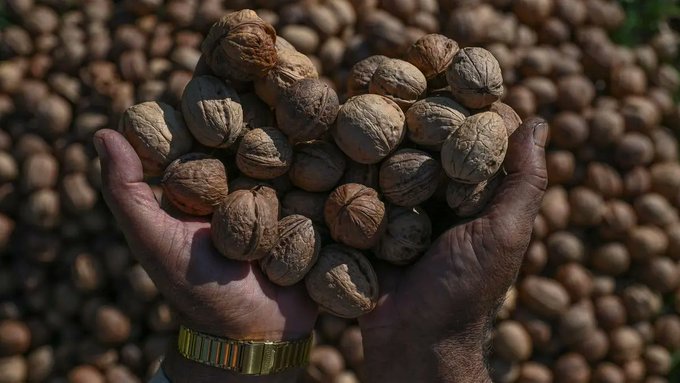
Chinese walnuts in the guise of Afghan in dry fruit container ship detained by Indian Customs at Nhava Sheva Port
MUMBAI : At least 46 containers of the Comoros-flagged vessel, WIV Reyfa, detained by the Customs officials at Nhava Sheva Port, are reported to be carrying walnuts from China, but “misdeclared” as Afghan produce.

The ship, carrying 310 containers and claimed to have originated from Bandar Abbas Port in Iran, has been held up by Customs officials over the past 2-½ weeks. Customs officials had acted on “specific information” on the misdeclaration of origin the Department of Revenue Intelligence (DRI) received on February 2.
A circular issued by the Customs Intelligence Unit (CIU) on February 17 said one person has been arrested in this connection, and investigations have revealed duty evasion to the tune of ₹50 crore. So far, no importer has come forward to identify the consignments.
US, CHILE WALNUTS TOO
“The vessel has been held up because of these 46 containers. Boxes containing walnuts have come from China, and the exporters did not even change the packages with Chinese markings,” said a Mumbaibased trade source, who did not wish to be identified.
“This mis-declaration has been happening for years. Walnuts from the US and Chile have been entering as Afghan produce to claim the zero-duty benefit under the South Asian Free Trade Agreement (SAFTA),” said a North Indian trader.
Walnuts from other origins, such as the US, have better kernel yield. Every kg of domestic walnut-inshell yields 350 gm of kernels. In the case of the US or other countries, the yield is 450-500 gm.
India currently imposes a 100 per cent import duty on walnuts to protect domestic growers, particularly from Kashmir. So, unscrupulous traders bring walnuts from other countries, claiming them to be from Afghanistan.
TRADE RIVALRY
“This time, the Customs acted because a section of traders gave specific information to the o§cials possibly due to business rivalry. It is not just the case with walnuts. It happens with arecanut and black cardamom also,” said the North Indian trader.
The modus operandi is that some traders purchase walnuts imported into one of the Gulf ports. Then, these are shipped to ports such as Bandar Abbas to claim zero-duty status under SAFTA.
“Similarly, arecanut from other growing countries, such as China, land in Colombo before being shipped to India to derive SAFTA benefits,” said the North Indian trader.
A South Indian trader said Chinese garlic was also finding its way into India in the same way. Traders said since the shipment documents are submitted manually, it is easy to “manipulate” the origin of a product.
DOMESTIC PRICES
The CIU circular said to substantiate the false country of origin, traders forge transit documentation (House Bill of Lading) and upload in E-sanchit, ICES (an e-commerce portal of the Indian Customs Department). Thus, a false trail of movement of goods is created from ports such as Bandar Abbas to other ports, particularly in the Gulf, such as Jebel Ali.
On e-commerce websites, Kashmir walnuts in shell cost ₹450 a kg for the jumbo variety and about ₹350 for other varieties, while the Californian and Chilean varieties cost ₹560 and ₹700 respectively.