Compliance complexity is the defining challenge amidst tariff uncertainties, a Maersk Asia Pacific survey shows
Key impacts of tariffs lie in compliance friction across operations, finance and supply
chain design, according to 260 Asia Pacific respondents
Amid tariff volatility, companies in the Asia Pacific (APAC) region are increasingly challenged not only by costs but also by the complexity of managing requirements across operations and supply chain
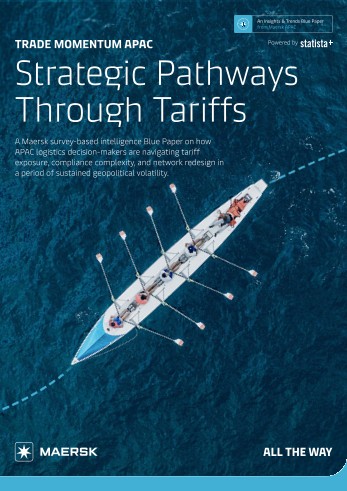
setup. This is one of the key findings from Maersk’s latest Blue Paper, Trade Momentum APAC: Strategic Pathways Through Tariffs, in collaboration with Statista+. The Blue Paper provides a comprehensive analysis based on a survey of 260 senior logistics and supply chain decision-makers in APAC.
Operational challenges lead tariff compliance impacts.
According to the survey, nearly three-quarters (72%) of APAC logistics decisionmakers report being highly or very highly exposed to tariff and duty changes. Automotive (95%), fashion (87%), and retail (84%) face the greatest structural pressure.
The most significant impacts of tariff changes are operational, including documentation (79%), administrative workload (76%) and customs clearance delays (70%). These are followed by increased landed cost (49%) and structuralimpacts, such as shifts in sourcing (32%) and redesign of routing patterns (27%).
Regulatory and documentation complexity is also a major constraint when companies shift to new APAC trade corridors, according to 93% of respondents.
The majority are navigating around tariffs, instead of reducing exposure In response to tariff changes, most respondents (89%) can implement logistics adjustments within four weeks. However, the majority focus on short-term measures rather than structural solutions: 71% pass costs on to customers; fewer pursue corridor optimisation, such as alternative export ports (49%), consolidation point shifts (37%), and intra-APAC hub moves (30%). Structural repositioning, such as reallocating capacity to APAC markets (30%) or shifting sourcing from China to ASEAN (21%), remains limited – even though it is the only
approach capable of reducing tariff exposure.
Five markets have risen significantly in multi-country supply chain configurations over the past 12–24 months: Vietnam (70%), Thailand (54%), Indonesia (48%), Malaysia (48%), and India (45%).
Limited visibility holds back proactive decision-making
Limited visibility across supply chain nodes and partners remains a core operational challenge as companies shift to new corridors or multi-modal routes. Nearly half of respondents (46%) report lacking the monitoring capabilities needed to identify disruptions before they materialise. Although companies face barriers in digital adoption to achieve visibility, a digitised compliance infrastructure is essential for them to fully understand their tariff exposure and take effective action.
AI is widely used for tariffs, but has yet to deliver a full impact
Logistics players are actively leveraging technology to address tariff challenges. AI adoption in tariff-related processes is significant: 74% use AI for tariff forecasting, 26% are testing it, and only 1% do not use it.
AI Operationalising firms, those applying AI across forecasting, routing and trade workflows, report lower compliance burdens and greater structural progress than AI Exploring peers, which use AI in isolated cases. However, higher AI maturity does not, on its own, reduce tariff exposure. Only 47% have connected AI to trade compliance or customs platforms: the integration that turns optimisation into exposure reduction. Most organisations have the tool; however, only a few have embedded it where it counts.
From managing tariff exposure to building structural advantage
To address the critical “how” of mitigating tariff exposure, the Blue Paper outlines three key actions: digitising compliance infrastructure to improve visibility, integrating AI into compliance platforms to unlock its full value, and redesigning networks to reduce exposure over the long-term.
“As volatility becomes a structural feature of global trade, companies should move beyond short-term, reactive tariff management to a more proactive approach to managing exposure,” said Rohit Sinha, Regional Head of Customs, Asia Pacific, Maersk. “Those better prepared for future shifts are organisations whose systems, data, and networks are designed to manage volatility before it
translates into cost.”
Methodology:
The study was conducted in 2026 through an online survey by Maersk in partnership with Statista. The online survey collected responses from 260 logistics and supply chain decisionmakers across the Asia-Pacific region. Respondents hold senior operational or strategic roles within organisations engaged in international trade across APAC corridors.
About A.P. Moller – Maersk
A.P. Moller – Maersk is an integrated logistics company working to connect and simplify its
customers’ supply chains. As a global leader in shipping services, the company operates in more
than 130 countries and employs over 100,000 people worldwide. Maersk is aiming to reach net
zero emissions by 2040 across the entire business with new technologies, new vessels, and green
fuels. For more information: www.maersk.com