



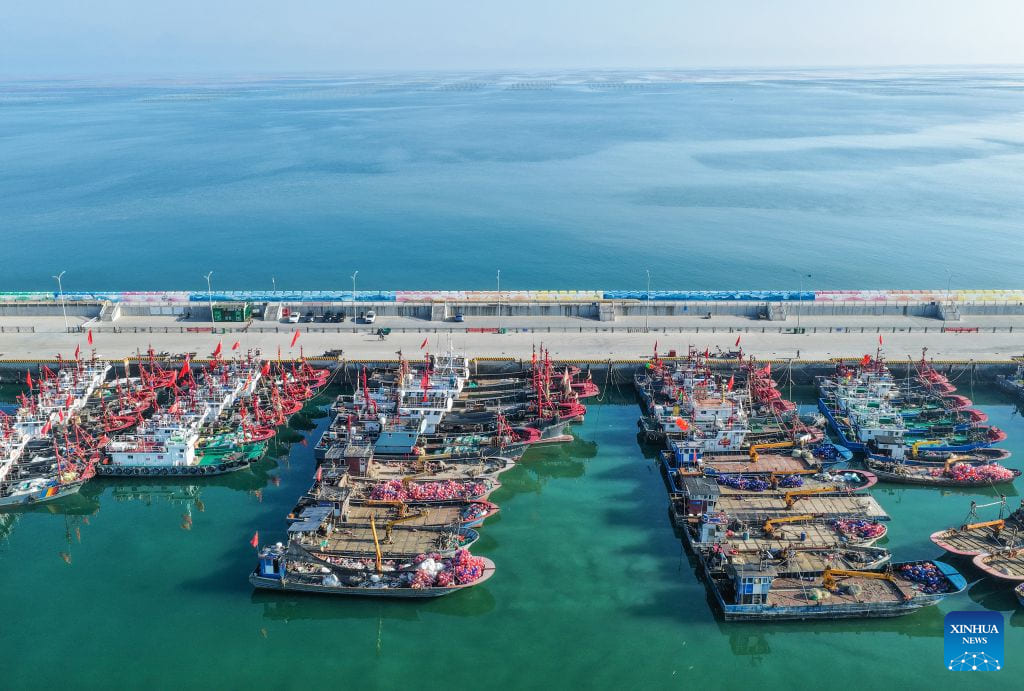
SINGAPORE: Container freight operations at major Chinese ports are gradually restarting after Typhoon Dolphin, but cargo backlogs, vessel delays and tight capacity could continue disrupting Asia’s supply chains for another one to two weeks, while congestion across north Asia has surged following the latest storm.
- China chemical markets experience spillover effects from logistics disruptions
- North Asia congestion exceeds 2.4 million TEU
- Asia-Europe rates decline despite supply disruptions
Dolphin was the strongest of three typhoons that hit China in five weeks, causing significant disruption at Ningbo and Shanghai while tracking north toward Qingdao.
China’s National Meteorological Center (NMC) said the storm had weakened to a tropical depression by 11 August, although heavy rainfall and flood risks persisted across parts of central and northern China.
More than 1 million people were evacuated ahead of the storm, which disrupted transport and logistics operations across eastern China, according to media reports.
According to container shipping analyst firm Linerlytica, port congestion across North Asia has surged, with more than 2.4 million twenty-foot equivalent unitscontainership capacity effectively tied up after Typhoon Dolphin struck China’s eastern coast on 9 August.
The storm forced vessels to seek shelter away from its path, disrupting schedules across regional shipping networks.
Ningbo and Shanghai were the hardest-hit ports, with terminal closures beginning on 7-8 August, while congestion has also spread to ports in southern China and is expected to take several weeks to clear fully as carriers work through vessel backlogs.
“In China, trucking and warehousing operations across Shanghai and Ningbo are coming back online following Typhoon Dolphin, with both cities easing their emergency response levels, though vessel and terminal recovery is expected to take longer as ports work through accumulated cargo and rescheduled sailings,” Zencargo said in its 11 August market update.
“The backlog is also raising the risk of missed sailings; carriers may roll cargo, bump containers from booked vessels, or skip Shanghai calls entirely, with delays and revised schedules likely to persist over the coming one to two weeks.”
The latest disruption follows Typhoon Noul, which shut down ports in southern China in late July while regional hubs were still recovering from an earlier storm.
Container freight rate benchmarking and booking platform Freightos said freight rates across all major trade lanes, including Asia-Europe routes where demand is cooling, could face upward pressure from supply-side constraints caused by successive typhoons.
Some carriers are already omitting Shanghai port calls because of severe congestion, while multi-day delays have also been reported in Ningbo, Shenzhen and Hong Kong.
CHEMICAL MARKETS BEGIN TO FEEL IMPACT
The logistics disruption is beginning to spill over into China’s petrochemical markets, with market participants citing delays to cargo movements and heightened concerns over prompt material availability.
Acrylonitrile (ACN) producer Shanghai SECCO Petrochemical raised its weekly ACN price by yuan (CNY) 500/tonne to CNY13,000/tonne ex-tank, while noting that the typhoon had disrupted logistics in east China and contributed to near-term supply concerns.
Market participants said temporary port closures, vessel delays and restrictions on cargo movements in eastern China could affect the movement of both feedstocks and finished petrochemical products, particularly in the Yangtze River Delta region.
Typhoon-related disruption has also provided some support to Asia’s toluene market despite sluggish downstream demand. Traders said reduced port activity and slower cargo flows in eastern China helped underpin sentiment, as the storm curtailed logistics operations and added uncertainty over near-term supply availability.
Container ships and costs for shipping containers are relevant to the chemical industry because while most chemicals are liquids and are shipped in tankers, container ships transport polymers, such as polyethylene (PE) and polypropylene (PP), which are shipped in pellets. Titanium dioxide (TiO2) is also shipped in containers.
They also transport liquid chemicals in isotanks.
CHINA PORTS WORK THROUGH BACKLOG
Weather-related disruption at Ningbo-Zhoushan compounded pre-existing congestion in Shanghai, where delays and elevated yard density had already been reported before Dolphin made landfall, according to Zenargo.
Weekend closures included a halt to empty and laden container handling across major Ningbo terminals including Beilun 1, 2 and 3, Daxie, shan, Yongzhou and Zhenhai.
Jinyang Terminal was fully suspended, while pilotage services were halted, preventing vessel arrivals and departures during the peak of the storm.
“As the typhoon weakens, terminals across Ningbo-Zhoushan (Beilun No.1, No.2, No.3, Meidong, Daxie, Yongzhou) are resuming laden container gate-in and pick-up,” Zencargo said.
“Once terminals fully reopen, recovery is expected to take several days as ports work through a backlog of waiting vessels and accumulated containers. Shippers should anticipate delayed vessel departures, longer transit times, and revised arrival schedules over the coming one to two weeks.”
Congestion remains acute across several Chinese gateways. Freightos reported that some carriers are omitting Shanghai calls because of severe congestion, while delays continue at Ningbo, Shenzhen and Hong Kong.
ASIA-EUROPE DEMAND SOFTENS, BUT CAPACITY STAYS TIGHT
Demand on the Asia-Europe route remains healthy but has softened over the last four weeks, consistent with indications that this year’s peak season has already passed.
Carriers have adjusted freight-all-kinds (FAK) rates accordingly.
FAK rates are spot freight rates set by ocean carriers for shipping standard containerized cargo, regardless of the specific goods being transported, and are typically used as a benchmark for short-term market pricing.
“August rates for the first half of the month settled at a lower level than July, continuing the downward trend,” Zencargo said.
“Full visibility on second-half August rates is not yet available, though early indications point to a further, more modest decrease on top of the first-half reduction.”
Peak season surcharges (PSS) remain in place.
However, Freightos noted that softer demand may not automatically translate into lower rates as capacity remains constrained by weather-related disruption.
For all major trade lanes, including Asia-Europe services where market consensus points to cooling demand, rates may still face upward pressure from supply-side constraints created by typhoon-related congestion, vessel delays and schedule disruptions.
Market capacity remains tight through August, unchanged from recent weeks. Space on named accounts (NACs) and long-term (LT) contracts continues to be strictly controlled and largely full.
ASIA-US RATES HOLD
The FAK rate increase implemented at the start of August on Asia-US routes has held and is expected to remain in place, with the possibility of another increase during the second half of the month, according to Zencargo.
FAK levels vary by destination, with US east coast and Chicago-via-west-coast routings priced higher than direct west coast services. Premium-tier pricing is higher still. Increases have been most pronounced on the US east coast and Gulf because of Panama Canal surcharges.
“Named account (NAC) Peak Season Surcharges (PSS) will continue through August, with a possible further increase in the second half of the month,” Zencargo said.
“Panama Canal surcharges are being applied to NAC rates as a separate, additional charge.”
Operational space remains highly restricted, although conditions have improved from July.
Additional carrier capacity is being deployed primarily to clear cargo backlogs accumulated in Asia following the previous tariff deal rather than because of genuinely loose market conditions.
“The additional capacity being deployed is primarily aimed at working through the backlog accumulated in Asia following the previous tariff deal, rather than reflecting genuinely loose conditions,” Zencargo said.
The tariff agreement had triggered a surge in transpacific bookings as importers accelerated shipments to take advantage of improved trading conditions, resulting in cargo backlogs across Asia and a sharp increase in demand for vessel space, it said.
Carriers subsequently added capacity to accommodate the influx of cargo, but much of that tonnage is still being used to work through accumulated volumes rather than creating meaningful slack in the market.
Demand is expected to remain high throughout August. Vessel schedule disruption continues across central and southern China transpacific services after typhoon-related closures at Ningbo and Shanghai from 7 August.
Panama Canal restrictions are also tightening, with carriers becoming more selective on cargo because of weight limitations. US port congestion remains manageable.
Source: ICIS