



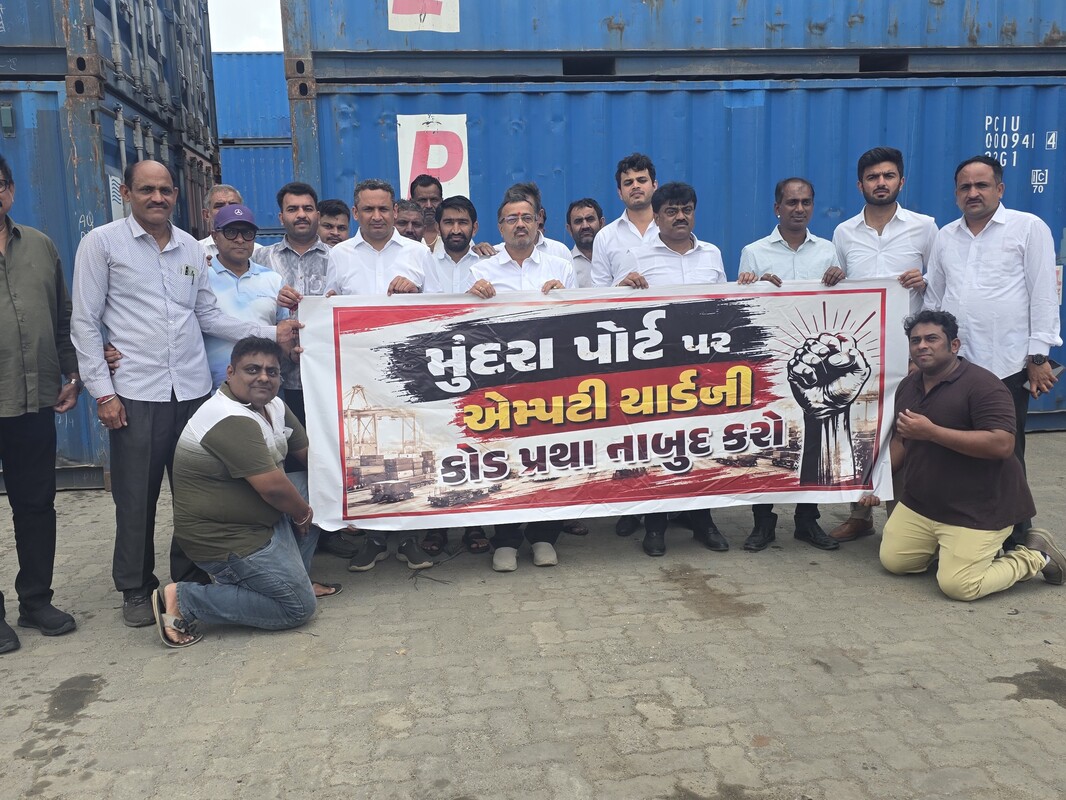
MUNDRA: The continuing confrontation over empty-container handling at Mundra Port is increasingly raising concerns among exporters, importers, freight forwarders and the wider logistics community, with the Rajkot Chamber of Commerce & Industry (RCCI) urging the Central Government to intervene urgently and help restore smooth container movement.
In a representation to the Secretary, Ministry of Ports, Shipping and Waterways, RCCI has sought immediate intervention over the disruption involving empty-container yards at Mundra Port. The representation, submitted by RCCI Vice-President Parth P. Ganatra, highlights the growing difficulties being faced by the export-import community following the ongoing standoff between Adani Ports and Special Economic Zone Ltd (APSEZ) and empty-container yard operators and associated transport service providers.
Dispute over empty-container operations
The immediate trigger for the disruption was APSEZ’s decision to change the existing system for handling empty EXIM containers at Mundra. From September 1, shipping lines were required to nominate empty containers to designated facilities within the Mundra Port/SEZ area, effectively freezing the use of external empty-yard codes.
APSEZ has maintained that the move is aimed at improving safety and security, reducing road congestion, improving truck turnaround times and strengthening operational efficiency. The port operator has subsequently announced a dedicated Empty Container Yard with integrated warehousing, covering storage, inspection, maintenance and movement of empty containers to exporters and CFSs.
However, the change has met strong resistance from empty-container depot operators and transporters, who suspended operations. Container transport operators subsequently joined the protest, bringing another important component of the landside logistics chain under pressure.
According to industry estimates cited in recent reports, around 5,000 containers a day have been held up, while approximately 1,500 container transporters have reportedly stopped movements.
Exporters caught in the middle
The disruption is particularly significant because empty containers are an essential link between shipping lines, exporters, transporters, container depots and port terminals. Exporters depend on timely availability of empty equipment for factory stuffing, while import containers need to be returned promptly after cargo is discharged.
A customer advisory issued by CMA CGM noted that empty-container release for factory stuffing of export shipments and gate-in of empty import containers at affected yards had become temporarily unavailable following the APSEZ directive. The carrier advised customers to review their container pickup and movement plans.
The impact is therefore extending beyond the depot operators themselves. Exporters risk missing vessel cut-offs, cargo rollovers, additional transportation costs, detention and other charges, while freight forwarders and transporters face uncertainty over equipment availability and movement.
Rajkot Chamber warns of wider consequences for trade
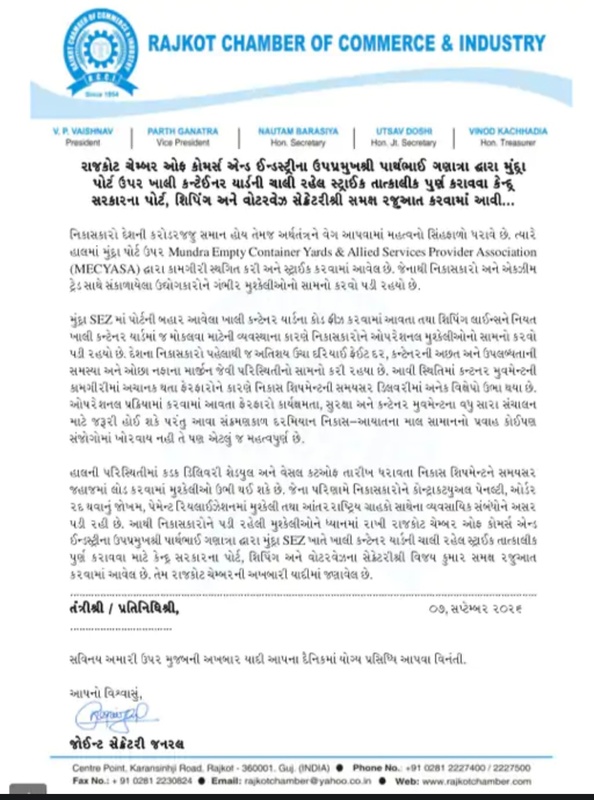
The Rajkot Chamber has expressed particular concern because exporters in the region are already operating in a difficult international trade environment, marked by high freight rates, equipment shortages and uncertainty across global shipping routes.
The Chamber’s representation points out that exporters have already been confronting challenges relating to container availability, delays and the smooth movement of export cargo. Any prolonged disruption in container logistics at Mundra could therefore further aggravate the difficulties faced by businesses dependent on the port.
RCCI has consequently appealed to the Central Government to take immediate steps to resolve the impasse and ensure uninterrupted movement of empty containers, so that exporters and importers are not forced to bear the consequences of a dispute over which they have little control.
APSEZ moves ahead with dedicated yard
Meanwhile, APSEZ has proceeded with its new dedicated Empty Container Yard at Mundra. According to the company, Mundra handles approximately 1.6 million TEUs of empty containers annually, while the port accounts for nearly 35% of India’s container trade. APSEZ said the new facility is intended to provide an integrated solution covering the empty-container lifecycle and reduce unnecessary container movements.
The development, however, has not by itself resolved the broader dispute. Recent industry reporting indicates that the standoff between APSEZ and the external depot and transport community has continued, with concerns increasingly shifting towards the effect on exporters, importers and freight forwarders.
A critical test for Mundra’s logistics ecosystem
Mundra is one of India’s most important gateways for containerised international trade, making the smooth functioning of its landside logistics ecosystem crucial for exporters across Gujarat and beyond.
For the trade community, the immediate priority is not merely where empty containers are stored, but whether exporters can obtain the right equipment on time, move laden containers to the terminal before vessel cut-offs and complete their shipments without additional disruption or costs.
With the dispute now stretching into its second week, the Rajkot Chamber’s intervention adds to the growing calls from trade and logistics stakeholders for a swift, practical and mutually acceptable resolution.
The latest developments suggest that while Mundra Port’s core vessel and terminal operations continue, the empty-container logistics chain remains under significant strain. The longer the impasse continues, the greater the risk that operational disruption will translate into higher costs and shipment delays for India’s EXIM community.