
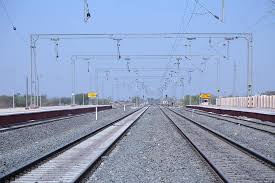
Economic Survey highlights twofold rise in new rail tracks since 2014
NEW DELHI : Sustained capital investment has accelerated the expansion of India’s rail network, with annual track commissioning rates more than doubling in the post-2014 period compared to the preceding decade, the Economic Survey for 2025–26, tabled in Parliament on Thursday.
The Survey noted that average annual commissioning of railway tracks rose from 1,499 km during 2004–2014 to 3,118 km between 2014 and 2024.
“Indian Railways continue to play a pivotal role in India’s infrastructure landscape by expanding network capacity, modernising assets and strengthening multimodal connectivity,” the Survey said.
As of March 2025, the rail network stood at 69,439 route kilometres (Rkm), with a further expansion of 3,500 km targeted in FY26. Electrification has covered 99.1 per cent of the network as of October 2025, it added.
A defining feature of recent years has been record capital expenditure on railway infrastructure, with investments focused on new lines, doubling and multi-tracking, rolling stock augmentation, signalling systems and safety-related works. Based on Budget Estimates for FY26, capital expenditure has been maintained at historically high levels to enable time-bound capacity creation.
The Survey also highlighted the growing role of Indian Railways as a backbone of the country’s freight and energy logistics, supporting coal movement, industrial supply chains and container traffic through dedicated corridors, modern terminals and first-mile connectivity projects.
Parallel investments in stations, signalling, telecom and digital systems are improving network reliability, safety and passenger experience, it said.
Flagging key initiatives such as Economic Railway Corridors under PM GatiShakti, the Mumbai–Ahmedabad High Speed Rail (MAHSR) project, Dedicated Freight Corridors (DFCs), station redevelopment, and technology-led track upgrades, the Survey underlined the transformative changes underway in the national transporter.
“Indian Railways is undergoing a transformation, driven by sustained capital investment, rapid network expansion, near-universal electrification and a corridor-based approach to capacity creation,” it said.
On the MAHSR project, the country’s first bullet train corridor, the Survey said over 55 per cent physical progress has been achieved as of October 2025, with land acquisition completed and most civil packages awarded.
It further noted that 2,741 km, or 96.4 per cent, of the 2,843-km Dedicated Freight Corridors network has been commissioned as of October 2025. While the Eastern DFC spanning 1,337 km has been fully completed, 1,404 km of the 1,506-km Western DFC is operational.
“These corridors are easing congestion on the passenger network, significantly reducing freight transit times and contributing to lower logistics costs,” the Survey said.
Commending the station redevelopment programme, the Survey said that under the Amrit Bharat Station Scheme, 1,337 stations have been identified for phased redevelopment, with works completed at select locations and progress underway nationwide to improve capacity, accessibility and multimodal integration.
It added that more than 78 per cent of railway tracks have been upgraded to support sectional speeds of 110 kmph and above.
In its outlook, the Survey said continued emphasis on dedicated freight corridors, economic rail corridors under PM GatiShakti, and modern signalling and station infrastructure will be critical to improving throughput, reliability and multimodal integration, while reducing logistics costs and strengthening connectivity.