
Fears of Bangladesh getting US trade deal edge overstated, says Tiruppur Exporters’ Association
TIRUPUR : Fears that Bangladesh will gain a disproportionate advantage in the US market under a new trade framework are overstated, said Kumar Duraiswamy, Joint Secretary of the Tiruppur Exporters’ Association, which represents garment exporters.
Concerns that the deal could hurt Indian cotton farmers are also misplaced, he said, arguing that the emerging trade landscape presents more opportunity than risk for India’s cotton and textile sector. Tiruppur is the largest knitwear and cotton textile hub in India.
“India’s expanding export commitments, rising domestic consumption and strategic trade negotiations ensure that Indian cotton farmers remain protected. In fact, the sector stands to benefit from higher demand and expanded cultivation opportunities,” he said.
Bangladesh currently imports around 85 lakh bales of cotton annually to service nearly 500 spinning mills. Its sourcing is largely diversified across Brazil, India and African nations, with negligible imports from the US in recent years.
Despite its spinning capacity, Bangladesh’s domestic yarn production remains insufficient to fully support its garment manufacturing industry, resulting in continued imports of yarn and fabrics. The country has also been strengthening its footprint in man-made fibre production, Duraiswamy added.
India exports approximately 12 lakh bales of cotton to Bangladesh annually.
Duraiswamy noted that India itself is not in a surplus cotton position. With an annual production of around 370 lakh bales and strong domestic consumption driven by spinning, weaving, processing and garmenting segments, the South Asian nation imports nearly 50 lakh bales each year to bridge the supply-demand gap.
“This clearly establishes that India is not surplus in cotton availability, even at current production levels,” he said.
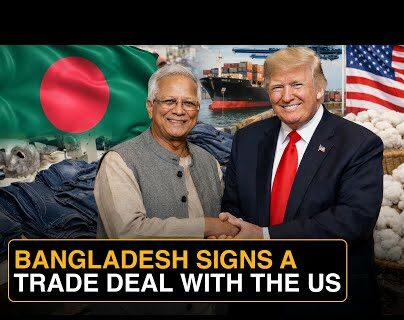
The US–Bangladesh Agreement on Reciprocal Trade, signed on February 9, lowers the reciprocal tariff on Bangladeshi goods from 20 percent to 19 percent. It also includes a mechanism for granting zero-duty access to textile and apparel products from Dhaka made with US-produced cotton.
Addressing apprehensions about the potential impact of the Bangladesh–US trade arrangement, Duraiswamy said India is well positioned, citing recently concluded and ongoing free trade agreement negotiations, including with the UK and the European Union, as well as the forthcoming pact with the US, which are expected to accelerate textile and apparel exports.
“As these FTAs come into effect, capacity expansion across spinning, weaving, processing and garmenting will gather pace. This will lead to higher domestic cotton consumption and further tighten supply,” he said, adding that in the absence of a significant increase in cotton productivity or acreage, India may in fact need to increase cotton imports rather than reduce them.
He also clarified that the much-discussed zero-duty access provision to the US market may not be Bangladesh-specific.
Referring to tariff guidelines released during the Trump administration, he said the framework allows any country to export finished goods to the US at zero duty, provided at least 20 percent of the import value consists of US-origin raw materials that are converted into finished products.
“This provision is uniformly applicable to all countries, not Bangladesh alone,” he said.
He added that textile and apparel industry bodies in India have consistently highlighted this clause in discussions with the Ministry of Commerce during bilateral negotiations with the US.
If incorporated into a future India–US trade agreement, India’s integrated textile value chain, scale of operations, and manufacturing depth would place it in a stronger competitive position.