



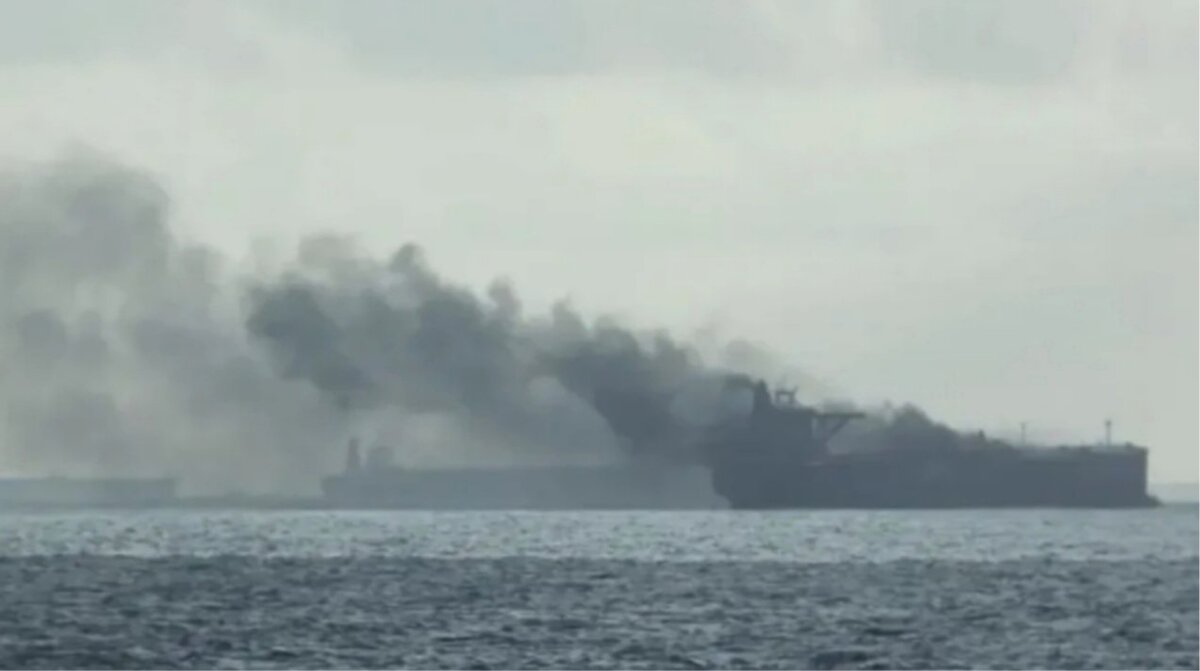
MOSCOW: Russia has reportedly restricted commercial maritime vessel traffic through major waterways connecting the country to the Black Sea after an apparent barrage of Ukrainian drone attacks in the Sea of Azov and Kerch Strait.
The scale and figures that Ukraine have claimed in a drone-based attack campaign against Russian shipping have not been publicly acknowledged by Russian officials or independently verified, but Reuters cited three unnamed sources from Russia’s energy and grain transport sectors in reporting that the Russian border guards had stopped accepting Kerch Strait passage applications for vessels and halted traffic on the Don-Azov Canal effective July 10, 2026, at 6:10 p.m. local time.
Maritime and security firm Vanguard Tech reported the same closures, citing international media reports, noting on 11 July that “no official timeframe for the resumption of navigation has been announced”.
The Don-Azov Canal runs from Russia’s interior to the Sea of Azov, which is connected to the Black Sea by way of the Kerch Strait, meaning that any restriction or closure of vessel traffic through the waterways would impact on Russia’s ability to export.
Vanguard reported an unmanned surface vessel (USV, or water-based drone) approach on St Vincent and the Grenadines-flagged containership MV Inter Sydney on 14 July as the vessel transited off the port of Novorossiysk, Russia.
Novorossiysk lies on the Black Sea coast, indicating that vessels may be subject to drone attacks outside the Sea of Azov and Kerch Strait.
Reports: Ukraine drone attack campaign on Russian shipping
Ukraine’s claims of drone attacks on Russian-linked vessels have been published in daily operational updates on X (formerly Twitter) by the “414th Separate Unmanned Strike Aviation System Brigade ’Magyar’s Birds’” along with communications channels for Ukraine’s Unmanned Systems Forces.
According to an update released on 14 July, the 414 Magyar’s Birds account said it had attacked five oil tankers, five dry cargo vessels and a tugboat overnight in the Sea of Azov.
On 13 July, the account said its force had attacked 15 Russian-linked vessels overnight, including seven tankers, five dry bulk carriers, one ferry and two tugboats. The group said those strikes brought the total number of vessels targeted since 6 July to 116 as part of what it called Operation “MoLoChKa”.
The units and online accounts reporting the attacks are reportedly associated with Major Robert Brovdi, known by his military call sign “Magyar”. Online biographies of Mr Brovdi portray him as a former businessman who reportedly volunteered for military service following Russia’s full-scale invasion in 2022. Mr Brovdi is said to have founded the drone unit that evolved into the 414th Unmanned Strike Aviation Brigade (better known as Magyar’s Birds).
Posts from the accounts have claimed a steadily increasing tally of purported strikes on Russian maritime assets, with totals rising to more than 100 by 13 July. Videos accompanying the updates appear to show first-person-view (FPV) drone strikes on moving vessels, harbour craft and port infrastructure. However, the footage does not confirm the identity of every vessel, the extent of damage sustained or the result of the claimed attacks.
The 14 July post on the 414 Magyar’s Birds X account, signed and dated by “Magyar” offered a brief rationale for the attacks on vessels, saying the aim was to degrade Russia’s ’shadow fleet’ of tankers.
“Paralyzing Russia’s feeder fleet – the small and medium 140-meter flat-bottomed “courier” tankers with a deadweight of around 7,000 tons – effectively cripples a major component of Russia’s shadow fleet. It prevents the export of its “black gold” from river-port oil transhipment bases and loading terminals through the Volga–Don Canal and the Sea of Azov to large tankers. Those larger tankers can’t reach the oil terminals or ports because of their draft, so they’re forced to load offshore in the Black Sea from these courier tankers, each of them taking on cargo delivered by 12–15 of these little water shuttles,” the post explained.
The post claimed that attacking those vessels and “the tugboats that keep dragging them around after they’ve been hit also limits deliveries of scarce gasoline to Crimea through the shallow bottleneck of the Sea of Azov”.
With limitations on waterborne exports, the alternative option becomes “road and rail tankers as the primary supply route – a far more dangerous option,” due to susceptibility to attack, according to the account’s rationale.
Maritime security consultancies including Ambrey and Dryad Global have assessed that the Ukrainian campaign of attacks, though unverified, would represent a significant escalation in Ukraine’s efforts to disrupt Russian maritime logistics, if accurate.
Alongside the reported vessel strikes, the Unmanned Systems Forces have claimed attacks on oil transhipment facilities, port infrastructure and energy assets supporting Russian military logistics in Crimea and the Sea of Azov.
On 9 July, international media reported an attack against Russia’s largest oil refinery in Omsk, Siberia, nearly 2,000 miles from Ukraine. On 10 July, Ukrainian President Volodymyr Zelenskyy announced the creation of a “long-range impact” command, as reported by Reuters and others, reportedly positioning an earlier drone-based attack on an oil terminal in St Petersburg as “long-range sanctions” against Russia.
Based on Ambrey incident reports, Russia has also hit Ukrainian ports and ships in attacks over recent days. Ambrey reported on 13 July that a Togo-flagged bulk carrier was struck by a Russian Unmanned Aerial Vehicle (UAV) while alongside at the Port of Chornomorsk, Ukraine. Five fatalities and seven injuries were reported in connection with the impact. No pollution was reported.
Both Russia and Ukraine have reported multiple fatalities and injuries in attacks in recent days.
IMO condemns attacks on merchant ships
International Maritime Organization Secretary-General Arsenio Dominguez issued a statement condemning attacks on commercial vessels in the Black Sea and Sea of Azov and more widely.
“I deplore the series of attacks over the past week against civilian merchant ships operating in the Sea of Azov and the Black Sea,” Mr Dominguez said.
“I condemn all unwarranted attacks on civilian merchant vessels arising from geopolitical conflicts, wherever they occur. Such acts endanger seafarers, threaten the safety of navigation, disrupt global supply chains and undermine the principles upon which international shipping depends. I call on all parties involved in conflicts to refrain from any action that endangers innocent merchant shipping or the marine environment, to respect international law, and to ensure the protection of seafarers. Seafarers should never become casualties of conflicts to which they are not a party. Every seafarer, wherever they serve, deserves to work in safety and security.”
If confirmed, the operation would represent one of the largest concentrations of attacks against merchant shipping since Russia invaded Ukraine in 2022.
Riviera has previously reported on the widening scope of Ukraine’s maritime campaign as attacks have increasingly extended beyond naval vessels to commercial shipping, offshore infrastructure and energy assets.
In January 2026, the Ukrainian military claimed successful strikes on a trio of offshore drilling platforms operated by the sanctioned Russian oil and gas entity Lukoil.
In early March 2026, EOS Risk Group told Riviera that 2003-built LNG carrier Arctic Metagaz was “subject to a likely drone attack” in the Mediterranean.
An intelligence assessment produced by EOS Marine Russia analyst John Walking drew parallels in the attack methodology with earlier attacks on Russia-linked vessels in the Mediterranean by Ukraine. Mr Walking assessed the probability of similar attacks in the future as ’highly likely’.
The Baltic region saw reports in recent months showing that Russia has added machine guns to an FSRU in the Baltic Sea.
Surveillance imagery from May 2026 showed heavy machine guns and fortified firing positions installed aboard the Russian floating storage and regasification unit (FSRU) Marshal Vasilevskiy. Head of the Estonian police and border guard board Veiko Kommusaar said in an emailed statement that the surveillance data confirmed that Russian Federation vessels present a security risk for Baltic countries. Analysts assessed the move as unprecedented for a civilian commercial vessel in the Baltic Sea and highlighted growing concerns that merchant ships and maritime energy infrastructure are becoming increasingly exposed to the wider conflict.
Source: Riviera