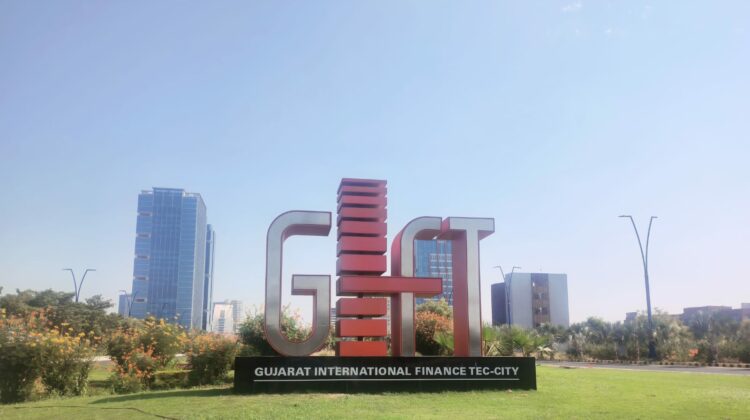
GIFT City on fast track after bid for 2030 CWG
GANDHINAGAR : GIFT City,Gandhinagar is expanding rapidly post-2030 Commonwealth Games bid, focusing on infrastructure and residential development to attract more residents.
Ahmedabad’s successful bid for the 2030 Commonwealth Games last week has renewed attention on GIFT (Gujarat International Finance Tec) City, a central business district in Gujarat’s Gandhinagar district
The idea to build an international financial centre on a greenfield site was conceived in 2007 by the then Gujarat chief minister Narendra Modi. After initial years of slow growth and setbacks, the government converted GIFT into a fully state-owned company.
By 2011, the state had carved out a contiguous 3-sq-km (900-acre) plot along the Sabarmati and laid down the physical foundations—wide roads, a riverfront edge and perhaps the country’s most advanced underground utility systems.
The decisive shift came in 2020, when the Centre created the International Financial Services Centre Authority (IFSCA), a unified regulator for banking, insurance, funds, aircraft leasing and other offshore financial activity.
About 25 buildings are now operational and almost fully occupied, bringing roughly 27,000 people into the city each day. Another 37 towers are under construction. For now, GIFT remains primarily a workplace rather than a place where people live, but that is beginning to change. Around 930 homes have been delivered and more than 7,000 are under construction.
Yogesh C Bhavsar, president of the National Real Estate Development Council (Gujarat), said that with Ahmedabad’s real estate market now nearly 60–70% saturated, the combination of upcoming global events, the growth of foreign university campuses, and steady organic urbanisation will accelerate GIFT City’s next phase of expansion.
“The long-term target is to eventually accommodate a density of about 250,000 people per square kilometre, comparable to Navi Mumbai’s,” said Loveleen Garg, chief planner and vice president (Planning), GIFT City.
With the hard infrastructure set in place, GIFT is investing in public spaces to attract residents. A 27-acre Central Park is under development along the extended riverfront. It will feature courts for soccer, box cricket, pickleball and basketball, a golf driving range, jogging and cycling tracks, plazas, lawns and an amphitheatre. A dedicated food zone with restaurants and kiosks is also planned to draw workers and residents into shared spaces.
Hiran Shah, who runs Capital Russian Bakery in GIFT City, said the demand for retail spaces is now rising. “We see one or two new families moving in every day. Currently, the two occupied residential towers—Shobha and SJ Sangath—are around 30% full. Most of my customers are office-goers,” he said. Shah travels 55 km daily to reach his bakery from Ahmedabad’s Shilaj area.
Upendra Sagar, a State Bank of India employee who drives from Gandhinagar, said, “People mostly come in the morning and go back in the evening as there isn’t much to stay back for yet”.
He said the neighbourhood has “very few cafés” and there is hardly any street life . “ Most of my colleagues are from outside Gujarat. Sagar said he isn’t considering shifting to GIFT for now, but after five years, when all the social amenities are in place, he hopes more people will shift to GIFT City.
Officials say improved connectivity will transform GIFT into a bustling, compact city over the next few years. Two new metro stations have been sanctioned as part of the Ahmedabad–Gandhinagar line extension, and a direct road link to the airport is expected to bring travel time down to about ten minutes. GIFT will also connect to the Sabarmati high-speed rail terminal, and once the Mumbai–Ahmedabad bullet train becomes operational, officials estimate that travel between GIFT and the Bandra-Kurla Complex could be about two hours and fifteen minutes.
What sets GIFT apart is its carefully engineered, below-ground infrastructure. Beneath the surface runs an underground utility tunnel—described by officials as the city’s “nervous system”—carrying power cables, fibre, potable and recycled water, district cooling pipelines and automated waste ducts. About 5.5–5.7 km of the planned 16 km tunnel is complete. All repairs occur inside the tunnel, keeping the surface “completely digging-free,” said Anil Parmar, Vice President (Engineering).
At its core, GIFT’s IFSC is also taking shape as the offshore financial district it was envisioned to be. The zone now hosts 35 global banks and a rapidly expanding fund ecosystem with 320 investment funds managed by 97 fund managers.
“Entities operating out of the IFSC have raised more than $58 billion for India so far,” said K Rajaraman, chairman of the IFSCA and former Union finance secretary. The tax architecture—including a 10-out-of-15-year income-tax holiday—is “aligned with Singapore”, he added.
The masterplan permits 62 million sq ft of built-up space; about 10% is currently active, but development rights for nearly half the total capacity—29.47 million sq ft—have already been allotted. “Based on ongoing work, we expect about 50 % of the entire project’s capacity to be physically built within three years,” said Nisarg Acharya, head of commercial at GIFT City company limited.
Source : HT