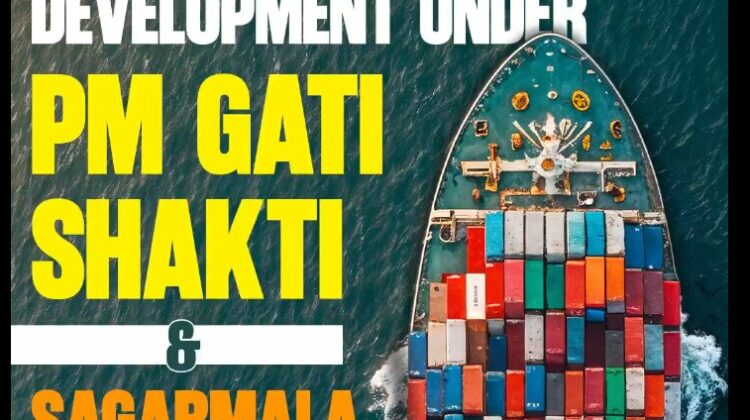
Government highlights transformative gains in Port-Led Development under PM Gati Shakti and Sagarmala
NEW DELHI : The Government of India detailed the significant strides made under PM Gati Shakti and the Sagarmala Programme, underscoring their transformative impact on India’s maritime and logistics ecosystem, in a written reply tabled in Parliament.

The reply outlined a series of policy reforms, infrastructure investments, and technology-driven initiatives that have accelerated port-led development, strengthened inland waterways, and advanced India’s commitment to green and sustainable shipping.
Major Capacity Expansion at Ports
As a result of sustained reforms and targeted investments, the cargo handling capacity of India’s major ports has increased substantially — from 555 million tonnes per annum (MTPA) to 1,681 MTPA. This nearly threefold expansion reflects modernization of berths, mechanization of cargo handling, development of deep-draft terminals, and enhanced private sector participation.
Operational efficiencies have also improved significantly. Container vessel turnaround time has reduced sharply due to digitization of port processes, direct port delivery systems, improved last-mile connectivity, and streamlined customs procedures. These measures have helped Indian ports move closer to global benchmarks in productivity and service standards.
Inland Waterways Witness Unprecedented Growth
The Government further highlighted the remarkable rise in inland waterways cargo movement — increasing from 18.07 million metric tonnes (MMT) to 145.84 MMT. This surge has been driven by the development of multimodal terminals, river information systems, fairway development, and increased private participation in cargo movement along national waterways.
The strengthening of inland waterways is reducing pressure on road and rail networks, lowering logistics costs, and significantly cutting carbon emissions — aligning with India’s broader climate commitments.
Driving Multimodal and Green Logistics
Under PM Gati Shakti, the focus has been on integrated planning through a digital platform that brings together multiple ministries and infrastructure projects to eliminate bottlenecks and ensure seamless multimodal connectivity. Port connectivity through rail corridors, highways, and dedicated freight corridors has been enhanced to improve cargo evacuation and reduce dwell time.
Meanwhile, the Sagarmala Programme continues to promote port-led industrialization, coastal economic zones, and coastal community development. Investments in green port initiatives, shore power supply, cleaner fuels, and energy-efficient equipment are further advancing India’s maritime sustainability agenda.
Advancing Green Shipping
Haritsagar, Green Port outlines, Green Tug Transition Programme and many more.
Tangible Outcomes, Capacity and Efficiency gains
Boosting Competitiveness and Trade
These reforms have collectively contributed to improved efficiency, lower logistics costs, enhanced global competitiveness, and increased ease of doing business. By strengthening maritime infrastructure and inland water transport, the Government aims to position India as a leading maritime hub and a key player in global supply chains.
The Parliamentary reply reaffirms the Government’s commitment to building resilient, sustainable, and future-ready maritime infrastructure that supports economic growth, trade expansion, and environmental responsibility.