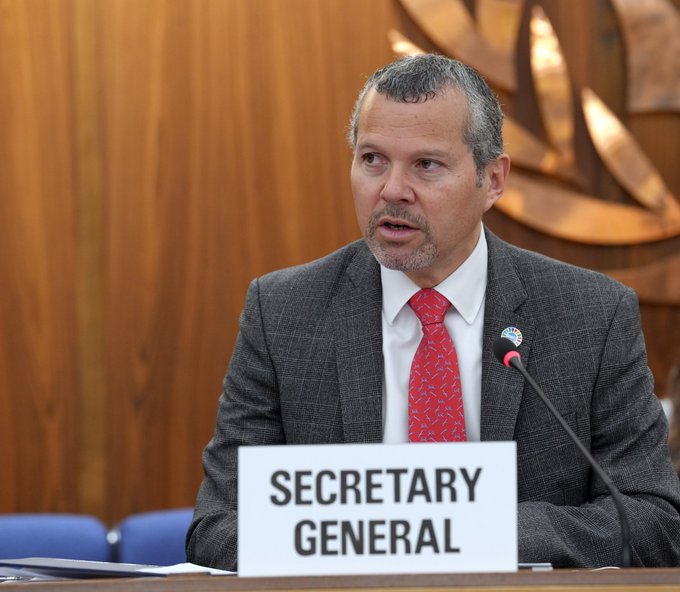
IMO Secretary-General working on an evacuation plan for hundreds of ships that have been stuck in the Persian Gulf
LONDON : The International Maritime Organization is working on an evacuation plan for hundreds of ships that have been stuck in the Persian Gulf since US and Israeli strikes on Iran began more than seven weeks ago, according to Secretary General Arsenio Dominguez said.
” The plan can only be put into action when there are clear signs of de-escalation, Dominguez said on the sidelines of Singapore Maritime Week. Details being discussed include an order of departure for vessels, depending on the length of time the crew has been stranded, among other factors, he added. The attacks on and seizures of commercial ships are unacceptable. I once again call for these reckless actions to cease and for any ships and innocent seafarers to be released immediately. The situation in the region remains extremely volatile. I cannot understand why companies would take risks and endanger seafarers’ lives. Today I spoke to a seafarer who was stranded in the Persian Gulf. He described the constant stress of missiles overhead, the danger of falling debris striking the ship, the need to ration supplies, and the difficulty of keeping his family informed about his situation. This seafarer was thankfully able to leave, but nearly 20,000 others remain, after more than seven weeks, still uncertain when they will be able to return home. There is much more work to be done. De-escalation, meaningful actions and restoring the freedom of navigation is the only way forward, ”IMO Secretary General added.
Any transits would follow a long-established route — the Traffic Separation Scheme that was proposed by Iran and Oman and adopted by the IMO in 1968, Dominguez said. Iran has developed a system over the past weeks that includes a specific route close to its coast and, in some cases, payment.
The discussions covered key areas including India’s continued engagement with the IMO, maritime safety and global shipping disruptions, seafarer welfare and humanitarian concerns, and decarbonisation and environmental commitments. India highlighted its re-election to the IMO Council (Category B) and reaffirmed its active contribution to IMO’s work through policy inputs and international cooperation.
Both sides also deliberated on the evolving challenges faced by the global maritime sector, particularly in light of recent geopolitical developments impacting shipping operations and seafarers. India emphasised the need for coordinated international efforts to address humanitarian concerns, ensure the safety of seafarers, and maintain the resilience of global supply chains, while continuing to support sustainable and inclusive maritime growth.
The IMO is in touch with littoral states, including Iran and Oman, and flag states to finalize the blueprint.