
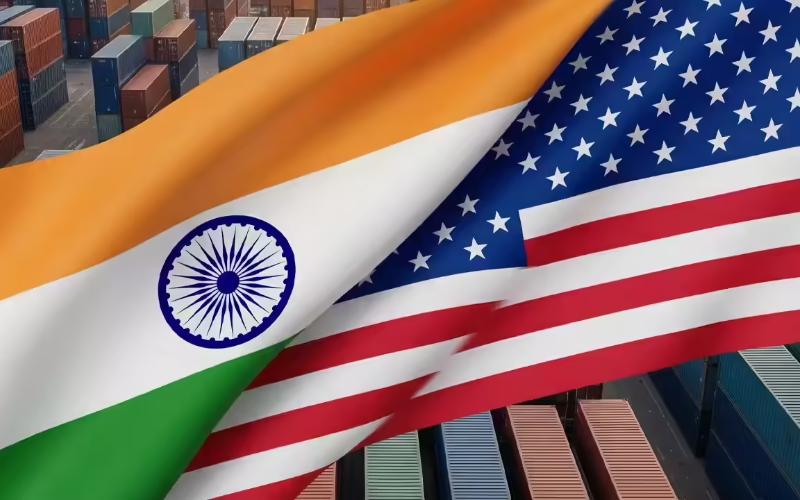
India-US Trade deal protects dairy, key agriculture products; no duty for $40 billion exports
NEW DELHI : The India-US Trade deal exempts Indian dairy and “sensitive” agriculture items from its ambit, provides for zero-duty access to over $40 billion worth of Indian goods, and reduces customs duties on labor-intensive Indian merchandise such as textiles, leather goods, marine products, chemicals, and certain agricultural items, including processed food, to 18% from day-one, people aware of the development said on Tuesday.
Elaborating upon the basic contours of the deal announced by President Donald Trump on Monday, the people cited above said the 25% punitive tariff imposed on Indian goods for purchasing Russian oil will be removed in a couple of days. Besides, the 25% reciprocal tariff imposed on goods worth about $30 billion (labour-intensive items) will become 18% days after the deal is formalised through a joint statement, they added, requesting anonymity. They were citing bilateral trade data for the calendar year 2024
“Indian exporters were struggling to survive in their biggest market against the cheaper labour-intensive products of competing countries such as Bangladesh, Cambodia, Vietnam, Indonesia, China, Malaysia and Thailand because of the huge duty differential. They paid around 19%-20% against Indian exporters being charged 50%. Now, after the deal, Indian exporters will have about 1-2 percentage point duty advantage,” one of them said.
Competing countries have higher import duties in the US market. For instance Vietnam is 20%, Malaysia 19%, Bangladesh 20%, Cambodia 19% and Thailand 19%.
Union commerce and industry minister Piyush Goyal said in New Delhi that the sensitive agriculture and dairy sectors were safeguarded in a deal that will boost labour-intensive and export-oriented sectors. “This is truly a deal that every Indian can be proud of,” he added.
US Trade Representative Jamieson Greer said in an interview that India had agreed to reduce tariffs on US exports and that India’s industrial goods tariffs will go to zero from 13.5%. “India is maintaining some protection around agricultural goods,” he told CNBC in the interview.
The developments came a day after Prime Minister Shri Narendra Modi announced that Indian goods will face a reduced US tariff of 18% after a phone conversation with Trump, who said the two sides had concluded a trade deal whereby New Delhi will cut its tariffs to zero and buy American goods, including energy, worth more than $500 billion.
The announcement concluded nearly 12 months of tense negotiations that saw bilateral ties nosedive. India’s labour-intensive sectors were the worst hit by the US tariffs that were the highest (50%) among competing countries. The sectors mainly comprised textiles and apparels, leather and footwear, marine products, chemicals, plastic, rubber, home decor, carpets, machinery, certain agri items, and processed agriculture products, the people cited above said.
According to them, the governments of both sides are finalising a joint statement, which will formalise the contours of the deal. Subsequently, the two sides will seal the deal after legal scrubbing. “Most of the provisions of the deal will come into force after the joint statement. Some of them could have certain specific timelines,” a second person said adding that the deal has already been negotiated in a structured manner, so it will be implemented expeditiously.
Indian government officials declined to comment on specific details of the deal before the formal joint statement as there could be some last-minute adjustments. They said, requesting anonymity, that the joint statement will formalise the understanding arrived at after lengthy negotiations.
Both Goyal and Greer separately hinted that the final language of the deal was yet to be firmed up.
“We will be shortly issuing a joint statement by both countries, along with the details which we will be shortly inking between the United States of America and India. And as soon as the final understanding of the deal is inked and the joint statement is finalised, technical processes are completed, full details will be shared,” Goyal said in Delhi.
“But I can assure the people of India, I can assure 140 crore brothers and sisters, that this is a deal that will make every Indian proud, that will protect the interest of every Indian, and provide huge opportunities for all the people of India, and will protect the sensitive sectors, the interests of our agriculture and our dairy sectors in full respect, opening up huge opportunities for our labor-intensive sectors, export sectors in textiles, plastics, apparel, home decor, leather and footwear, gems and jewelry, organic chemicals, rubber goods, machineries, so many products, aircraft components,” he said.
Greer said the Trump administration was working on finalising the trade agreement.”We’ll finish papering it, but we know the specifics, we know the details,” he added.
Earlier in the day, US secretary of agriculture Brooke Rollins had said that Washington will export more farm products to India as part of the deal that will pump more cash into rural America.
”Thank you US President Donald Trump for ONCE AGAIN delivering for our American farmers. New US-India deal will export more American farm products to India’s massive market, lifting prices, and pumping cash into rural America. In 2024, America’s agricultural trade deficit with India was $1.3 billion. India’s growing population is an important market for American agricultural products and today’s deal will go a long way to reducing this deficit. America First victory on top of the dozens of deals for ag,” she said on X.
According to the people mentioned above, the $500 billion purchase commitment is spread over five years and involves items that are primarily and essentially imported by India. “For example, with its rapid economic growth, India needs airplanes worth over $100 billion, including parts. Similarly, it will involve imports of crude oil and gas (liquefied natural gas or LNG) worth billions of dollars every year. According to available data, in the month of November 2025 alone, India saw 47.6% annualised jump in import of crude oil from the US at over $1.9 billion. In volume terms, the jump was 31.4% to 5,385,271 tonnes.
The $500 billion purchase commitment will also involve import of precious metals and stones such as diamonds (except for gold, which will have some kind of tariff rate quota or TRQ), for value-addition in India, hi-tech products, equipment for data centres and global capability centres (GCC) and semiconductors. It will also involve collaboration in the artificial intelligence (AI) sector. “All these technological items and sectors are important for India’s growth and to make it a developed country, thus it will help the Indian economy immensely,” the first person said.
India may get zero duty exports to the US after the trade deal for goods worth about $10 billion, which America allows to almost all of its FTA partners. This is as per the US’ Annexure III, which is Potential Tariff Adjustments for Aligned Partners (PTAAP). According to the US government websites, about 2,000 products are eligible for reduced or zero duties under PTAAP, covering sectors such as natural resources, coffee, tea, fruits such as bananas and oranges, tomatoes, and fruit juices. This is besides the $4 billion worth of Indian goods already exempted, such as certain agri products, papers, and minerals.
To be sure, the US does not levy any tariff on these items for anyone.
As pharmaceuticals and mobile phones were already exempted, they will remain under the exempt category even after the deal, people mentioned above said, adding that they are exempt because they are also part of the PTAAP.
Apart from that, there are items worth $12-13 billion on which the US has imposed safeguard duties, such as steel, aluminium, auto and auto components and copper. The matter is under the ambit of the World Trade Organization and these safeguard duties are levied on everybody, the people mentioned above said.
Items from the US with high sensitivity may continue to enjoy duty protection in India, while the least sensitive American goods will get zero-duty access immediately.
Sensitive items include dairy, cereals, maize, meat, poultry, rice, wheat, GM foods, soybeans and ethanol.
Moderately sensitive items such as almonds, pistachios, cherries and hazelnuts may have tariff rate quotas, while others such as lettuce and some oils will have duty phase-out arrangements over 3-10 years.