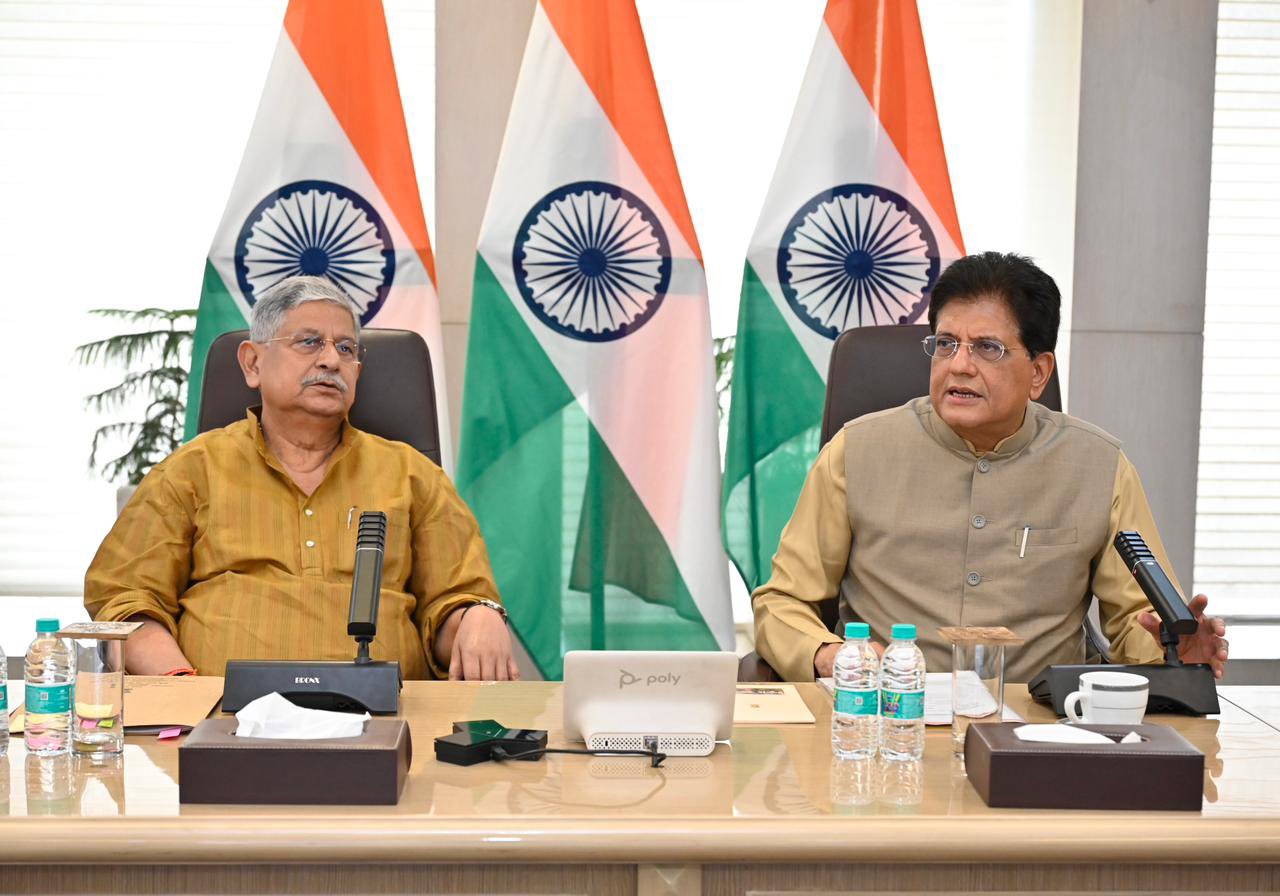
Piyush Goyal and Rajiv Ranjan Singh hold high-level meeting to accelerate seafood sector growth
NEW DELHI : A high-level joint meeting between Union Minister of Commerce & Industry Shri Piyush Goyal, and Union Minister of Fisheries, Animal Husbandry & Dairying Shri Rajiv Ranjan Singh, was held on Thursday to deliberate on a roadmap for accelerating the growth of India’s seafood sector and strengthening the country’s global export competitiveness. The meeting was attended by senior officials from the Department of Commerce, Department of Fisheries, MPFI, DPIIT, MPEDA and EIC. The meeting stressed the need for aligning the export promotion activities with the objectives of the PMMSY and allied schemes.
The two Ministries reaffirmed their commitment towards enhancing growth of seafood exports through a coordinated strategy focused on value addition, infrastructure development, product diversification, quality assurance, market expansion, deep-sea fishing and greater stakeholder participation.
As part of this initiative, a two-day “Chintan Shivir” will be jointly organized by the ministries on 5–6 June 2026 at Visakhapatnam involving the Ministry of Food Processing Industries (MoFPI), Marine Products Export Development Authority (MPEDA), National Fisheries Development Board (NFDB), Coastal Aquaculture Authority (CAA), State fisheries departments, seafood exporters, startups, fishers, farmers and other industry stakeholders.
The Department of Fisheries will explore developing a dedicated Production Linked Incentive (PLI) Scheme for MSMEs in the seafood sector to improve international competitiveness, strengthening export-oriented infrastructure, encourage technology adoption, support research and development and promote value addition.
The proposed framework aims to substantially increase the share of value-added seafood products in India’s total seafood exports and expand the number of seafood exporters from around 1,200 presently to 5,000 in the coming years. The initiative is expected to improve export realization and strengthen India’s position in global seafood value chains.
Special emphasis will be placed on developing the tuna sector, particularly in the Andaman & Nicobar Islands and Lakshadweep. Focused interventions will be undertaken to promote sustainable harvesting, processing, branding and export of tuna and other high-value marine products.
The Department of Fisheries and MPEDA will also jointly organise trade and business delegations to major international markets to expand market access, strengthen trade partnerships and promote Indian seafood globally. MPEDA and NFDB will undertake a comprehensive assessment of export potential and infrastructure gaps across States and Union Territories, including inland regions, to facilitate wider participation in the seafood export ecosystem.
The meeting highlighted the need for an integrated approach towards addressing Sanitary and Phytosanitary (SPS) issues in aquaculture and capture fisheries. Efforts will be undertaken to strengthen traceability, quality assurance systems, disease-free zones and compliance with international food safety standards from the primary production stage onwards. Possibilities for GI tagging of seafood species and products will also be explored.
Laboratory infrastructure across States and Union Territories will be upgraded to strengthen testing, certification and export compliance capabilities, with special focus on Lakshadweep and the Andaman & Nicobar Islands.
The Ministers also appreciated the pilot initiative by MPEDA for collection and recycling of marine plastic waste in collaboration with fishers. It is envisaged to scale up the programme across all coastal States and Union Territories to strengthen marine conservation and support sustainable fisheries.
The meeting underscored the commitment of both Ministries towards transforming India into a leading global seafood export hub through sustainable fisheries development, modern infrastructure, improved quality systems and enhanced participation of MSMEs, startups and fisher cooperatives. The initiatives are expected to contribute significantly to employment generation, higher fishers’ incomes, inclusive development of coastal and island regions and the overall growth of India’s blue economy.