
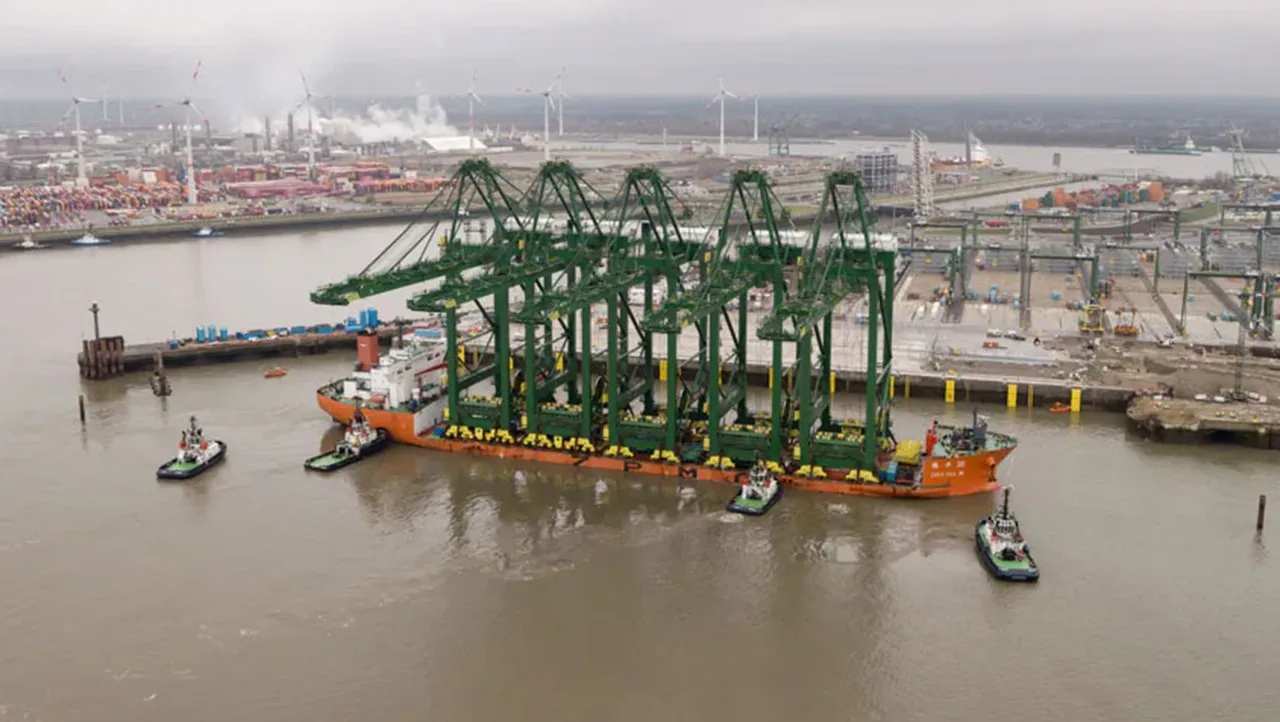
PSA Antwerp receives five mega STS cranes for Europa Terminal under Project Emerald
ANTWERP : PSA Antwerp has marked a key milestone in its Project Emerald with the arrival of five new mega ship-to-shore cranes at the Europa Terminal. The cranes were guided over the Scheldt river by tugboats.
The new cranes are purpose-built to handle the world’s largest container vessels and represent the largest STS cranes ever ordered for the Port of Antwerp. Their arrival supports the terminal’s preparation for the next generation of ultra-large container ships.

Capacity and operational performance
Once installed, the cranes will stand 52 metres high with an outreach of 71.8 metres, enabling them to handle vessels up to 26 containers wide. They feature a dual-hoist lifting capacity of up to 112 tonnes, designed to increase operational efficiency, berth productivity, and service reliability.
The cranes are a core component of the transformation of Europa Terminal, a joint project between PSA Antwerp and Port of Antwerp‑Bruges.
Safety, technology, and workforce
The equipment includes anti-sway systems, remote diagnostics, high-precision controls, and integrated digital monitoring. Operator cabins are ergonomically designed, and training will include a virtual-reality environment to support skills development and safety.
Integrated lashing platforms allow coning and deconing activities to take place on elevated platforms, creating separation between lashing teams and terminal traffic to reduce operational risk.
Sustainability features
The cranes are equipped with energy-efficient electric drives, regenerative power systems, and smart-grid compatibility, aimed at reducing energy consumption and emissions during vessel handling.
Project timeline and impact
The delivery marks progress in Phase 1 of Project Emerald, which combines infrastructure upgrades — including quay wall deepening, reorientation, and extension — with technology and sustainability measures.
According to Edward Tah, the project will increase Europa Terminal capacity by 800,000 TEUs annually and enhance operational efficiency, reliability, and sustainability.
Johan Klaps stated that the cranes demonstrate preparations to keep the port competitive and ready to receive the largest container ships. Work on the new quay wall is ongoing, with preparations underway for initial operations at the renovated section.
Following offloading, the cranes will undergo assembly, testing, and safety checks. They are expected to become operational in the second half of 2026, subject to project progress.