
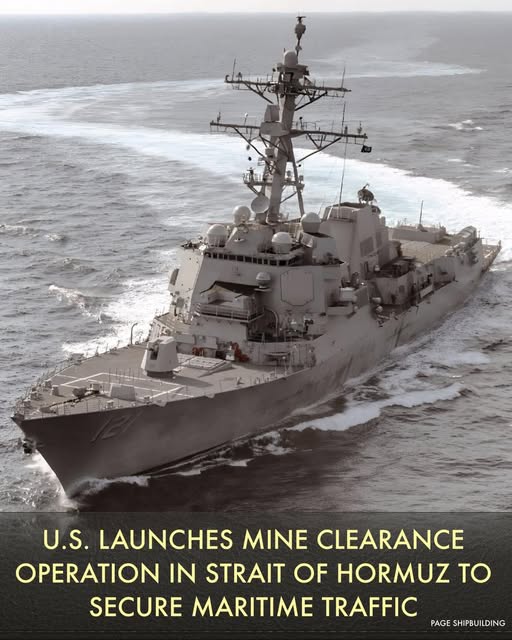
Two US Navy destroyers cross Strait of Hormuz in mine clearance operation : Centcom
WASHINGTON : Two US Navy destroyers have crossed the Strait of Hormuz, marking the start of a US-led effort to remove sea mines and reopen one of the world’s most critical oil transit routes, according to US Central Command.

The operation, announced Saturday, involves the guided-missile destroyers USS Frank E. Peterson (DDG-121) and USS Michael Murphy (DDG-112). Both vessels moved through the strait and into the Arabian Gulf as part of a broader mission aimed at ensuring maritime safety following the placement of mines attributed to Iran’s Islamic Revolutionary Guards Corps.
“Today, we began the process of establishing a new passage and we will share this safe pathway with the maritime industry soon to encourage the free flow of commerce,” said Admiral Brad Cooper, head of CENTCOM, in a statement shared on X.
US President Donald Trump confirmed the operation in a post on Truth Social, saying, “We’re now starting the process of clearing out the Strait of Hormuz,” and describing the move as “a favor” to global economies dependent on uninterrupted energy supplies. He singled out countries like China, Japan, and France, saying they “don’t have the Courage or Will to do this work themselves.”
Trump also claimed that Iran’s position in the conflict is weakening, stating that Tehran is “LOSING BIG!” while acknowledging that the presence of mines remains a lingering danger. “The only thing they have going is the threat that a ship may ‘bunk’ into one of their sea mines,” he wrote.
According to earlier reporting by Axios, the US operation was not coordinated with Iranian authorities, highlighting the continued lack of direct military alignment despite ongoing diplomatic efforts.
Meanwhile, negotiations aimed at ending the conflict are underway. Senior officials from Washington and Tehran met face-to-face in Islamabad on Saturday, seeking to stabilize a situation that has sent shockwaves through global markets and heightened geopolitical uncertainty.
Although a fragile ceasefire was introduced earlier in the week, reopening the Strait of Hormuz had been considered a key condition for easing tensions. The US move to begin mine clearance appears to be a step toward restoring commercial shipping through the corridor, even as political and military uncertainties persist.
In a separate remark, Trump said empty oil tankers from around the world were heading toward the United States to load supplies, though he did not provide further details.
The military command noted that more resources are expected to join the operation in the coming days, including underwater drones designed to detect and neutralise naval mines. The effort comes at a time when the strait, a passage that handles roughly a fifth of global crude shipments, has been severely disrupted amid escalating conflict.
The transit represents the first such movement by US warships since hostilities between the United States, Israel, and Iran intensified earlier this year. The waterway had effectively been rendered unusable after Tehran blocked access following the start of US-Israeli airstrikes on February 28.