
UK freight association highlights need for stronger cross-sector coordination to tackle vehicle crime
LONDON: The British International Freight Association (BIFA) has underlined the critical role that the freight forwarding sector can play in helping to combat organised vehicle crime.
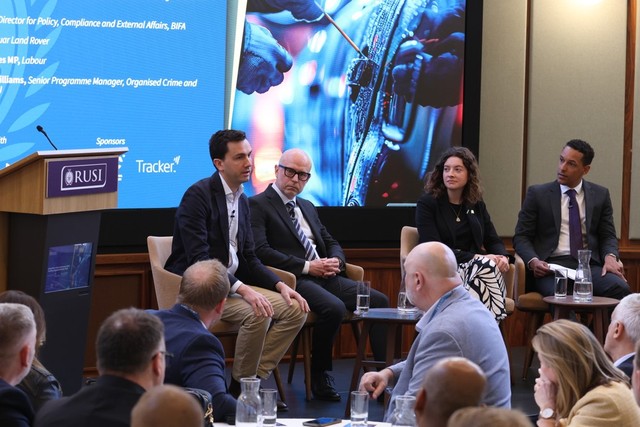
Speaking at the Royal United Services Institute (RUSI) Acquisitive Crime Conference 2026, Pawel Jarza (pictured above, second from left), BIFA’s director of policy, compliance and external affairs emphasised that while progress has been made in understanding the scale and nature of the problem, more coordinated action is urgently needed.
The event, held at RUSI in London, brought together policymakers, law enforcement, and industry leaders to address the growing threat of organised vehicle theft, described as a sophisticated and increasingly cross-border criminal enterprise.
Jarza spoke during a panel session “Far From Victimless: Framing Today’s Threat and Response”, which explored the real-world impacts of vehicle crime across multiple sectors.
He said: “The top line from the panel is that there is now a much better understanding of the problem of vehicle crime, particularly its international and organised nature. Whilst the freight forwarding community is often unwittingly involved in the shipment of stolen vehcicles, it is well placed to support efforts to tackle the problem, especially given its role within global supply chains.
“However, to be truly effective, we need better tools and a more coordinated approach. That means closer collaboration between government, police forces, border agencies, and all those operating across the wider supply chain.”
Jarza highlighted that freight forwarders can play a key role in identifying suspicious movements, strengthening due diligence processes, and supporting intelligence-sharing initiatives. However, he noted that current systems and levels of coordination are not yet sufficient to fully disrupt criminal networks.
The conference reinforced calls for a more integrated national response, with stronger partnerships between public and private sectors seen as essential to tackling vehicle crime at scale.
On behalf of its members, BIFA reiterated its commitment to working with enforcement agencies and industry partners to improve supply chain security and contribute to practical solutions that address the evolving threat landscape.