

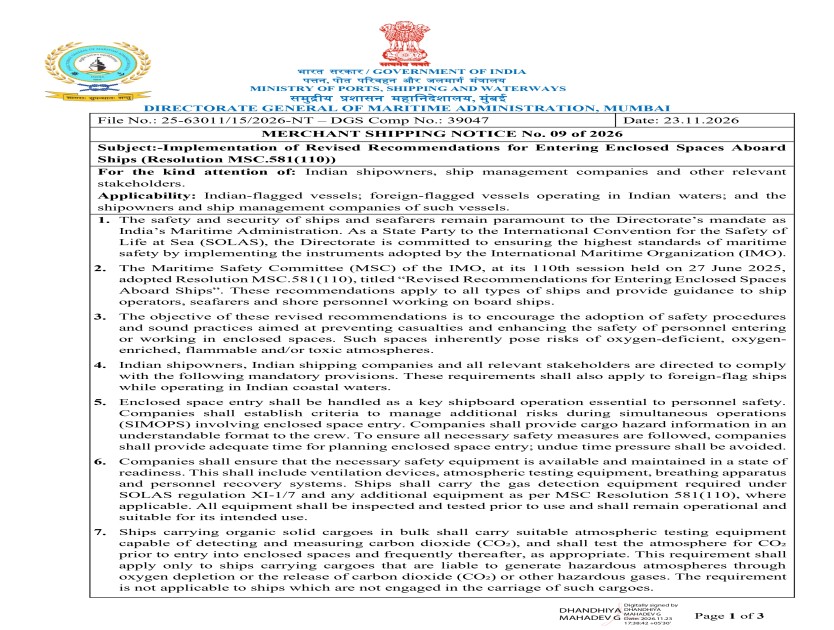
MUMBAI: The Directorate General of Maritime Administration (DGMA) has implemented revised recommendations for entering enclosed spaces aboard ships through Merchant Shipping Notice No. 09 of 2026, in accordance with the International Maritime Organization’s (IMO) Resolution MSC.581(110), titled Revised Recommendations for Entering Enclosed Spaces Aboard Ships.
The new requirements aim to strengthen onboard safety management practices, prevent enclosed space-related accidents and protect the lives of seafarers and other personnel working aboard vessels.
The Notice applies to Indian-flagged vessels, foreign-flagged vessels operating in Indian waters, shipowners and ship management companies. All concerned stakeholders have been directed to ensure effective implementation of the prescribed safety measures.
Comprehensive Safety Requirements for Enclosed Space Entry
Under the revised recommendations, shipping companies are required to strengthen their enclosed space safety management systems through comprehensive training, hazard identification, risk assessment and emergency preparedness.
Key requirements include:
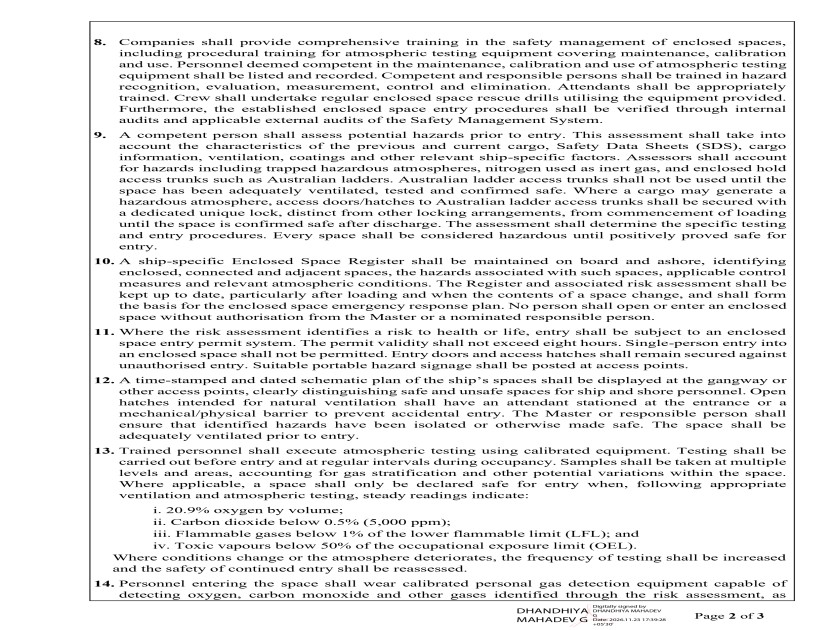
Comprehensive Safety Training: Companies must provide specialised training to crew members and responsible personnel in enclosed space safety, atmospheric testing equipment, hazard recognition and rescue procedures. Regular enclosed space rescue drills are also mandatory.
Mandatory Risk Assessment: A competent person must assess potential hazards before entry, considering previous and current cargoes, Safety Data Sheets (SDS), ventilation, coatings and other ship-specific factors. Every enclosed space must be treated as hazardous until it is positively confirmed safe.
Enclosed Space Register: Ships must maintain an updated, ship-specific Enclosed Space Register identifying enclosed, connected and adjacent spaces, associated hazards, control measures and relevant atmospheric conditions.
Enclosed Space Entry Permit: Where risks to health or life are identified, entry must be authorised through a formal permit system. The permit shall not remain valid for more than eight hours. Single-person entry into enclosed spaces is strictly prohibited.
Atmospheric Testing and Monitoring: Trained personnel must conduct atmospheric testing using calibrated equipment before entry and at regular intervals during occupancy. The prescribed safe-entry parameters include 20.9% oxygen by volume, carbon dioxide below 0.5% (5,000 ppm), flammable gases below 1% of the Lower Flammable Limit (LFL), and toxic vapours below 50% of the Occupational Exposure Limit (OEL).
Personal Gas Detection Equipment: Personnel entering enclosed spaces must wear calibrated personal gas detection equipment capable of detecting oxygen, carbon monoxide and other gases identified through the risk assessment.
Strengthened Emergency Preparedness and Rescue Procedures
The Notice places particular emphasis on emergency preparedness and the prevention of secondary casualties during rescue operations.
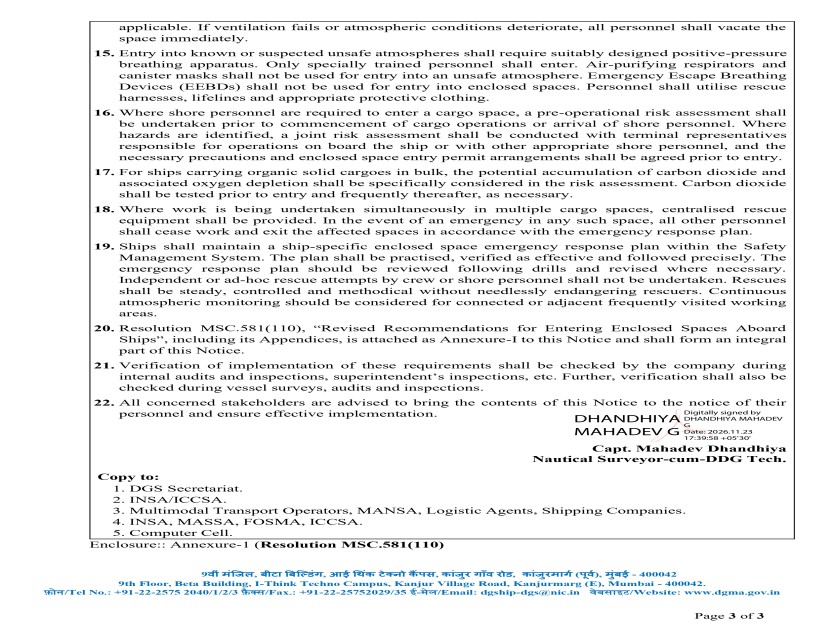
Entry into known or suspected unsafe atmospheres requires suitably designed positive-pressure breathing apparatus, and only specially trained personnel are permitted to undertake such entry. Air-purifying respirators, canister masks and Emergency Escape Breathing Devices (EEBDs) must not be used for entering enclosed spaces.
Ships are also required to maintain ship-specific enclosed space emergency response plans within their Safety Management Systems. These plans must be regularly practised, reviewed and updated following emergency drills.
Where multiple cargo spaces are being worked simultaneously, centralised rescue equipment must be provided. Particular attention must also be given to carbon dioxide accumulation and oxygen depletion in ships carrying organic solid bulk cargoes.
The Notice further requires appropriate coordination and joint risk assessments when shore personnel need to enter cargo spaces, ensuring that necessary precautions and enclosed space entry permits are agreed upon before entry.
Compliance and Verification
Implementation of these requirements will be verified through company internal audits and inspections, inspections by ship superintendents, vessel surveys and other applicable audits and inspections.
The revised recommendations under IMO Resolution MSC.581(110), including its appendices, have been attached as Annexure-I and form an integral part of the Merchant Shipping Notice.
The Directorate has advised all concerned stakeholders to familiarise their personnel with the requirements and ensure effective implementation across their operations.
With the implementation of these strengthened safety measures, DGMA reinforces India’s commitment to improving maritime safety standards, enhancing onboard emergency preparedness and ensuring safer working environments for seafarers and maritime personnel.