

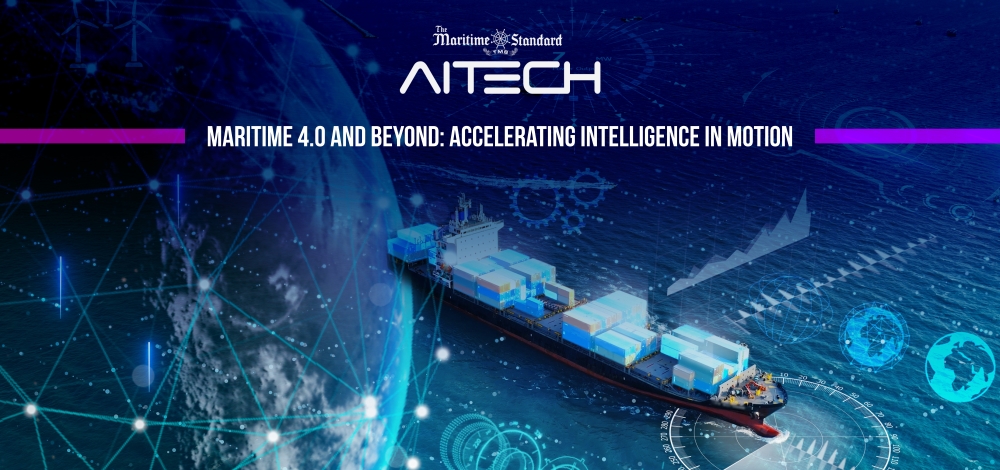
DUBAI: The Maritime Standard successfully hosted the inaugural edition of TMS AITECH (Artificial Intelligence & Technology Conference) 2026 on 24 November at Taj Exotica Resort, The Palm, Dubai, bringing together senior executives, technology specialists, researchers and maritime professionals to examine the growing role of artificial intelligence and digital technologies across the maritime and wider transport sectors.
Held under the theme “Maritime 4.0 and Beyond: Accelerating Intelligence in Motion,” the conference provided a platform for exploring how AI, automation, connected data and emerging technologies are reshaping maritime operations, improving efficiency, strengthening resilience and supporting more sustainable business models. Through keynote presentation, expert discussions, industry case studies and a panel discussion, the programme addressed both the opportunities created by technological advancement and the practical challenges of implementing these solutions across complex operational environments.
Commenting on the significance of the conference and its role in advancing maritime technology, Trevor Pereira, Managing Director of The Maritime Standard, said: “Artificial intelligence is creating opportunities to rethink how the maritime industry operates, competes and prepares for the future. However, the real value of technology lies not in its adoption alone, but in its ability to deliver tangible improvements in efficiency, safety, sustainability and resilience. With TMS AITECH, we wanted to create a platform where maritime expertise meets technological innovation, bringing industry leaders and technology specialists together to exchange knowledge, explore practical solutions and accelerate the transformation of our industry.”
The conference was moderated by Ramia Farrage, formerly with Forbes Middle East and founder of Open Source Media, who guided the proceedings and set the tone for discussions on the growing role of AI across ports, fleets, logistics networks and global trade.
The conference featured a keynote address by Capt. Ammar Al Shaiba, CEO, Maritime Cluster & Noatum Maritime, AD Ports Group, who examined the transition towards Maritime 4.0 and the role of intelligent systems in connecting vessels, ports and shore-based teams. Drawing on AD Ports Group’s digital transformation initiatives, he discussed applications in fleet management, predictive maintenance, voyage planning, fuel optimisation and emissions monitoring. Highlighting the importance of practical technology adoption, he observed: “The future will not belong to those with the most advanced technologies. It will belong to those who know how to use them best.”
H.E. Prof. Saeed Al Dhaheri, Chairperson of the Robotics and Automation Society, UAE, explored the evolution from digital foundations and predictive analytics to generative and agentic AI in his presentation, “From Digital Foundations to Agentic AI: Building Trusted, Future-Ready Intelligent Systems for Transport and Logistics.” Drawing on examples from AD Ports Group, the Port of Rotterdam and Singapore, he highlighted the importance of data integration, cybersecurity, effective governance and human accountability in building trusted autonomous systems. His central message was that “The ports and fleets that lead will not be the most automated, they will be the most trusted.”
Prof. Dr Hoda Alkhzaimi, Associate Vice Provost for Research Translation, Innovation and Entrepreneurship and Assistant Professor of Engineering at New York University Abu Dhabi, addressed the strategic importance of maritime infrastructure in supporting global trade, economic security and industrial competitiveness. She examined how geopolitical disruptions and vulnerabilities across critical shipping routes reinforce the need for resilient, interconnected port ecosystems. Drawing on international examples, she emphasised that ports must evolve beyond cargo handling to become drivers of industrial innovation and economic value creation, observing that “A port is not a port anymore. A port could be an investment vehicle, a port could be an industrial infrastructure, a port could be a mechanism of stabilizing the world.”
The programme also featured presentations from senior industry executives and technology specialists, including Lawrie Pattison, Senior Vice President, Onshore Services at ADNOC Logistics & Services; Sasi Prabhakaran, Director of Maritime Assets at AD Ports Group; Daejin Lee, Managing Director of AltView Insights.
Their contributions addressed the practical application of AI and digital technologies across enterprise systems, fleet management, intelligent logistics, predictive intelligence and maritime infrastructure. Discussions examined how organisations can move from fragmented digital systems towards integrated platforms, use operational data more effectively, improve asset performance and translate technology investments into measurable business outcomes.
The conference also featured industry case studies demonstrating the application of technology to specific operational challenges. Katherine Yakunchenkova, General Manager of Al Safina Security Services, examined intelligence-led maritime security, using route risk assessments and threat intelligence to demonstrate how data can support informed chartering and voyage decisions. Ron Singh, Managing Director of Twenty4X Solutions, presented a practical approach to maritime digitalisation based on standardising, connecting and automating operational systems, showing how integrated data can uncover hidden inefficiencies and generate measurable savings. Giftson Eliyesar, Director, New Business APJ & Middle East at Veson Nautical, explored how digital intelligence and integrated voyage data can help shipping companies manage emissions, navigate evolving environmental regulations and incorporate sustainability into commercial decision-making.
The panel discussion brought together industry perspectives on the opportunities and challenges associated with AI adoption and digital transformation. Among the participants was Khalid Al Zadjali, Senior Manager, Operations Technology (Head of IT) at ASYAD Shipping, who contributed insights into the role of operational technology, data integration and intelligent systems in supporting the evolution of maritime operations.
The discussions also addressed the growing importance of AI in improving supply chain coordination, predictive maintenance, vessel performance, port operations, cybersecurity and regulatory compliance. Speakers emphasised that successful digital transformation requires more than deploying new technologies. It depends on reliable data, interoperability, effective governance, workforce readiness and a clear understanding of the commercial and operational value being created.
With its inaugural edition, TMS AITECH established a dedicated forum for examining the intersection of artificial intelligence and maritime operations, bringing technology providers and industry decision-makers together to explore practical applications, share experience and consider the direction of future innovation across the sector.