


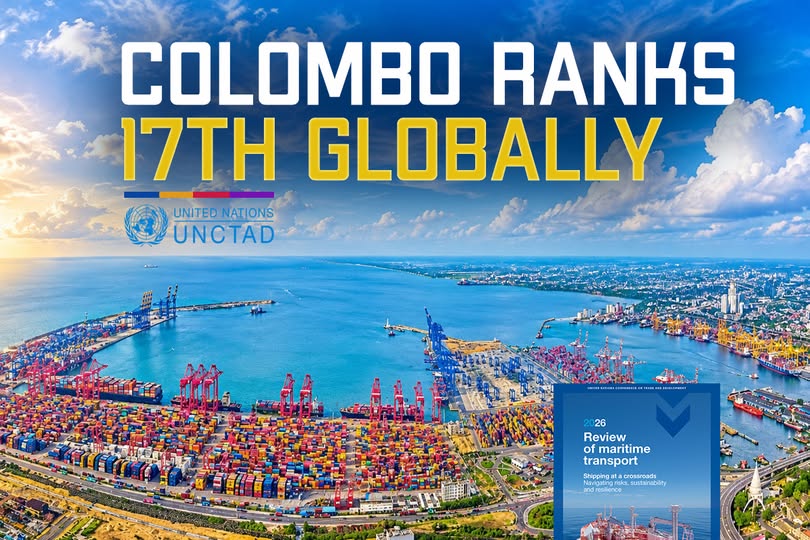
COLOMBO : The Port of Colombo has secured the 17th position among the world’s most connected container ports, recording a score of 719.11 in the Liner Shipping Connectivity Index (LSCI) for June 2026, according to the United Nations Conference on Trade and Development (UNCTAD). The ranking, published in UNCTAD’s Review of Maritime Transport 2026, released on 26 November, places Colombo among the world’s top 20 container ports and reinforces Sri Lanka’s strategic importance in international maritime trade and global shipping networks.
The achievement underscores Colombo’s continued role as a major regional transshipment hub, connecting international shipping services with key markets across the Indian subcontinent and beyond. According to the report, the port accounts for approximately 56% of the scheduled container shipping capacity in the Indian subcontinent, highlighting its significant position in regional maritime connectivity and cargo distribution.
In the global rankings, Shanghai topped the list with an LSCI score of 2,372.47, followed by Ningbo with 2,040.69 and Singapore with 1,833.94. Malaysia’s Port Klang secured seventh position with 1,075.80, while Thailand’s Laem Chabang ranked 16th with 743.29. Colombo followed at 17th position, ahead of Japan’s Yokohama (18th), Vietnam’s Haiphong (19th) and Germany’s Hamburg (20th).
Indian Subcontinent Records Growth in Container Shipping Capacity
The UNCTAD report also highlights the growing importance of the Indian subcontinent in global container shipping networks. Between February and June 2026, container ship capacity deployed through regional hubs increased by 21%, reflecting the expansion of shipping services and the region’s growing integration into international trade routes.
Indian ports also recorded significant growth during this period. Mundra Port registered a 53% increase in scheduled container capacity, while Nhava Sheva recorded a 47% rise. These developments underline the expanding capabilities of India’s container port infrastructure and its increasing role in accommodating international shipping services and long-haul trade movements.
The growth at these ports also reflects the changing dynamics of regional shipping networks, with Indian ports strengthening their capacity to handle increasing cargo volumes and support the evolving requirements of global shipping lines.
Changing Shipping Patterns Reshape Regional Maritime Hubs
Beyond the Indian subcontinent, UNCTAD’s assessment draws attention to the changing distribution of container traffic across the Gulf and Red Sea region. The UAE’s Khor Fakkan experienced a substantial surge in container activity, with volumes increasing nearly 25-fold by early May 2026. Daily truck movements also rose dramatically, from approximately 100 to 7,000, demonstrating the scale of operational activity generated by changing regional cargo flows.
Omani ports, along with Fujairah and other regional facilities, also attracted additional shipping activity, reflecting the evolving role of alternative maritime gateways in international cargo movements.
Vietnam Emerges as a Major Global Connectivity Player
The report further highlights Vietnam’s remarkable progress in global liner shipping connectivity. Its position in the LSCI rankings improved from 28th in February 2006 to sixth in June 2026. During the same period, its deployed annual container shipping capacity expanded significantly from 3 million TEUs to 43 million TEUs.
Vietnam’s LSCI also registered an 8% year-on-year increase between June 2025 and June 2026, reflecting its growing integration into international shipping networks and the expansion of its maritime trade infrastructure.
Strengthening South Asia’s Position in Global Shipping
Colombo’s 17th-place global ranking and its commanding 56% share of scheduled container shipping capacity in the Indian subcontinent underline its continued importance to the region’s maritime logistics ecosystem. At the same time, the expansion of container capacity at Indian ports, particularly Mundra and Nhava Sheva, signals the growing competitiveness of South Asian maritime gateways.
The findings of UNCTAD’s Review of Maritime Transport 2026 highlight how investments in port infrastructure, improved shipping connectivity, operational efficiency and evolving liner service networks are reshaping the global container shipping landscape.
As international shipping networks continue to adapt to changing trade patterns, Colombo remains a critical transshipment hub for South Asia, while the growing capabilities of Indian ports are creating new opportunities for the region to strengthen its position in global maritime commerce.