



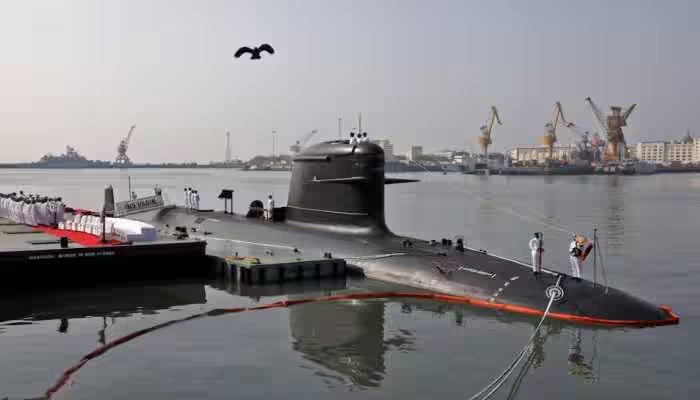
NEW DELHI : Germany and India are reportedly poised to sign a deal worth over $8 billion for the supply of six SSKs (Submersible Ship Hunter-Killer) submarines, with transfer of technology, during Chancellor Friedrich Merz’s visit to India.
Germany’s Thyssenkrupp Marine Systems (TKMS) and Indian state-owned Mazagon Dock Shipbuilders Ltd. (MDL) will work together to manufacture the vessels.
In August 2024, the Ministry of Defence (MoD) cleared MDL to build six submarines in partnership with Germany’s TKMS.
The diesel-electric submarines, being procured by the MoD under Project 75I, will feature Air Independent Propulsion (AIP) and will be larger and more advanced than the current Indian Navy (IN) submarines.
TKMS, which had initially declined to bid for Project 75I due to the RFP’s “terms and conditions,” entered the competition after the German government backed the project.
Why the Need for Import
It is intriguing that India, having built four SSBNs and currently building two SSNs (with a total of six SSNs planned), still needs to acquire SSKs from Germany, especially after already inducting seven Scorpene-class SSKs with technology transfer from France.
- The SSBNs and SSNs are being built in India with foreign (Russian?) assistance, assemblies, equipment, and materials. No real ToT took place as part of Project 75.
- Despite trumpeting the Atmanirbhar Bharat (self-reliance) mantra, the Government of India continues to use defence procurement as a geopolitical ingratiation tool.
- Indian shipyards capable of building submarines are fully committed to existing submarine projects.
- The Need for Fast-Paced Procurement
- We will set aside the first two explanations as overly speculative and assume that Project 75I procurement through a foreign OEM is driven by the Indian Navy’s urgent operational need to replenish its ageing submarine fleet.
- It is noteworthy that the Indian Navy had initially stipulated that only operational submarine designs would be considered under Project 75I.
TKMS, however, has proposed a submarine based on its Type 214 design, incorporating specific modifications for the Indian Navy, such as enhanced stealth and AIP. Clearly, TKMS is not offering a fully operational, off-the-shelf design. As such, the possibility of delays runs counter to the objective of fast-paced procurement.
According to Khalil Rahman, head of TKMS India, the company successfully demonstrated the AIP capability on its Type 212 submarine during evaluation.
India’s Limited Options
The qualitative requirements (QRs) stipulated by the Indian Navy (IN) when Project 75I was initiated were extremely ambitious. They included construction of all boats at Indian shipyards, fitment of DRDO-developed AIP, and the ability to launch land-attack cruise missiles (LACMs).
The draft RFI mandated that, in addition to DRDO-developed AIP, the submarine should be fitted with Indian steel, missiles, and torpedoes, including the DRDO-developed heavyweight torpedo.
The Navy also wanted all intellectual property rights for the submarine to rest with India after the initial batch of six boats, enabling India to export the design.
No submarine OEM met these QRs. As a result, the QRs were repeatedly diluted, delaying procurement by nearly a decade.
Only Germany and Spain eventually submitted bids for Project 75I, after multiple deadline extensions, culminating in July 2023. However, Spain’s Navantia was unable to immediately demonstrate an AIP system while submerged, having only demonstrated it on a surfaced submarine.
Procurement negotiations progressed under the Strategic Partnership model of the defence acquisition procedure. L&T and MDL were shortlisted as Indian partners to collaborate with foreign submarine manufacturers.
Robust Existing MDL–TKMS Relations
Fortunately for India, MDL and TKMS share a long-standing working relationship dating back to the early 1980s.
In December 1981, India signed an agreement with Howaldtswerke-Deutsche Werft (HDW) to procure Shishumar-class diesel-electric attack submarines. The Shishumar boats are Indian variants of the HDW Type 209, featuring a larger-diameter pressure hull.