


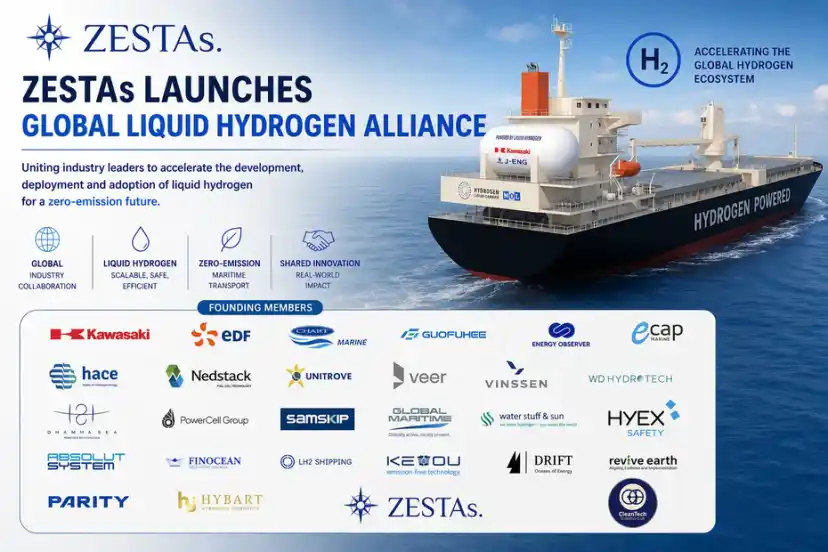
LONDON: The Zero Emissions Ship Technology Association (ZESTAs) on Monday launched the Global Liquid Hydrogen Alliance (Alliance), a new international platform dedicated to advancing pure green hydrogen and liquid hydrogen (LH2) as a deployable, scalable, and commercially viable zero-emission fuel for international maritime shipping.
The Alliance launches as the transition moves from aspiration to deployment. At MEPC 84, the IMO’s Net Zero Framework emerged intact as the agreed basis for future negotiations, confirming that a clear global majority continues to back the world’s first globally binding carbon price for shipping. The signal is unambiguous: the regulatory direction is set, the political will is durable, and the window for first movers to shape the terms of that transition is now. Yet capital intent alone is not enough. Over 600 hydrogen project announcements globally are linked to Europe, backed by more than €175 billion in committed investment, yet projects remain fragmented, offtake is uncoordinated, and final investment decisions are stalling. The gap is not ambition. It is architecture. ZESTAs is bringing together the organisations ready to build the LH2 value chain in the real world, faster, at scale, and with credibility.
“Zero-emission shipping is already underway. The investment is moving, the regulation is coming, and the early movers are setting the terms,” said Madadh MacLaine, Alliance Co-founder and Secretary General of ZESTAs. “According to industry reports, the liquid hydrogen market reflects that momentum: valued at $9 billion today, it is projected to reach $19 billion by 2032 and exceed $54 billion from 2037 onward, with global liquefaction capacity set to more than quadruple in the same period. The Global Liquid Hydrogen Alliance exists because LH₂ needs to be at the core of that transition, at scale, not catching up to it. We’re here to do the coordination work that makes deployment happen: evidence, policy alignment, and commercial frameworks that turn LH₂ from a credible option into a bankable fuel.”
Unlike broader hydrogen initiatives focused primarily on derivatives or blended fuels, the Alliance will work exclusively on pure green hydrogen, building a neutral, transparent evidence base and driving the commercial and policy coordination needed to make the fuel bankable and operational.
What the Global Liquid Hydrogen Alliance will deliver
The Alliance will operate as an action-focused platform built around four priorities:
- Build a global ground truth for LH₂
Create a neutral, verifiable evidence base around liquid hydrogen technology, safety, logistics, costs, and performance to support policymakers, investors, ports, shipowners, and offtakers. - Position LH₂ as a primary energy carrier for shipping
Advance a clear, technically grounded argument for LH₂ as a primary zero-emission marine energy carrier, particularly for long-range, energy-dense, and globally tradable applications.
- Accelerate market creation and international alignment
Support for demand aggregation, offtaker coordination, standards development, certification pathways, and aligned policy engagement across the IMO, Europe, and across key producing regions like Africa, the Caribbean, Latin America, and even on the high seas.
- Turn policy momentum into deployment
Identify how LH₂ rolls out through shipping corridors, port infrastructure, vessel integration, and supply chain partnerships, including routes that reduce dependence on fossil fuel chokepoints and build energy resilience for importing nations, making the case that climate alignment and supply chain security are the same investment.
“The discussion around zero-emission fuels is now shifting from ‘if’ to ‘how fast.’ Liquid hydrogen offers one of the few scalable pathways for truly zero-emission long-range shipping, and the Alliance is intended to help accelerate the ecosystem needed to make that transition commercially viable,” said Bart Biebuyck, CEO of Hybart and Alliance Co-founder.
LH₂ is uniquely suited to long-range, high-energy-density maritime applications where other zero-emission fuels face infrastructure or scalability constraints. It is the only zero-emission maritime fuel that can be produced, stored, and transported at scale using renewable electricity, without the safety, toxicity, traceability, or land-use trade-offs associated with ammonia, methanol, or crop-based biofuels. The technology is not emerging; it has an industrial track record spanning more than six decades, with a global market currently valued at approximately US$45 billion and global liquefaction capacity of around 600 tonnes per day. Containerised LH2 transport is commercially operational today, using standard 40-foot cryogenic containers transportable by road, rail, and ship under existing regulatory frameworks, with no new infrastructure category required.
The deployment gap is geographic and coordination-related, not technical: Europe, which is projected to account for roughly one-third of global hydrogen demand, currently has only around 30 tonnes per day of liquefaction capacity. With vessel deployments already underway and investments in bunkering infrastructure advancing in key port hubs across Europe, Asia, and the Pacific, LH2 is ready to scale. The Alliance will provide the technical evidence base, policy coordination, and commercial frameworks that convert available technology into bankable deployment.
“Maritime navigation has the potential to become one of the leading sectors in the adoption of hydrogen technologies,” said Karima El Kmiti, from Dhamma Sea. “Real-world projects are already demonstrating that hydrogen is a viable solution for maritime decarbonisation and the future of cleaner mobility.”
Join the Global Liquid Hydrogen Alliance
The Alliance is open to companies across the value chain, including shipowners, ports, hydrogen producers, technology developers, classification and safety stakeholders, infrastructure developers, cargo interests, investors, and public-sector partners, united by a shared focus on making LH₂ bankable and deployable now.
ZESTAs is inviting organisations to join as Founding Members and help shape the frameworks, evidence base, and deployment pathways that will define this fuel’s role in zero-emission shipping.