



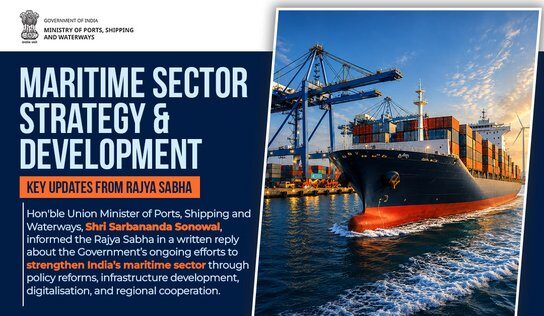
NEW DELHI : India is strengthening its position as a leading global maritime nation through an ambitious agenda of policy reforms, digital transformation, infrastructure expansion, and regional cooperation, aimed at enhancing the country’s competitiveness in global trade and logistics.
In a written reply in the Rajya Sabha, Union Minister of Ports, Shipping and Waterways, Shri Sarbananda Sonowal, outlined a series of initiatives undertaken by the Government to modernise India’s maritime sector and build a resilient, technology-driven shipping ecosystem.
The Minister highlighted that the Government is implementing a comprehensive maritime development strategy anchored by Vision MAHASAGAR (Mutual and Holistic Advancement for Security and Growth Across Regions), which seeks to strengthen regional maritime cooperation, enhance maritime security, improve connectivity, and promote sustainable economic growth across the Indian Ocean Region.
A major pillar of this transformation is the Sagarmala Programme, under which ports are being modernised, connectivity infrastructure is being strengthened, and port-led industrialisation is being promoted to reduce logistics costs, improve cargo movement, and enhance India’s global trade competitiveness. The programme continues to drive investments in port infrastructure, multimodal logistics parks, coastal economic zones, and last-mile connectivity.
The Minister also emphasized the growing role of digital transformation in improving efficiency and transparency across the maritime ecosystem. Flagship digital platforms such as Sagar Setu and e-Samudra are streamlining interactions between ports, shipping companies, customs authorities, logistics providers, and other stakeholders by enabling paperless documentation, faster cargo clearance, real-time information exchange, and improved ease of doing business.
Highlighting recent legislative reforms, Shri Sonowal noted that the Government has introduced landmark maritime laws to create a modern regulatory framework aligned with international standards. These reforms are aimed at enhancing maritime governance, improving safety and environmental compliance, encouraging private investment, and supporting long-term sectoral growth.
A key announcement outlined in the reply is the Government’s ₹69,725 crore package designed to strengthen India’s shipping and shipbuilding ecosystem. The package includes major policy interventions and financial support to boost domestic shipbuilding capacity, expand the Indian-flag fleet, promote indigenous manufacturing, encourage green shipping technologies, and position India as a globally competitive maritime manufacturing and repair hub.
The initiatives are expected to generate employment, attract private and foreign investment, reduce dependence on overseas shipbuilding, and strengthen India’s role in global supply chains. They also complement national programmes such as PM GatiShakti, the National Logistics Policy, Maritime Amrit Kaal Vision 2047, and the country’s long-term objective of becoming a leading maritime and logistics powerhouse.
The Minister reaffirmed that the Government remains committed to building world-class ports, strengthening coastal and inland waterways, modernising shipping services, improving multimodal connectivity, and fostering innovation across the maritime sector.
With sustained investments, progressive policy reforms, and the adoption of advanced digital technologies, India continues to lay the foundation for a future-ready maritime ecosystem capable of supporting higher trade volumes, sustainable economic growth, and enhanced global competitiveness.
Strengthening ports. Modernising shipping. Advancing Maritime India.